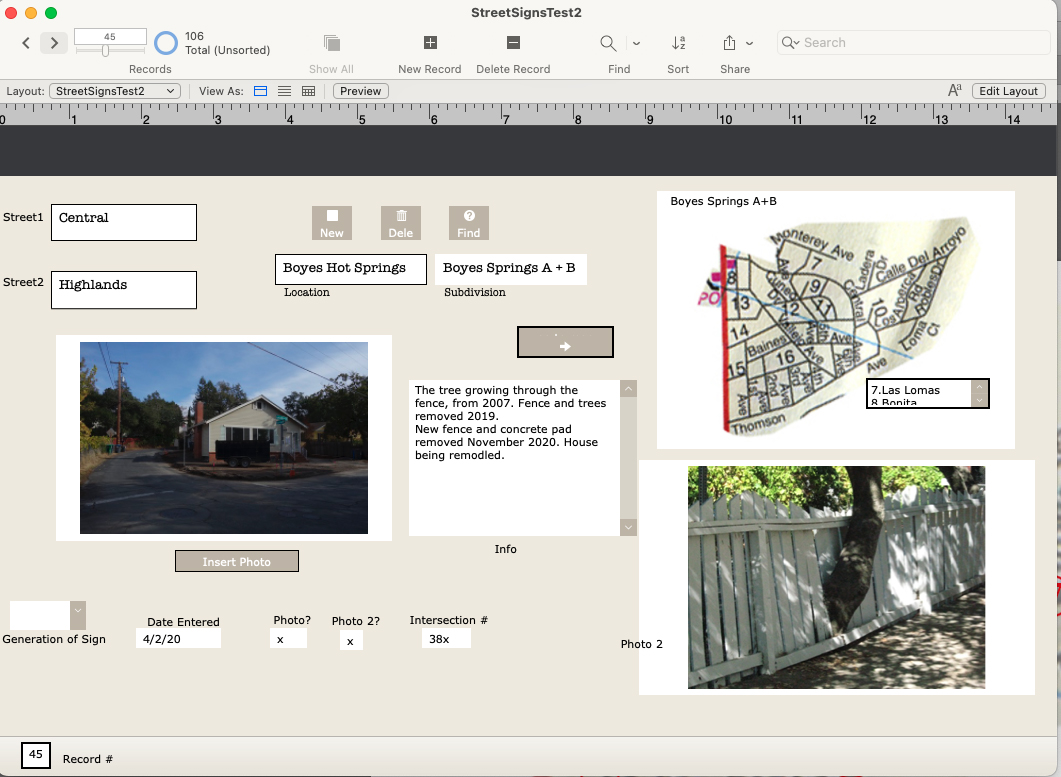
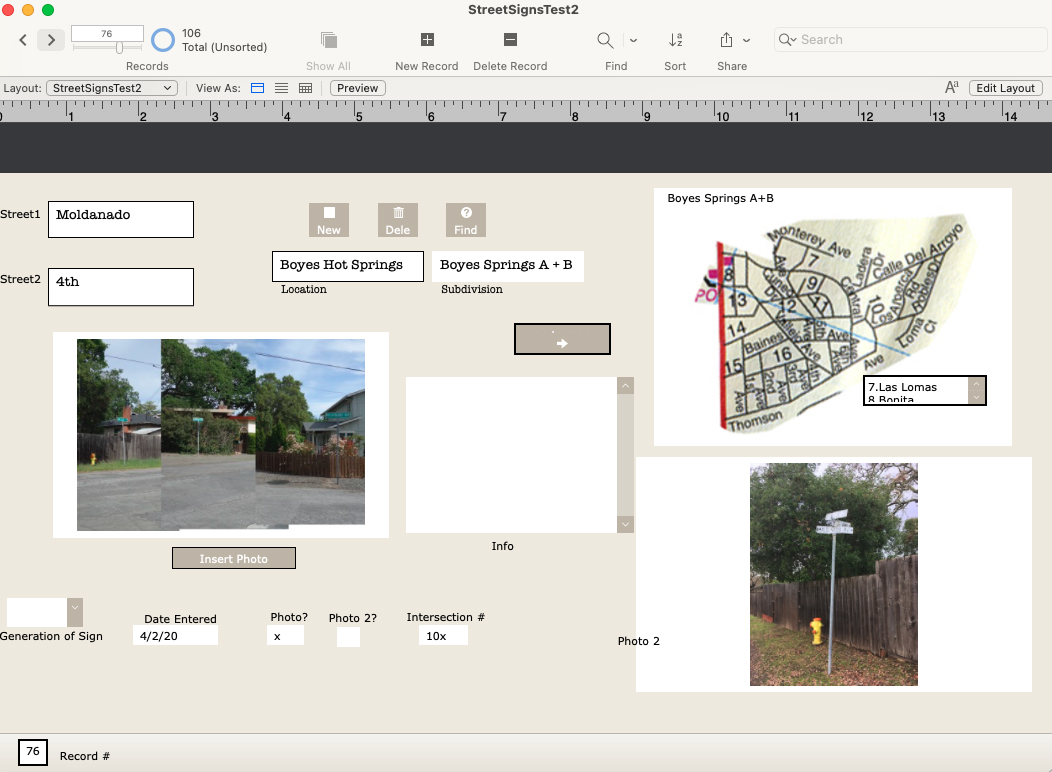
In 2020 I photographed every street sign in my immediate neighborhood with the intention of creating a database of intersections. Why? Obsessiveness. Completeness. The desire to record and collect (see website introduction.) Future use. It’s history. Because it might all burn down, and no one would remember what it looked like. (And, I really like databases and consider them an art medium.) I have also included photographs of the Neighborhood Phenomena in the vicinity of the intersections, such as, the tree growing through the fence above.
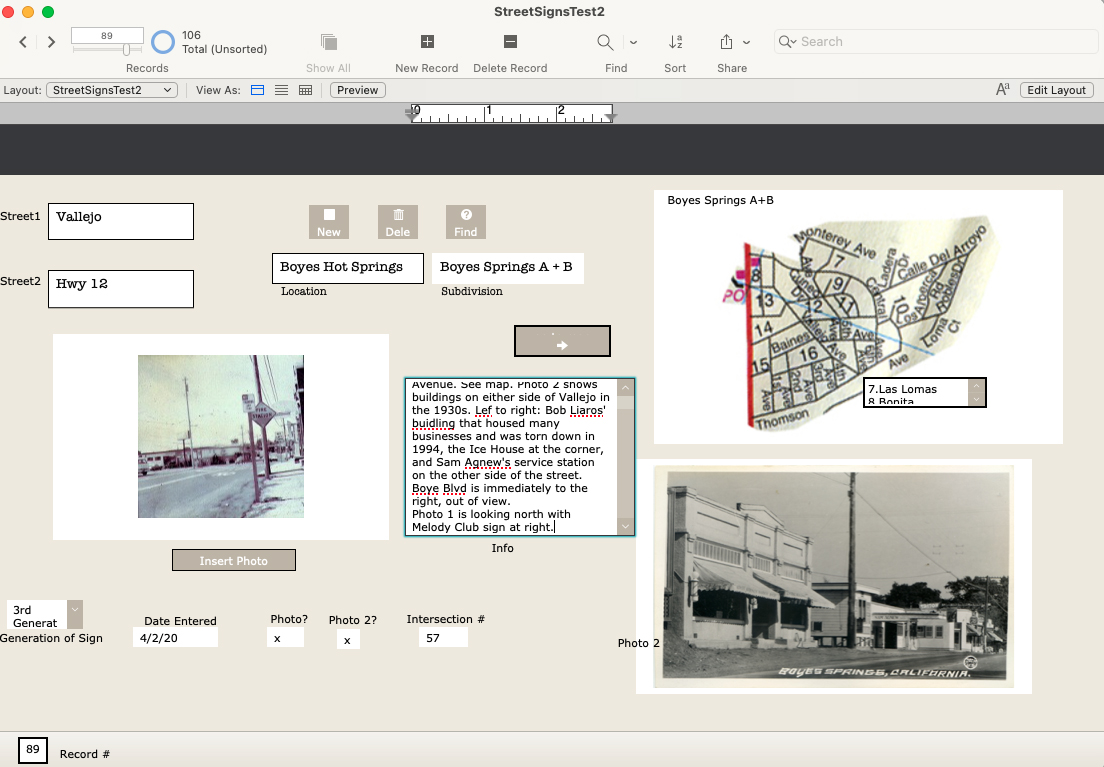
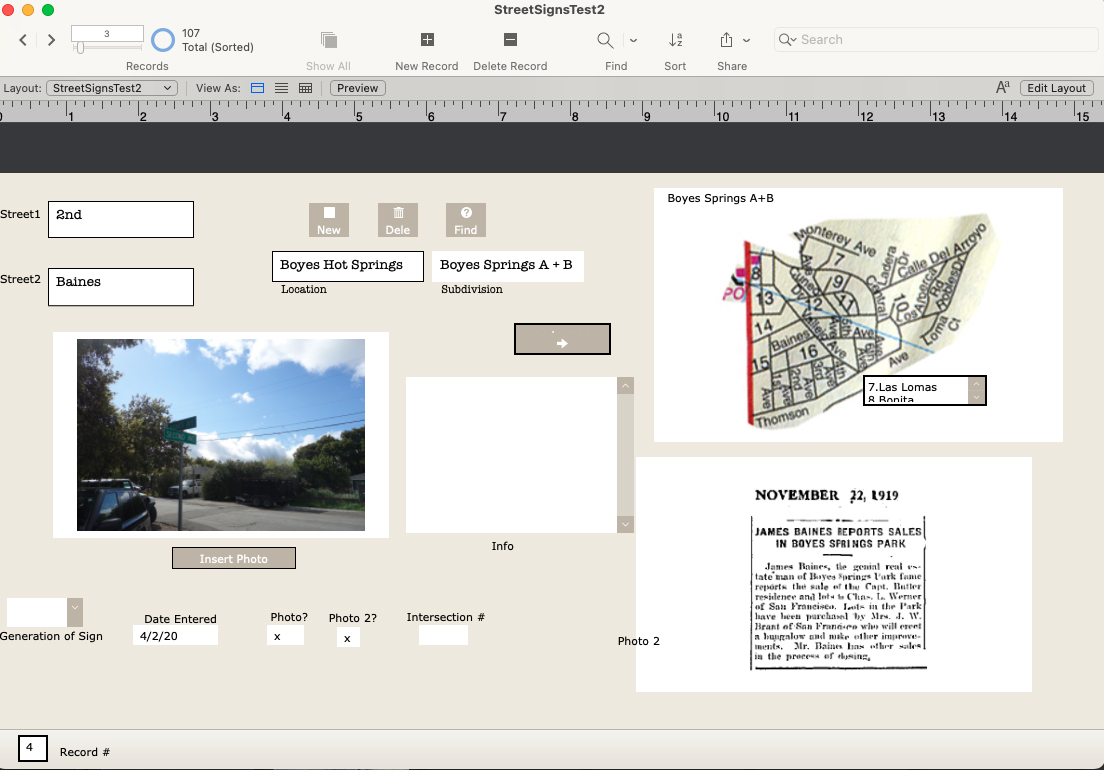
In addition to my photographs, I have included older (“historic”) ones, where they exist, newspaper clippings, and other ephemera. I know of no older photographs of intersections other than the ones at Highway 12, which were made primarily for commercial purposes.
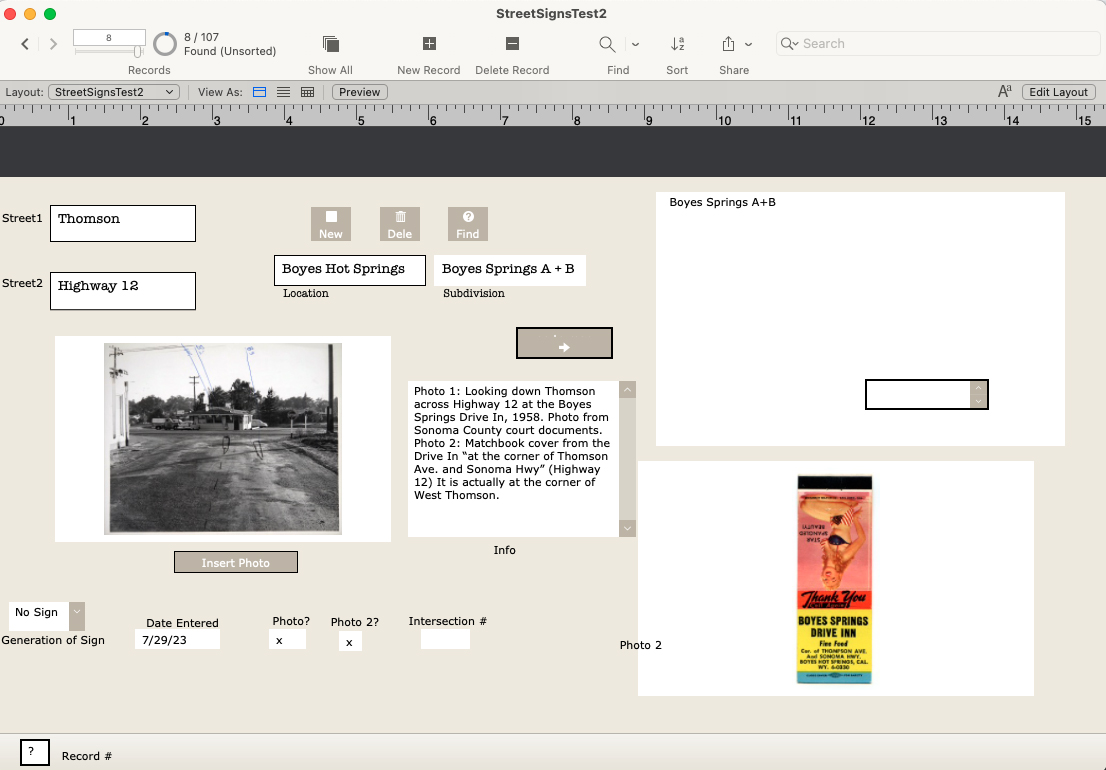
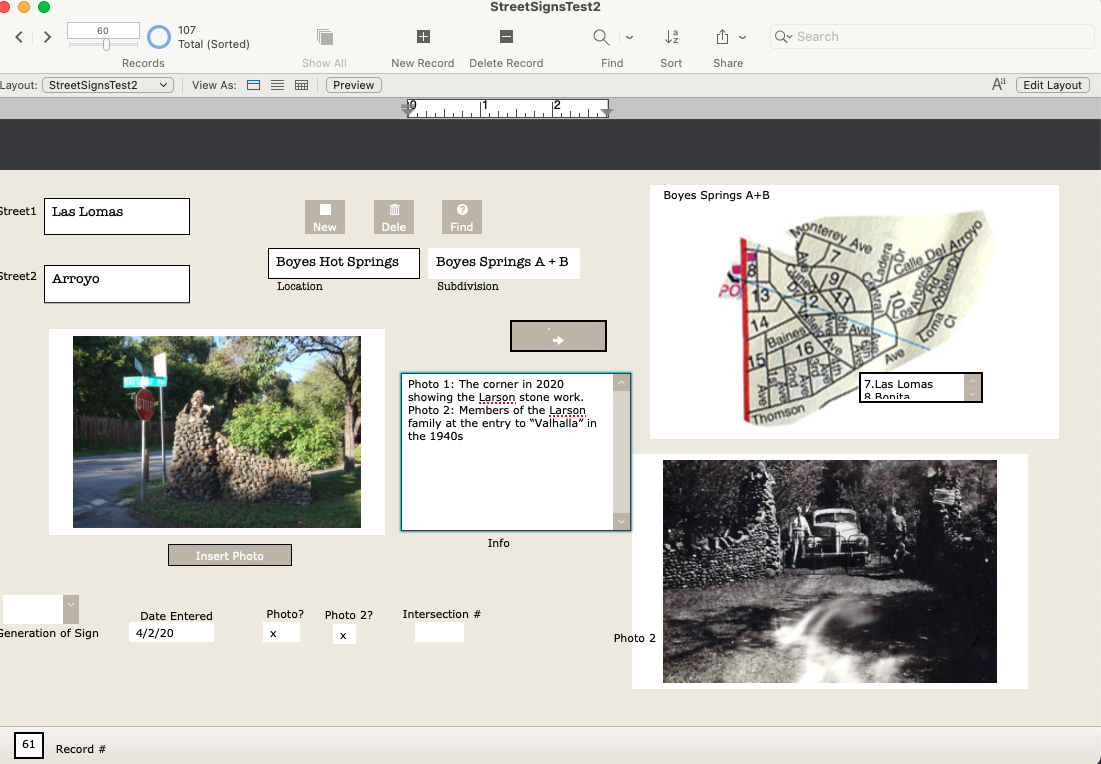
There are 107 records in the database (I probably missed some), one for each intersection in the Boyes Springs A and B subdivisions. The fields include “Generation of Sign” because three distinct styles of sign exist. Time permitting, the database would be expanded to include the surrounding subdivisions (more here) Sonoma Highlands, Woodleaf Park, etc.
The corner of Maldonado, 4th, and Vallejo had three of the oldest style signs on one pole until recently. I realize I misspelled Maldonado in the db.
The Thomson and Highway 12 entry features a photo from 1958 and a matchbook cover.
Las Lomas and Arroyo shows the stonework built by the Larson family, in 2020 and the 1940s, with family members.
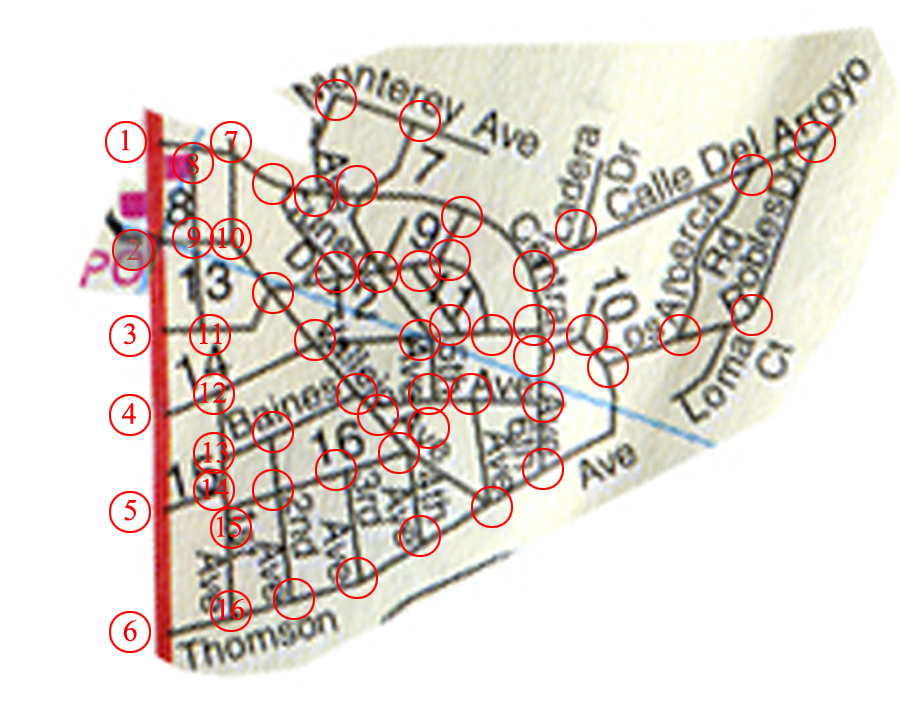
The map is still under development (ie, my Filemaker skills need improving.)
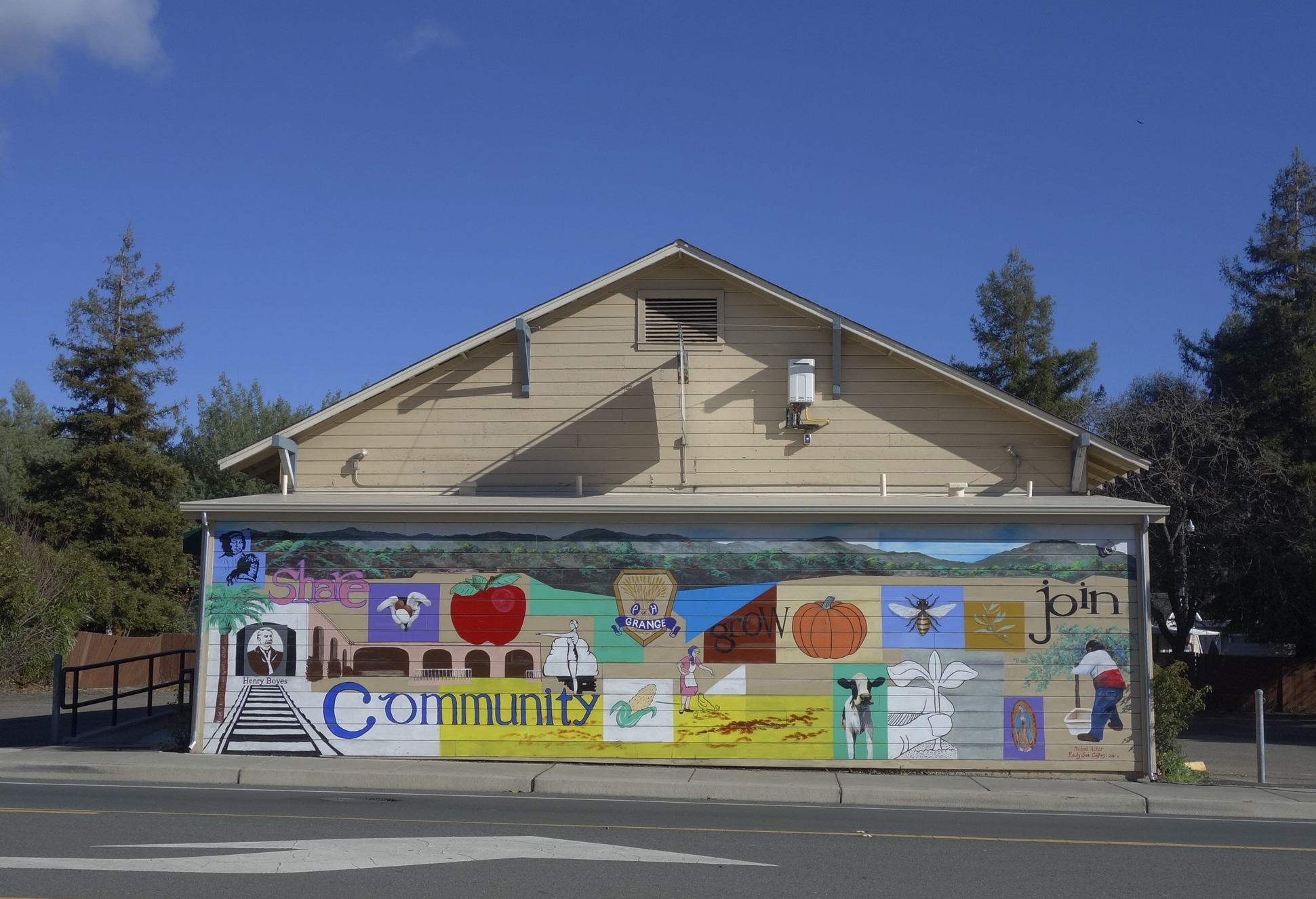
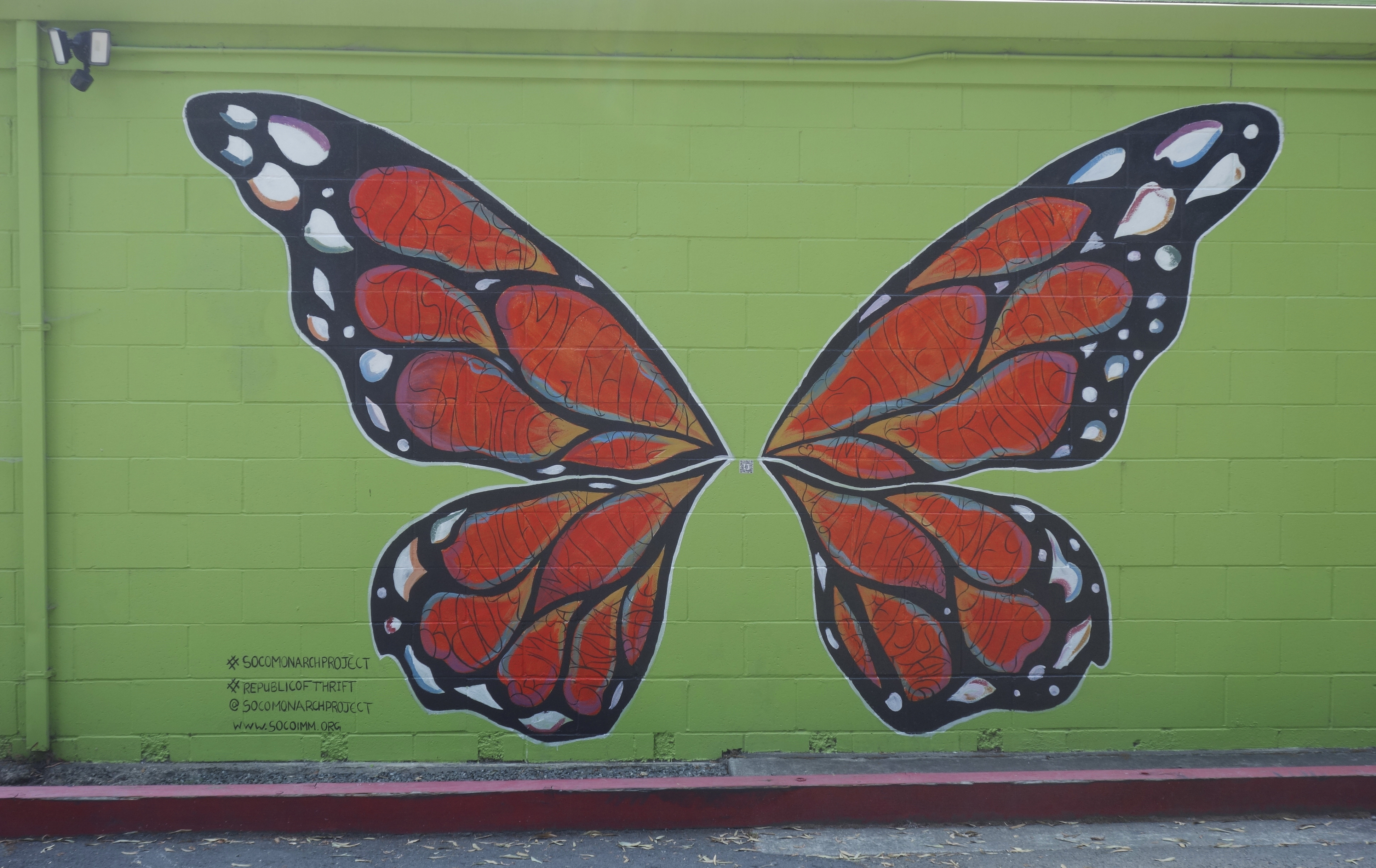
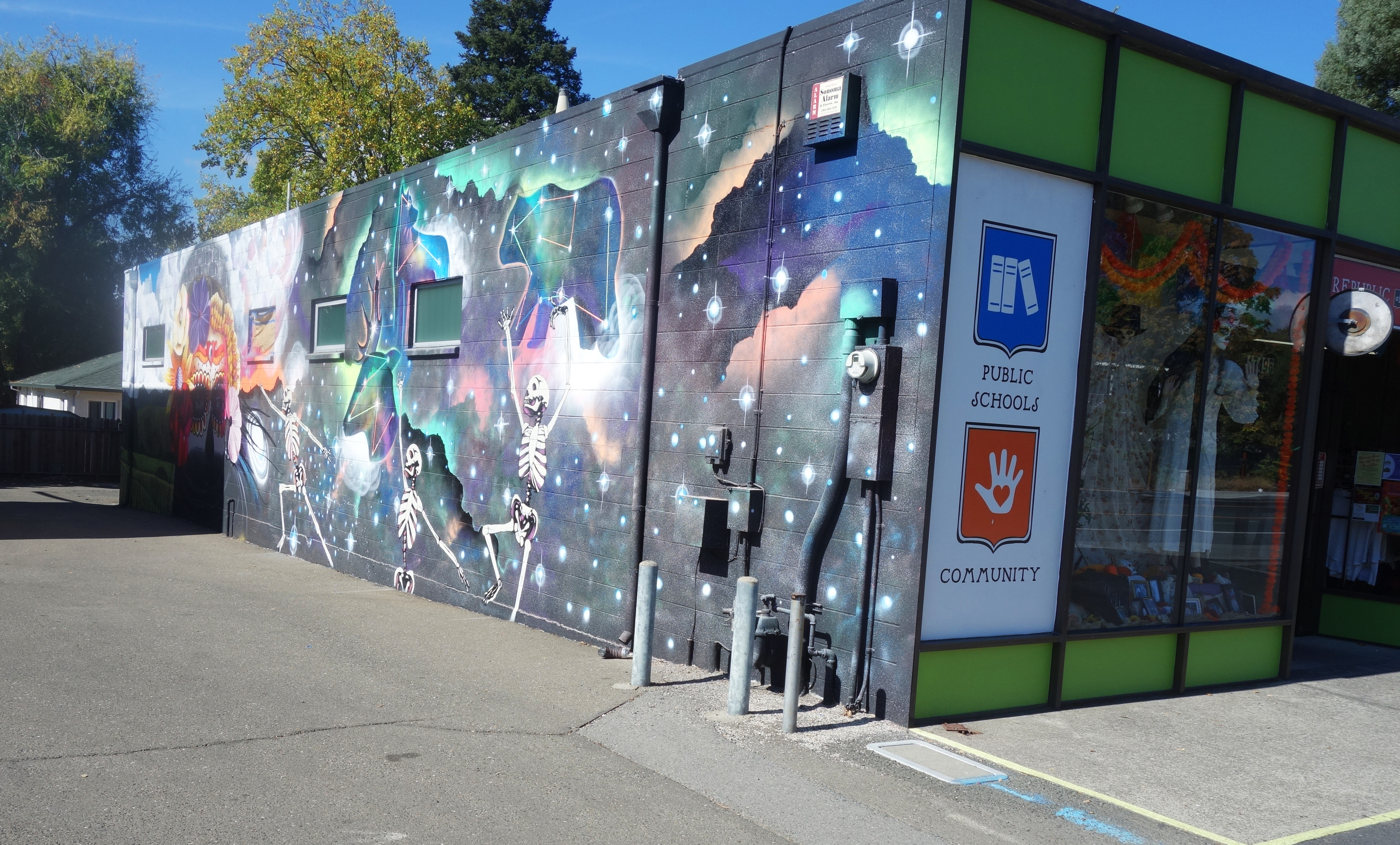
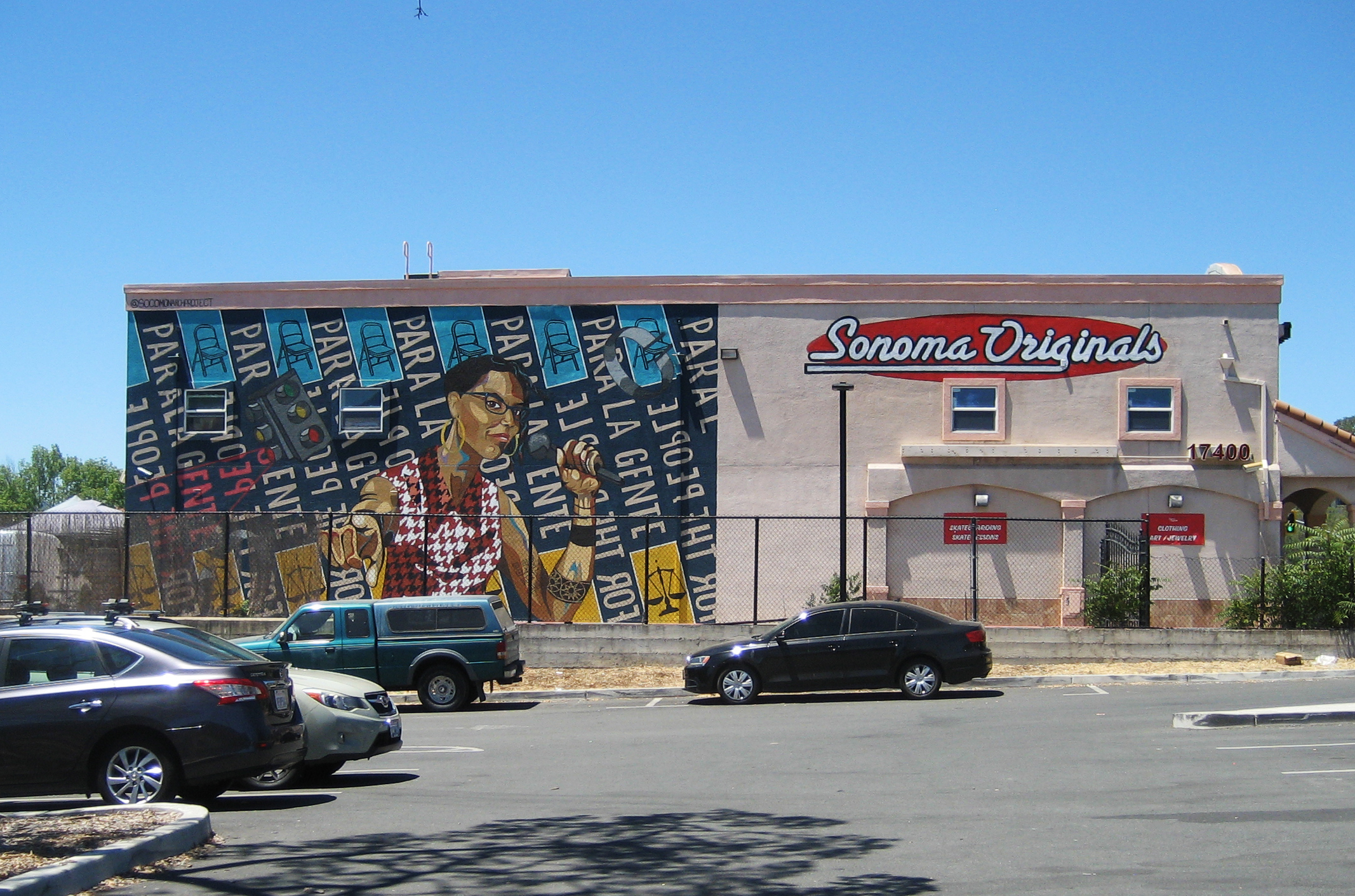
Public art grows in fits and starts hereabouts but we are starting to build up a nice stock of murals. Here we look at four of them.
The mural on the front of the Sonoma Valley Grange building, located at 18627 Sonoma Highway. The Grange has owned the building, which was probably originally a dance hall, since 1934. See (https://springsmuseum.org/2022/06/28/the-sonoma-valley-grange-traditionchange-and-renewal/) for more about the Grange. Through the Redevelopment Façade Improvement project, the Grange got funding for the mural in 2010. It was designed by Michael Acker and painted in collaboration with Randy Sue Collins. It depicts a bit of Boyes Hot Springs and Grange history. It being on the west facing wall, it takes a terrific beating from the sun, and has been restored twice.
The Republic of Thrift building at 17496 Sonoma Highway has two murals sponsored by the Monarch Project (https://www.socoimm.org/) along with others. On the west facing wall is the giant Monarch butterfly, completed in June 2020. According to the Index Tribune, “Artist Rima Makaryan, just 17 years old, painted a Monarch butterfly as part of “The Monarch Project,” a Sonoma County nonprofit organization working to tell the stories of immigrants and empower the community.” “We are working to have a conversation about immigration through art,” said Makaryan. “Oftentimes immigrants are labeled aliens or talked about negatively. The goal of the Monarch Project is to find beauty in the subject.” The mural, painted on the west-facing wall of the thrift store, features a Monarch butterfly filled with words describing the immigrant experience, such as resilience, hope, amor, sacrifice and fear. Makaryan noted, “The words are meant to embody the journey and diversity of all migrants. It’s all about the beauty of the topic, good and bad.”
On the east wall a fantastical spray-paint mural by the artist Chor Boogie (https://chorboogie.com/), along with a crew of high school students was painted in 2018. the Led by Sonoma Valley Museum of Art, community partners were Artescape and La luz Center. Co-sponsors were the California Arts Council, the NEA, and the Bank of Marin.
The building at 17400 Sonoma Highway displays yet another Monarch Project mural. Completed in June 2021, it features an image of Dmitra Smith, “…a powerful force fighting against racism in Sonoma County,” according to their website. “Ms. Smith is the former Chair of the Sonoma County Commission on Human Rights, and was the program manager for the Junior Commission, having mentored over 100 Sonoma County students between 2013- 2020. Smith is a co-founder of the essential workers’ mutual aid collective Food for All – Comida para Todos.”
At the time the mural was painted, the building was the home of Sonoma Originals skate shop. Sadly, it is now empty.
We actually have a lot of art in the Springs, some of it “official,” as the above are, some harder to find, personal expressions, often ephemeral, but worth noting, as we will do in future posts
Index Tribune courtesy of the Sonoma Valley Historical Society
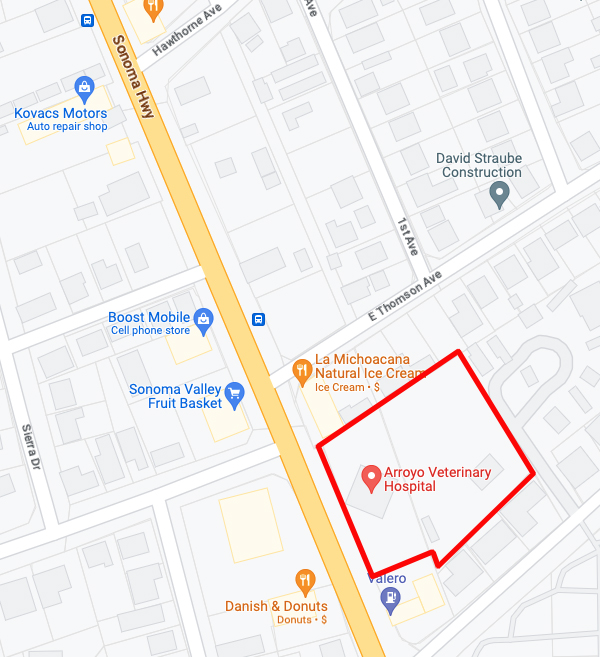
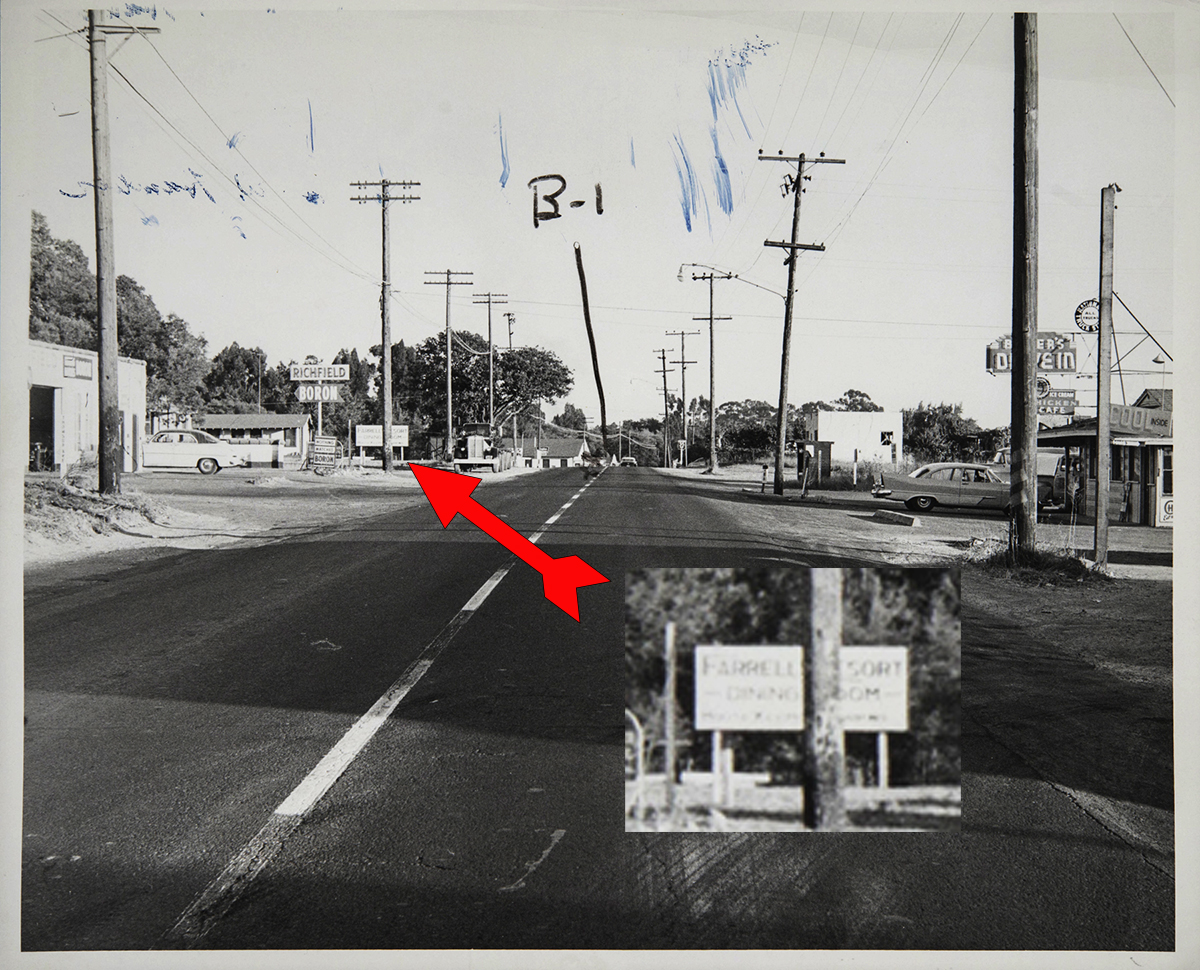
Farrell’s Resort existed on land near the corner of Siesta Way and Sonoma Highway, between the years 1945 and 1958. A county court photograph from that year shows the resorts sign on the highway. An Index Tribune story in 1959 about a barn fire on the property mentioned “the pioneer Ferrell’s Resort property,” which implies, to me, it didn’t exist in 1959, as the barn was being burned by the fire department for training.
This photo is an exhibit from a lawsuit involving a traffic accident in 1958, courtesy of the Sonoma County Library. Difficult to see, at left, below the Richfield sign, half obscured by a power pole (!) is a sign advertising Farrell’s Resort. Thomson Ave (not East Thomson!) is at left. Across the highway is Baker’s Drive-In, current site of the Fruit Basket.
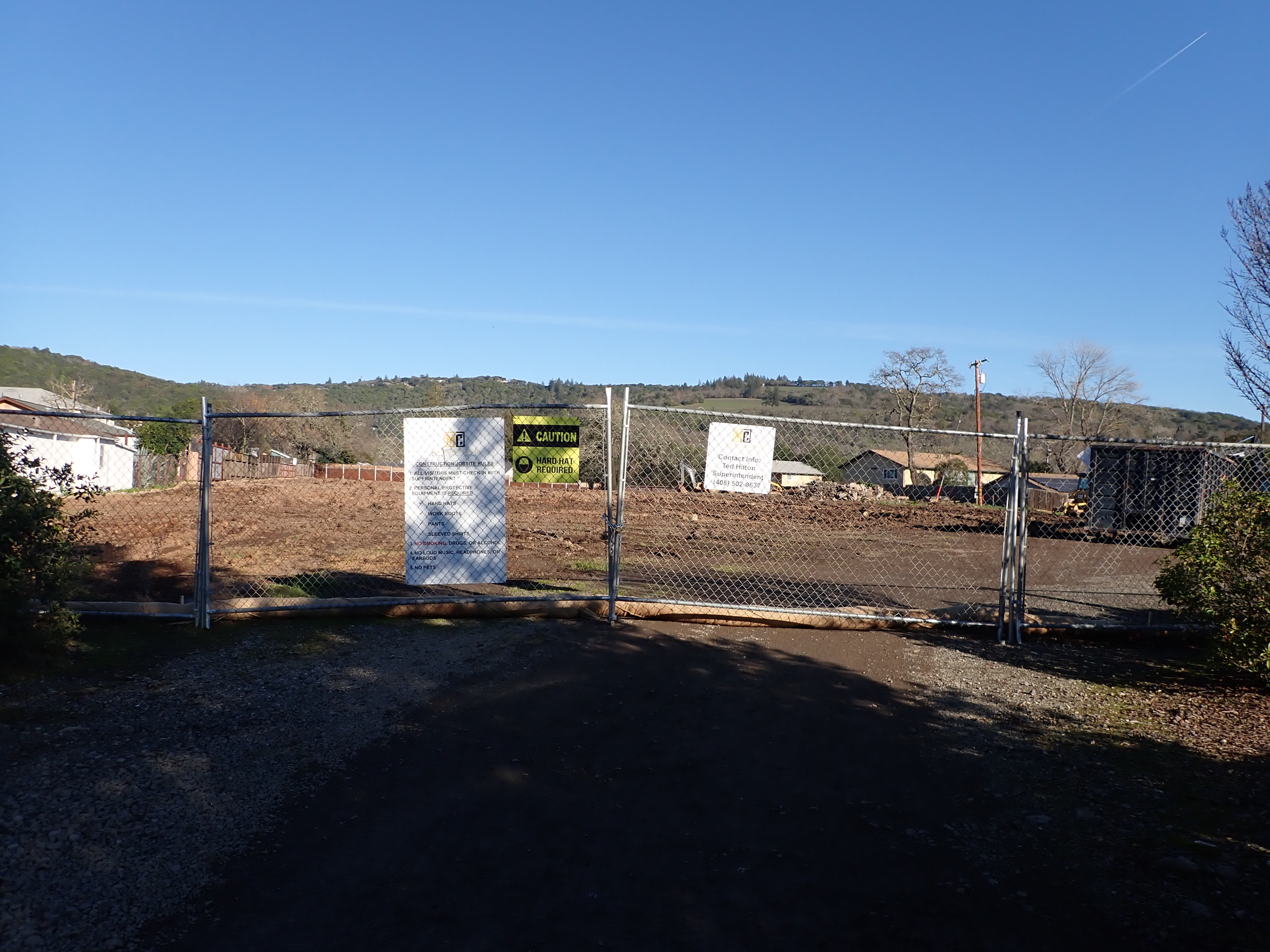
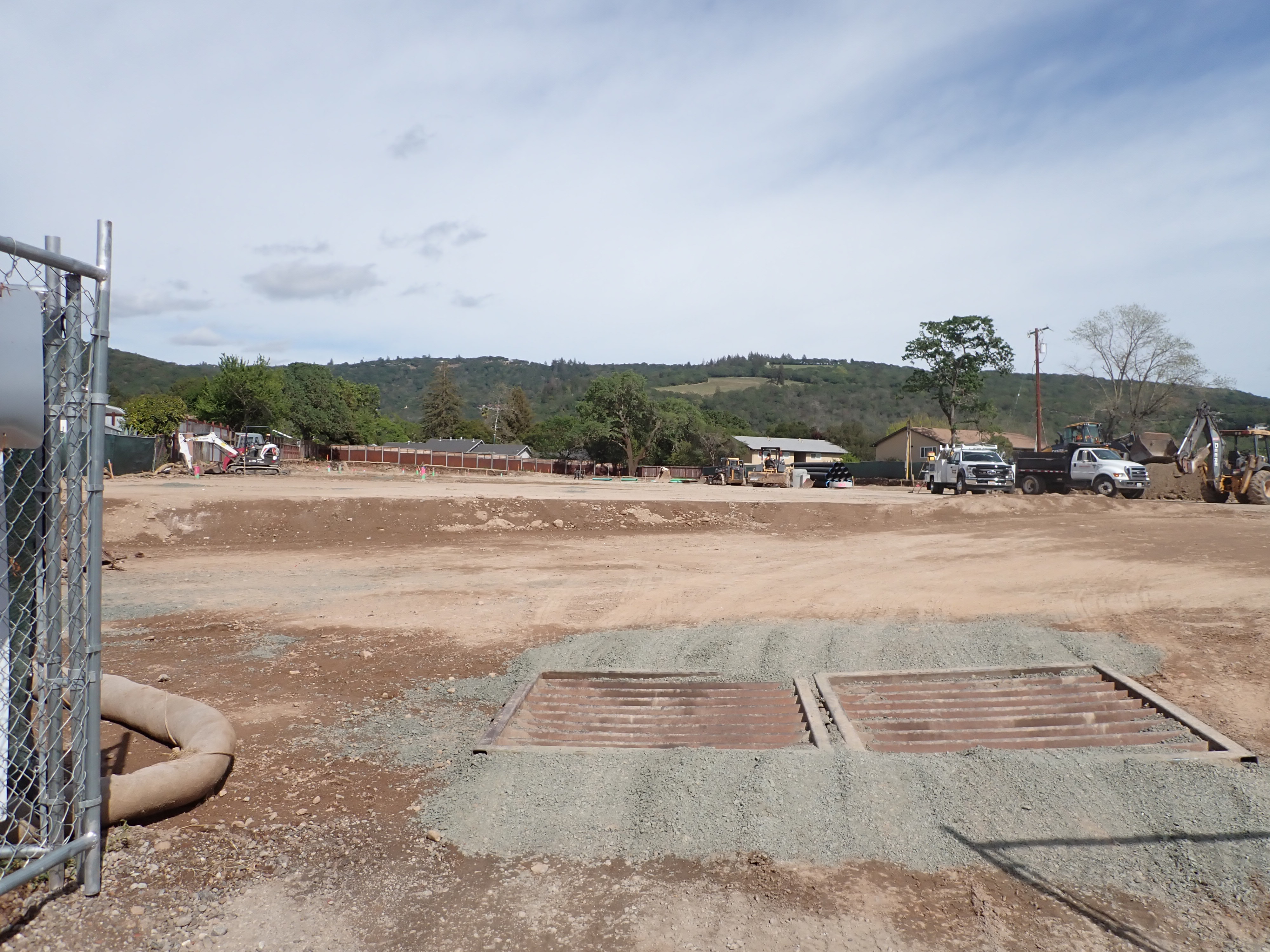
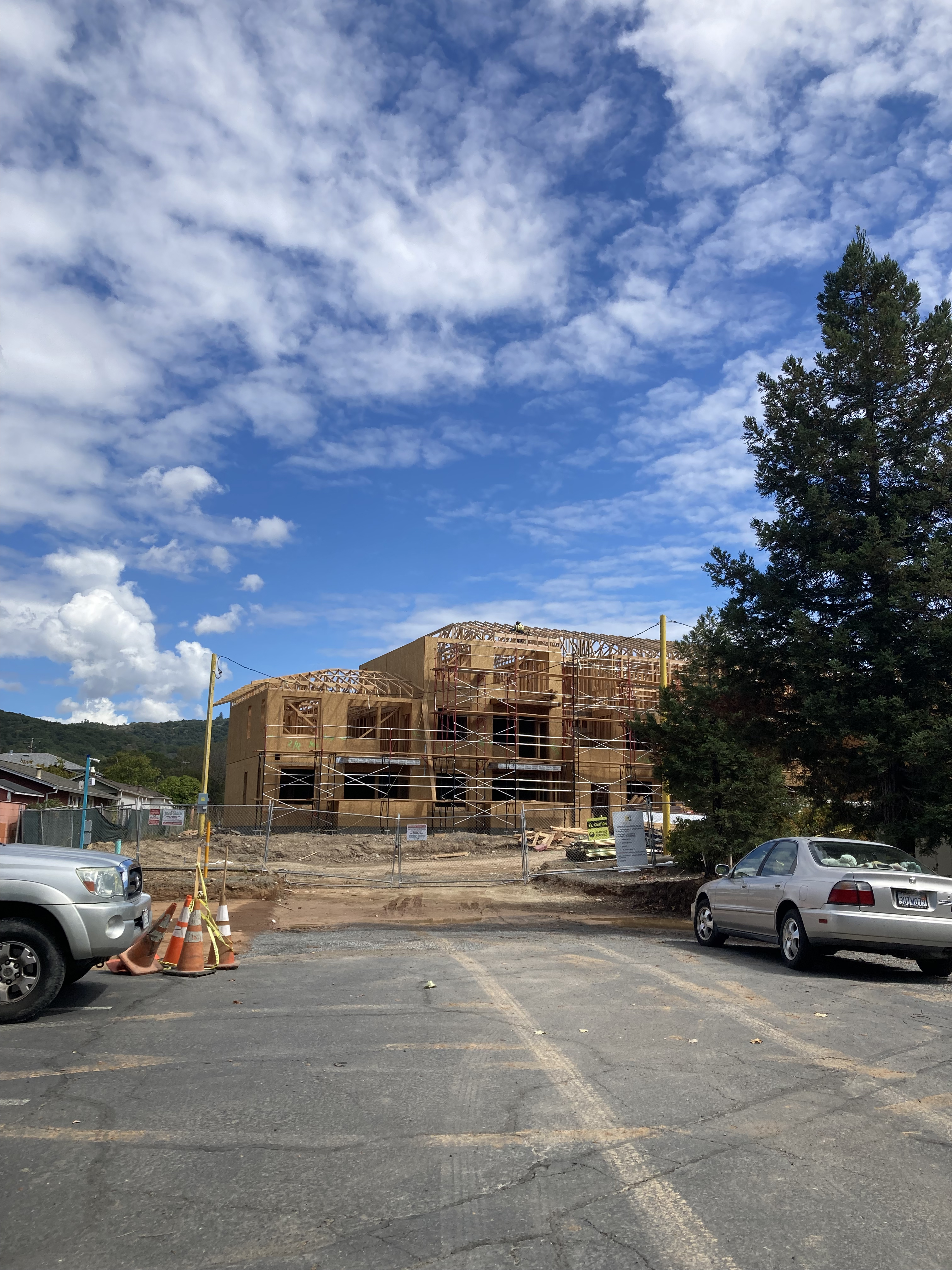
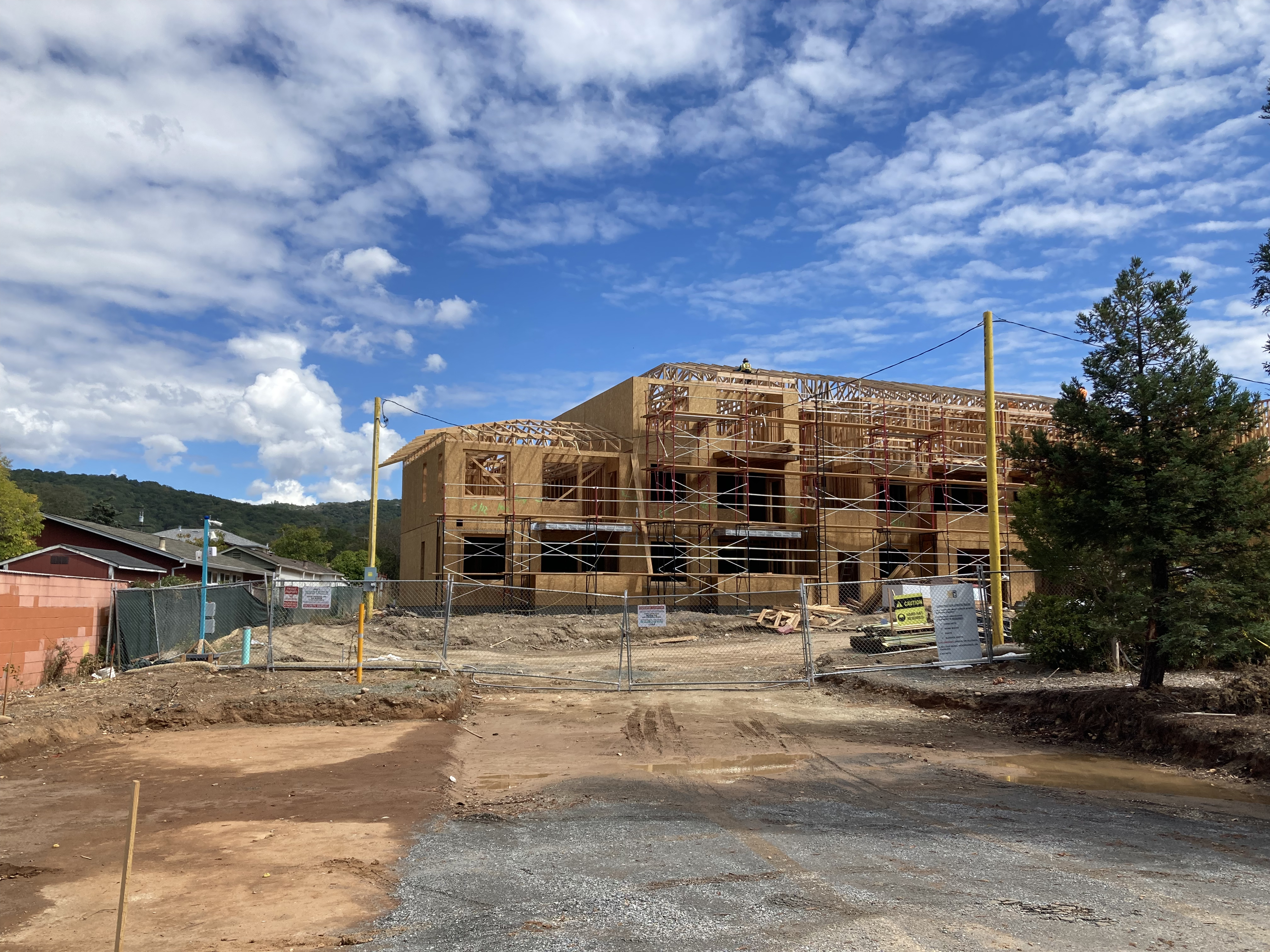
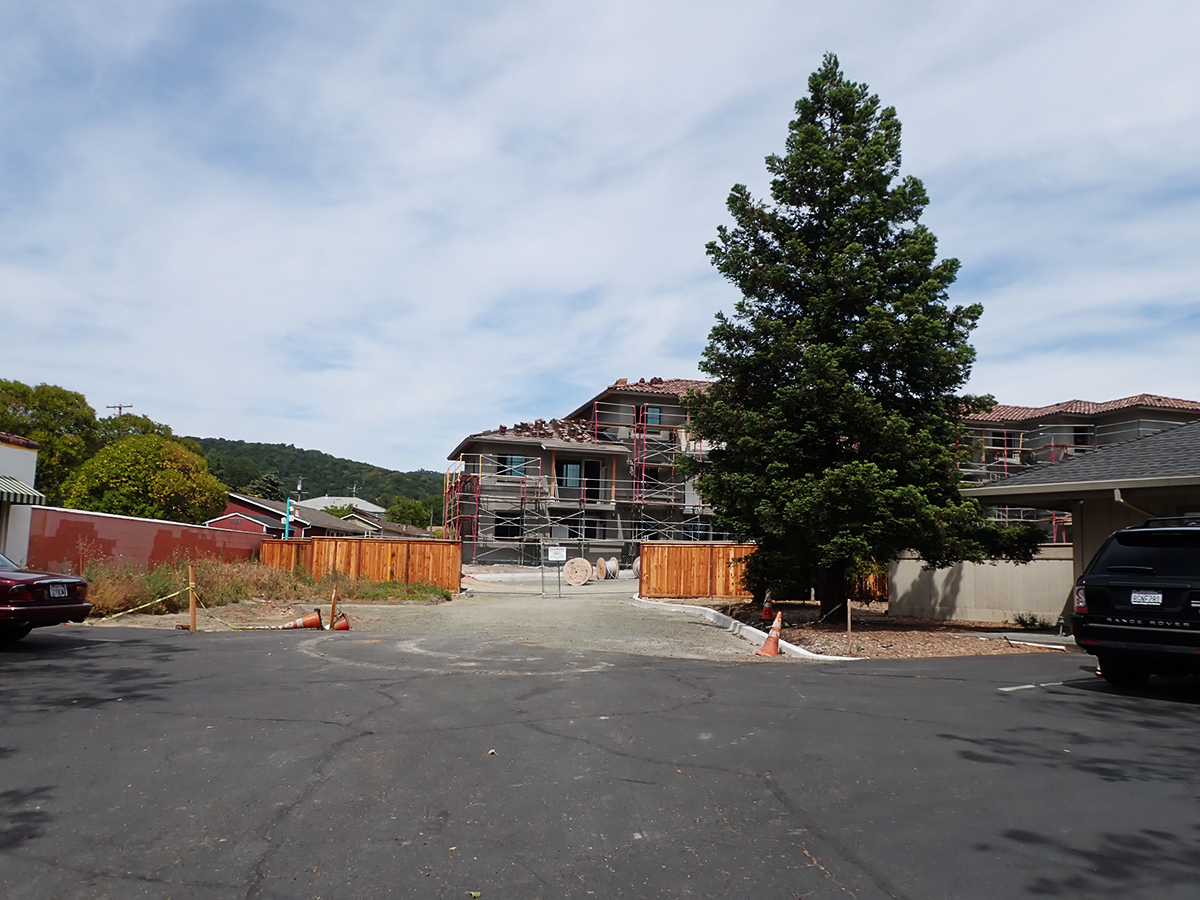
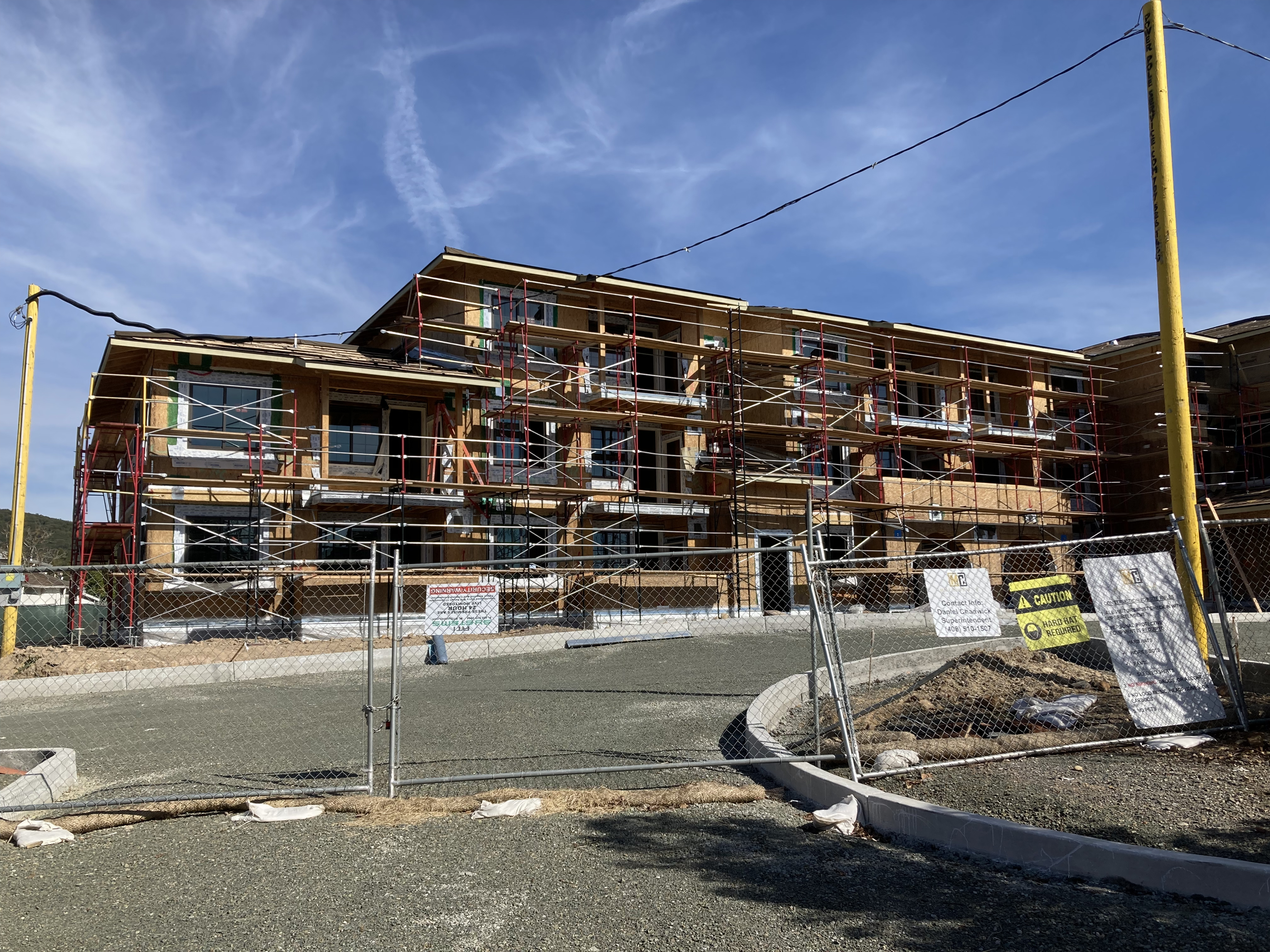
The property behind the Arroyo Vet building continued as a trailer park until 2020 when affordable developer Milestone Housing (https://milestonehousing.com/projects/) bought the land. In 2022 they started construction on a 92 unit apartment complex intended for senior households that have incomes in the 30 to 60 per cent of area median income. In May of 2023 construction is ongoing. See photos below.
Apartment construction, February 2022 through May 2023
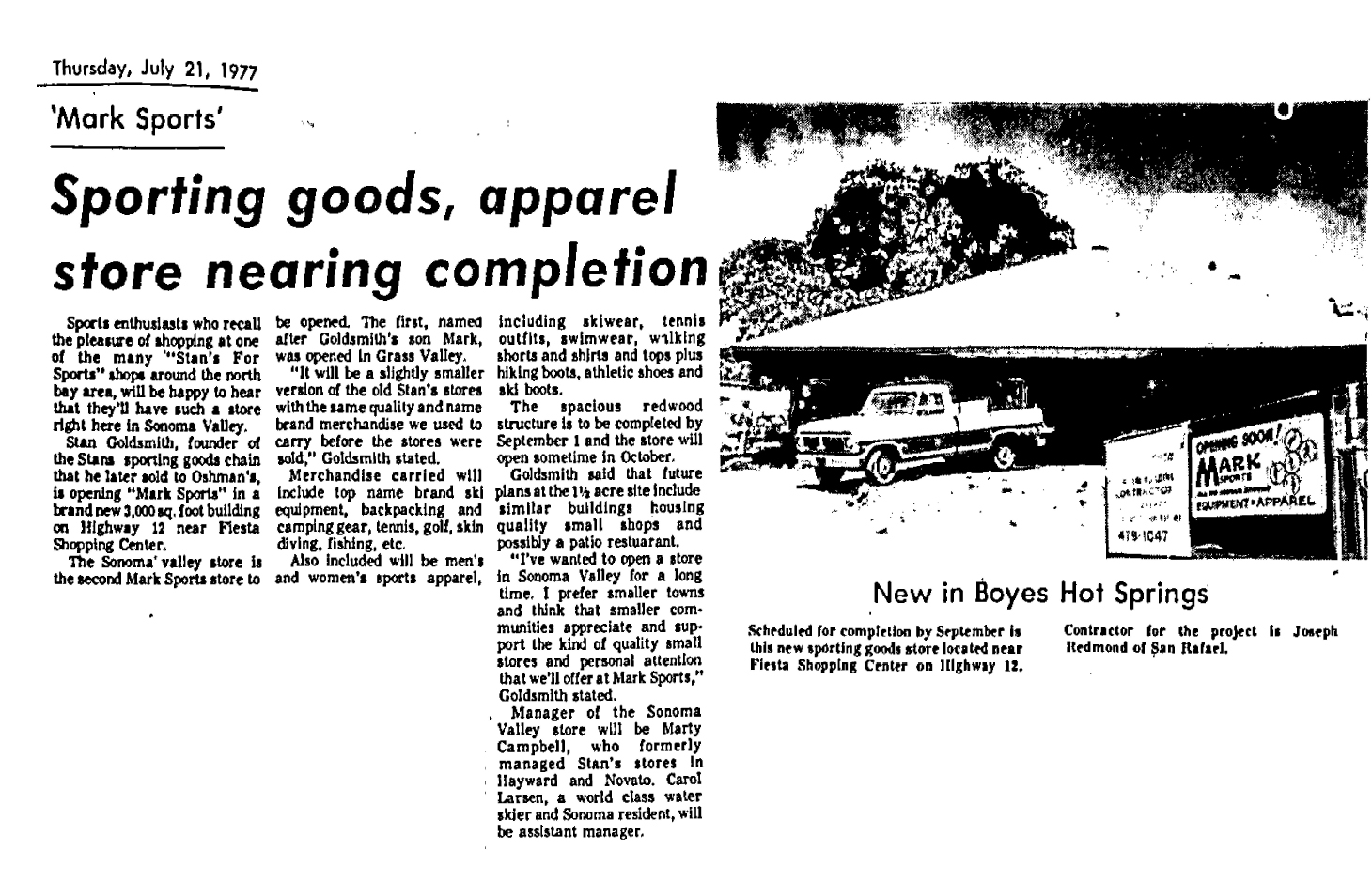
In 1977, on part of the Farrell’s site facing the highway, Stan Goldsmith built a commercial building to house his Mark’s Sporting Goods. Goldsmith owned the whole property and told the Index Tribune that “…future plans at the 1.5 acre site include similar buildings housing quality small shops and possibly a patio restaurant.”
Goldsmith had founded a successful chain of sporting goods stores, located throughout California, which he sold before moving to Boyes Hot Springs. According to some of his ad copy, “In 1954 Stan Goldsmith revolutionized the retail sporting goods business by building the largest sport store in northern California (10,000 sq ft.) and becoming the first to combine active sportswear with sports equipment…Stan Goldsmith founded the Marin Skin Divers Club, the Northwoods Bowmen’s Club and designed the first nylon covered sleeping bag. Stan’s and the first air compressor to fill dive tanks in Northern California.” Index Tribune advertisement, 1979.
Mark’s Sporting Goods in Boyes Hot Springs, named after Stan’s son, opened in 1977. It was the second Mark’s. the first one was in Grass Valley, in an identical building.
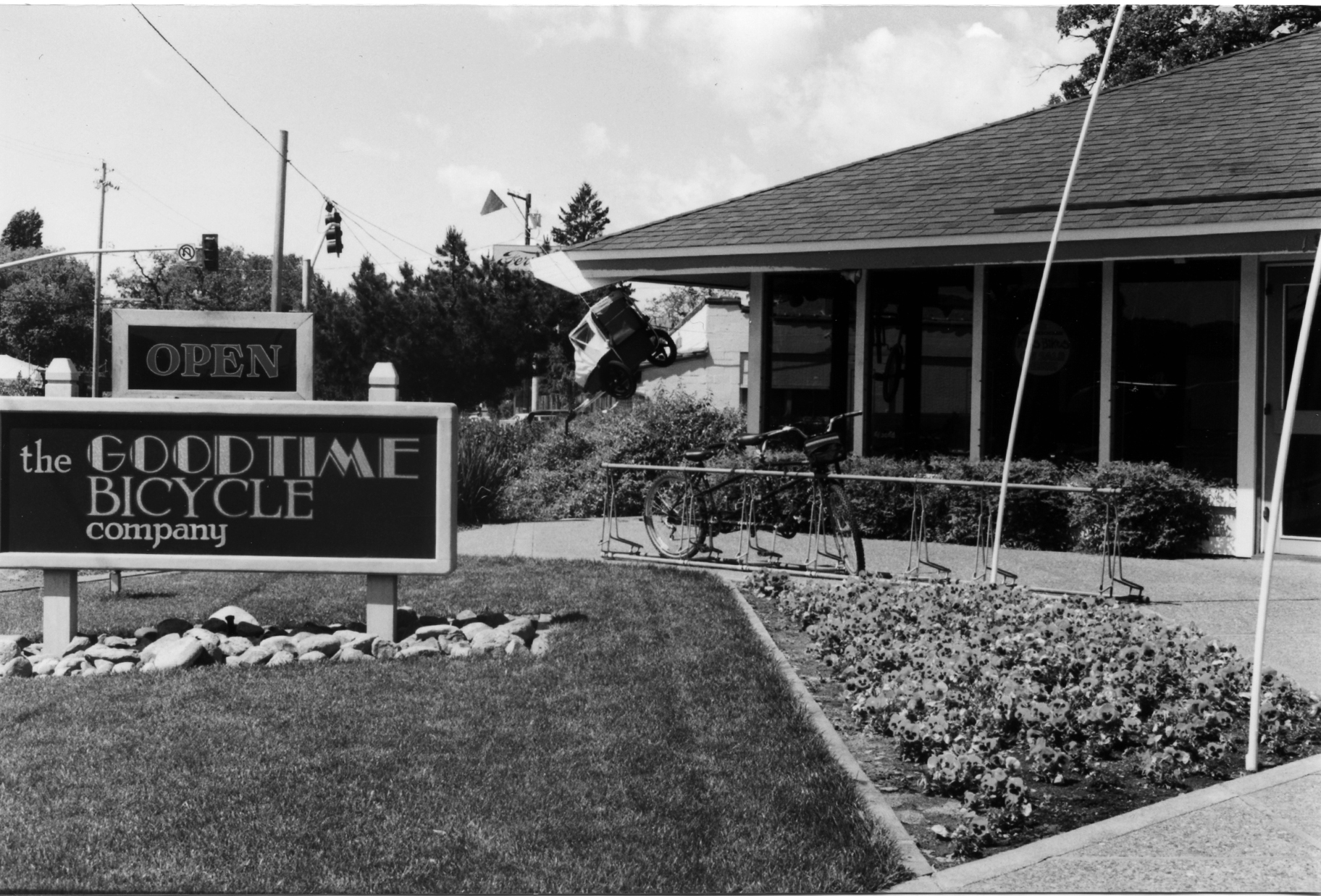
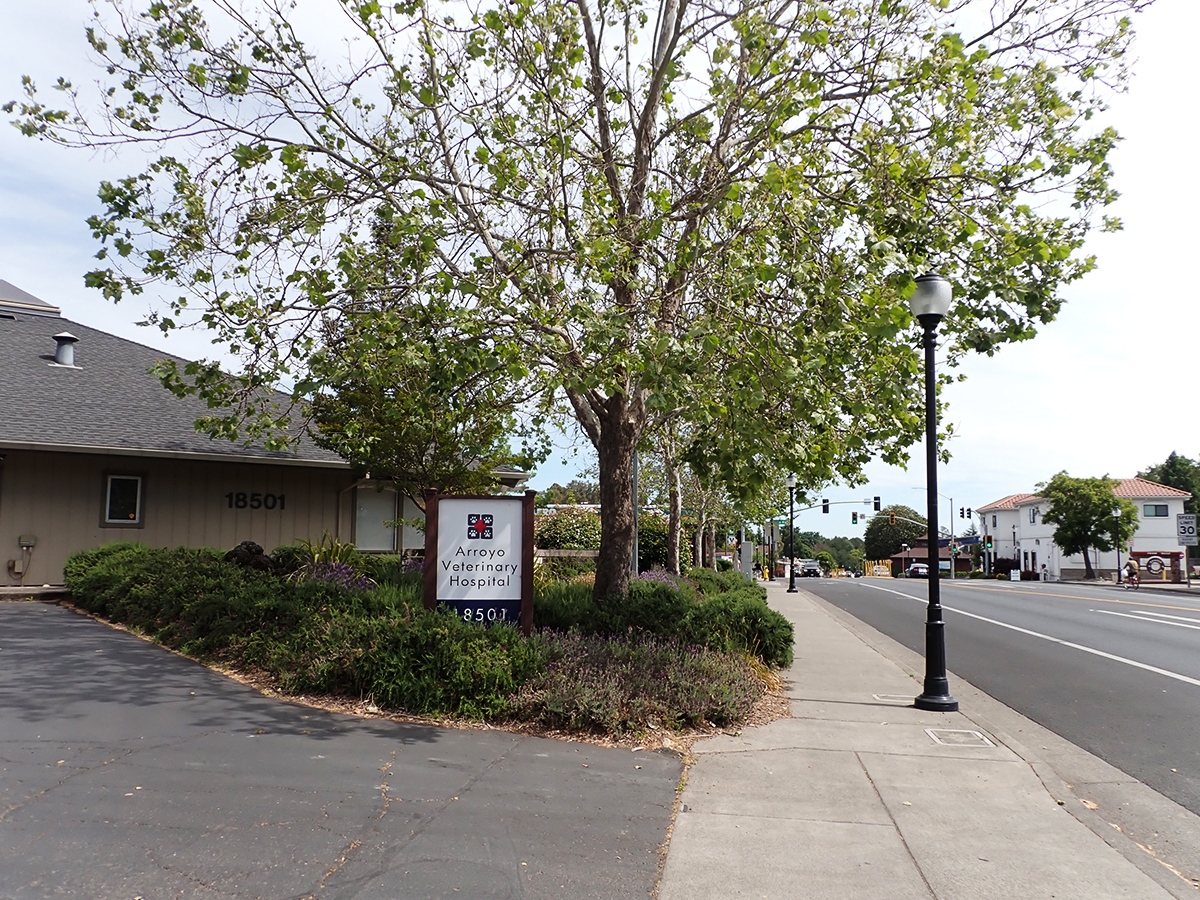
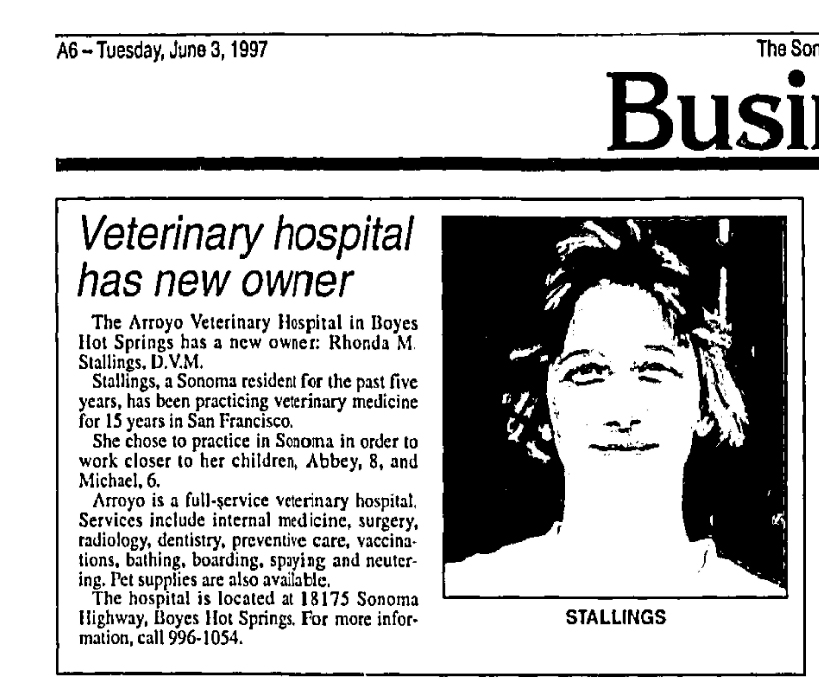
Tragically, Stan was killed in the crash of his private plane in 1982. His widow sold and the store continued operating until 1990, when Doug McKesson bought the building, but not the entire parcel, to house his Goodtime Bicycle Company. McKesson sold to Dr. Rhonda Stallings and Rich Lee in 2000. A major remodel was necessary to convert the space. The new Arroyo veterinary Hospital opened in 2001.
1990s
2023
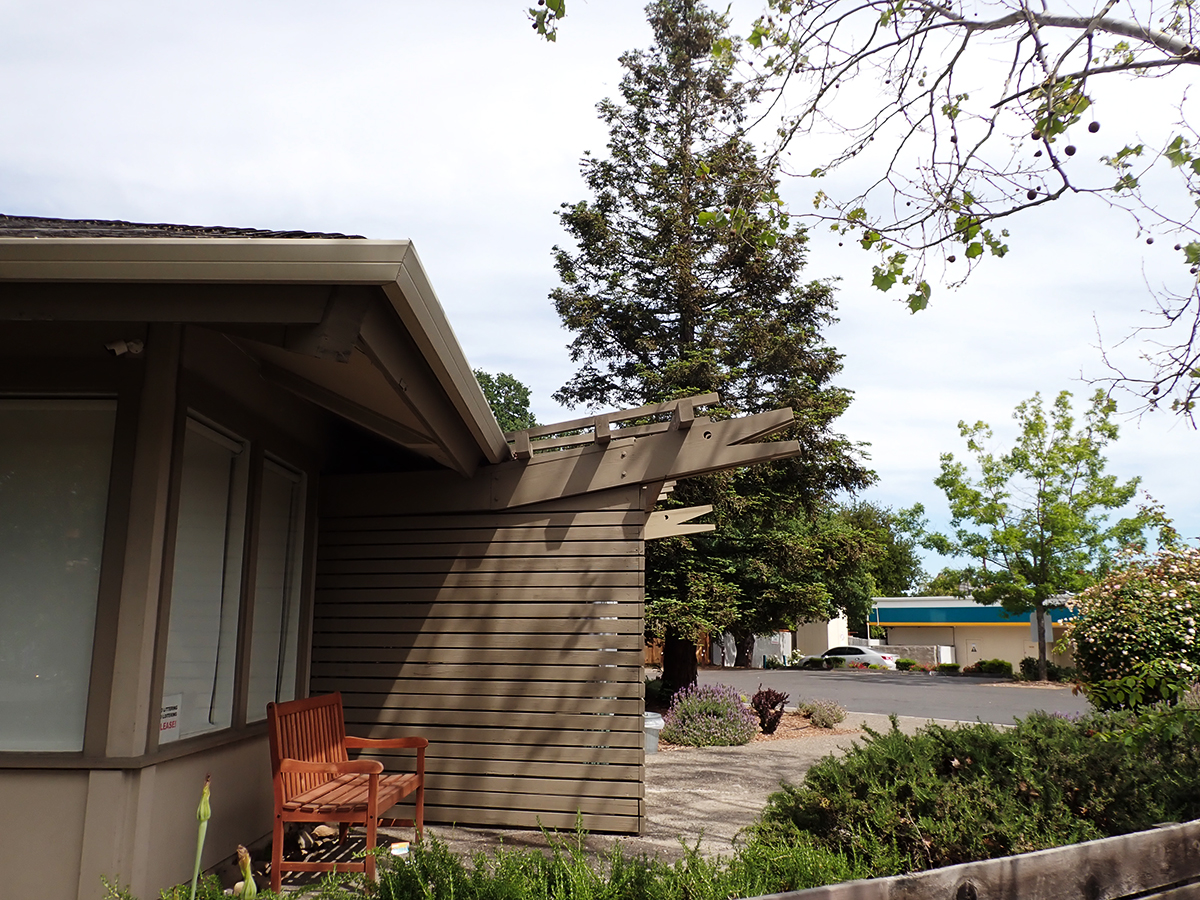
Appropriate, whimsical rafter-tails were added during the conversion to an animal hospital.
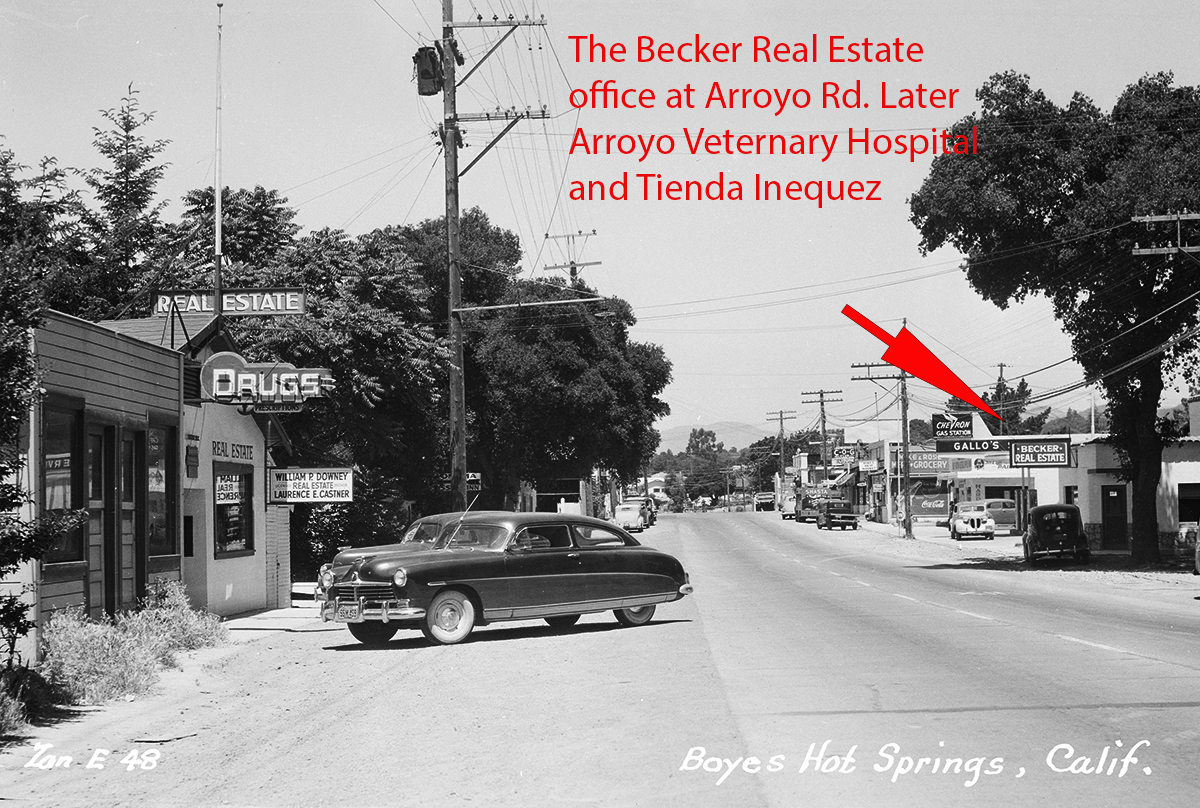
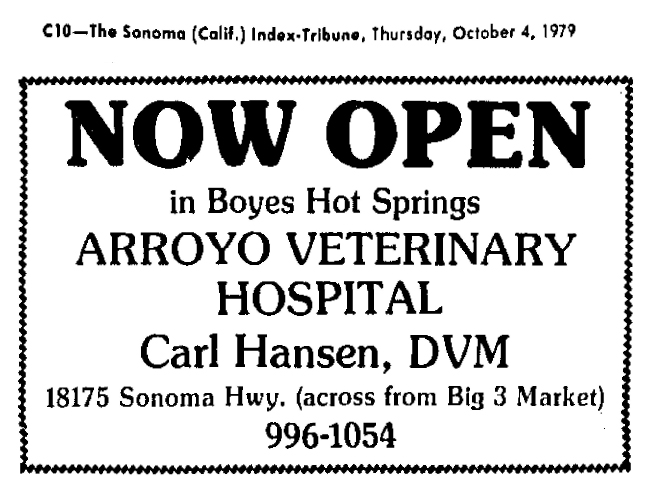
Digression the First: The original Arroyo Vet Hospital was started by Dr. Hansen 1979, in a building on Sonoma Highway at Arroyo Rd, which was probably built in the 1920s, and had housed various businesses including Becker’s Real Estate Agency. Dr. Rhonda Stallings took over from Dr. Hansen in 1997, the same year your correspondent moved into a house just a block up Arroyo Road. Imagine our sense of security knowing we could WALK our sick cat to the vet’s office. And thank you to Rhonda for saving Ralph’s life.
Ralph
1950s
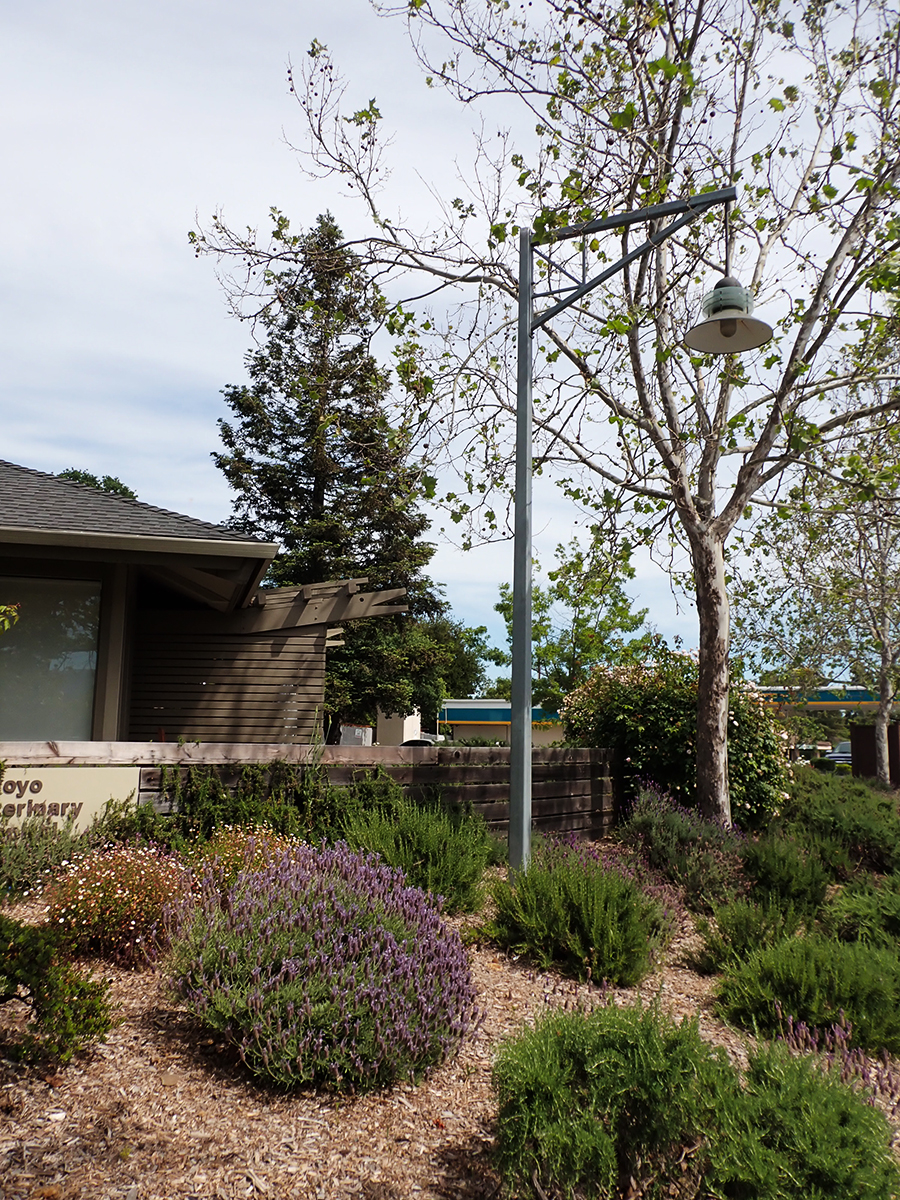
Digression the Second: The photo below shows a streetlight proposed for the Redevelopment sidewalk project. This was offered by landscape architect Ron Wellander and installed in 1997. The design was not used. It stands today, in 2023, lonely, unlit.
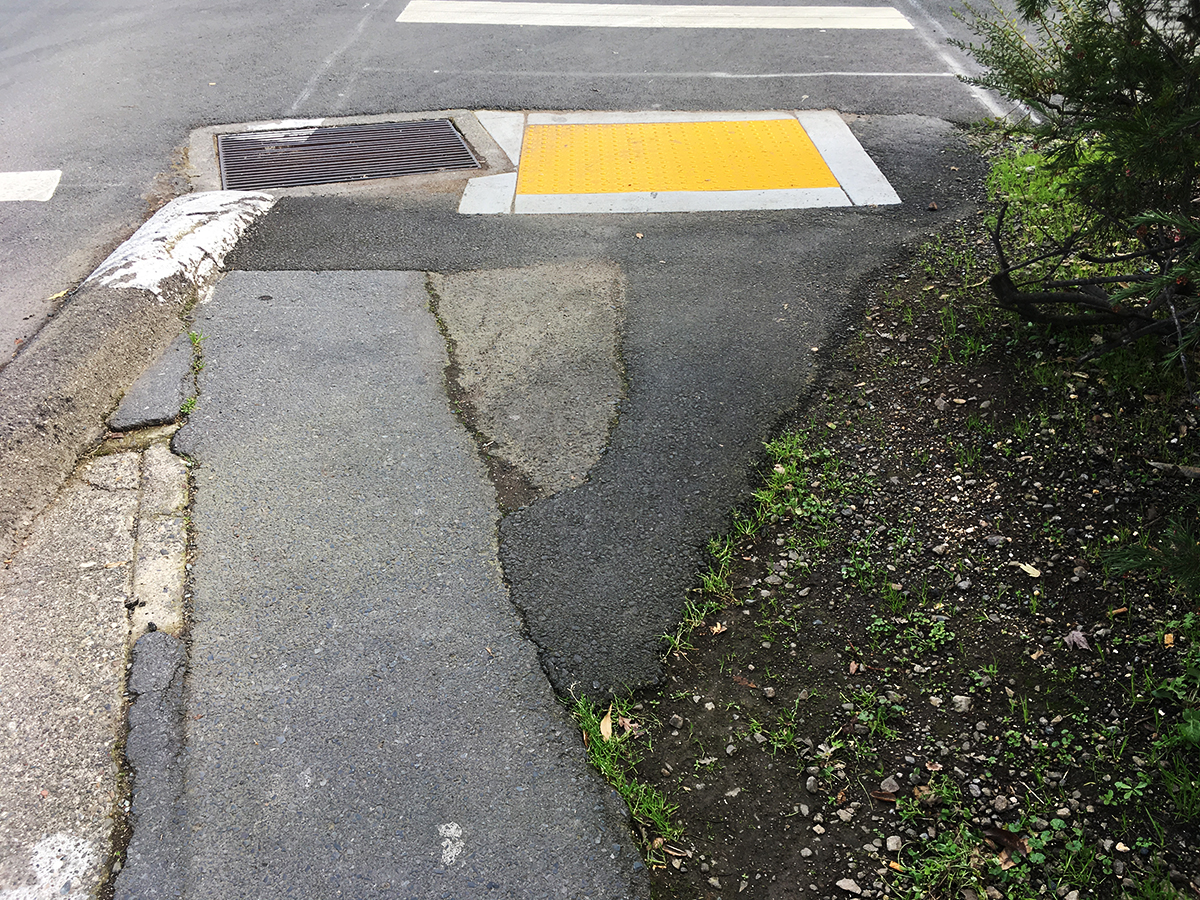
The first hearings for the sidewalk project were held in 1984. The initial pilot project was completed in 2002. The entire project, two miles of sidewalks and streetlights, was finished (except for one very irritating and dangerous gap) in 2016. Thirty. two. years.
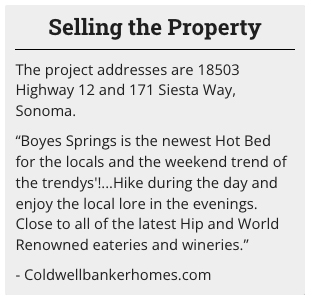
I can’t resist sharing this text from a Coldwell Banker website. The addresses represent the apartment site.
Please stay tuned to the Springs Museum. We aim to bring you all the best in local lore!
Thanks to Rich Lee and Doug McKesson for their memories
Index Tribune courtesy of the Sonoma Valley Historical Society
Zan postcard courtesy of Stanford University Library, Special Collections
UPDATE, September 17, 2023
According to Mrs. Mary Farrell’s obituary in the Index Tribune in January of 1956, her resort was “part of the former Appleton ranch.” Before Appleton, a certain ”Mrs. Loud came to California in 1864…Her husband was Alfred C. Loud, who settled on what was afterward the Appleton ranch.” Index Tribune of Jan 14,1922 obit of Mrs. Loud.
In the 1975 obituary for Appleton’s daughter, the renowned Carrie Burlingame, Horatio Appleton established his ranch “in the Springs area in 1865.” He was “a pioneer vineyardist and a descendant of the Greenleaf and Adams families of New England.” He was instrumental in identifying the Phylloxera louse that decimated American vineyards in the 19th century.
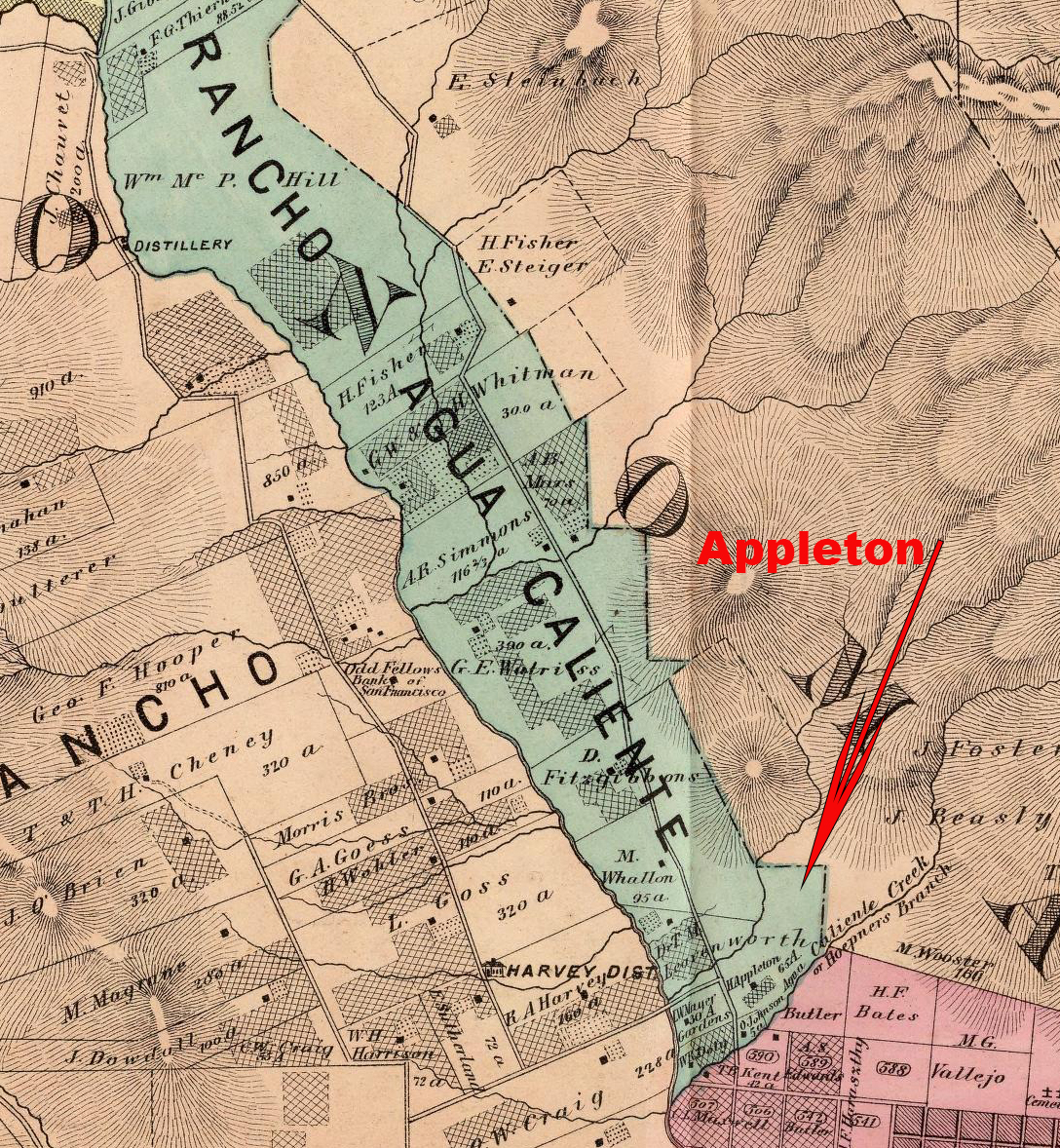
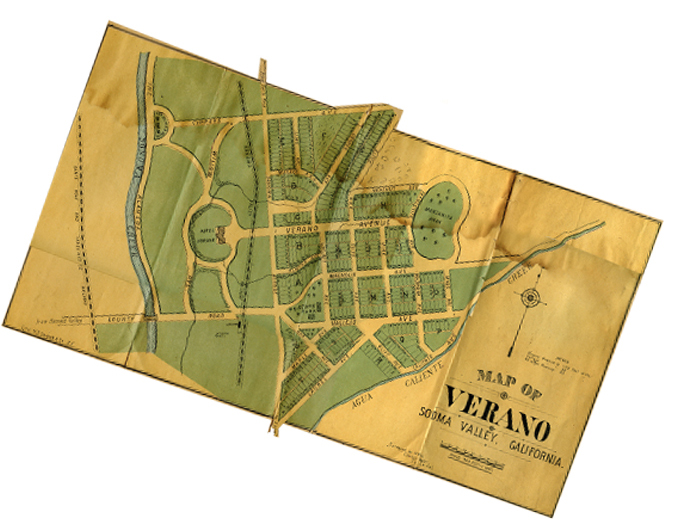
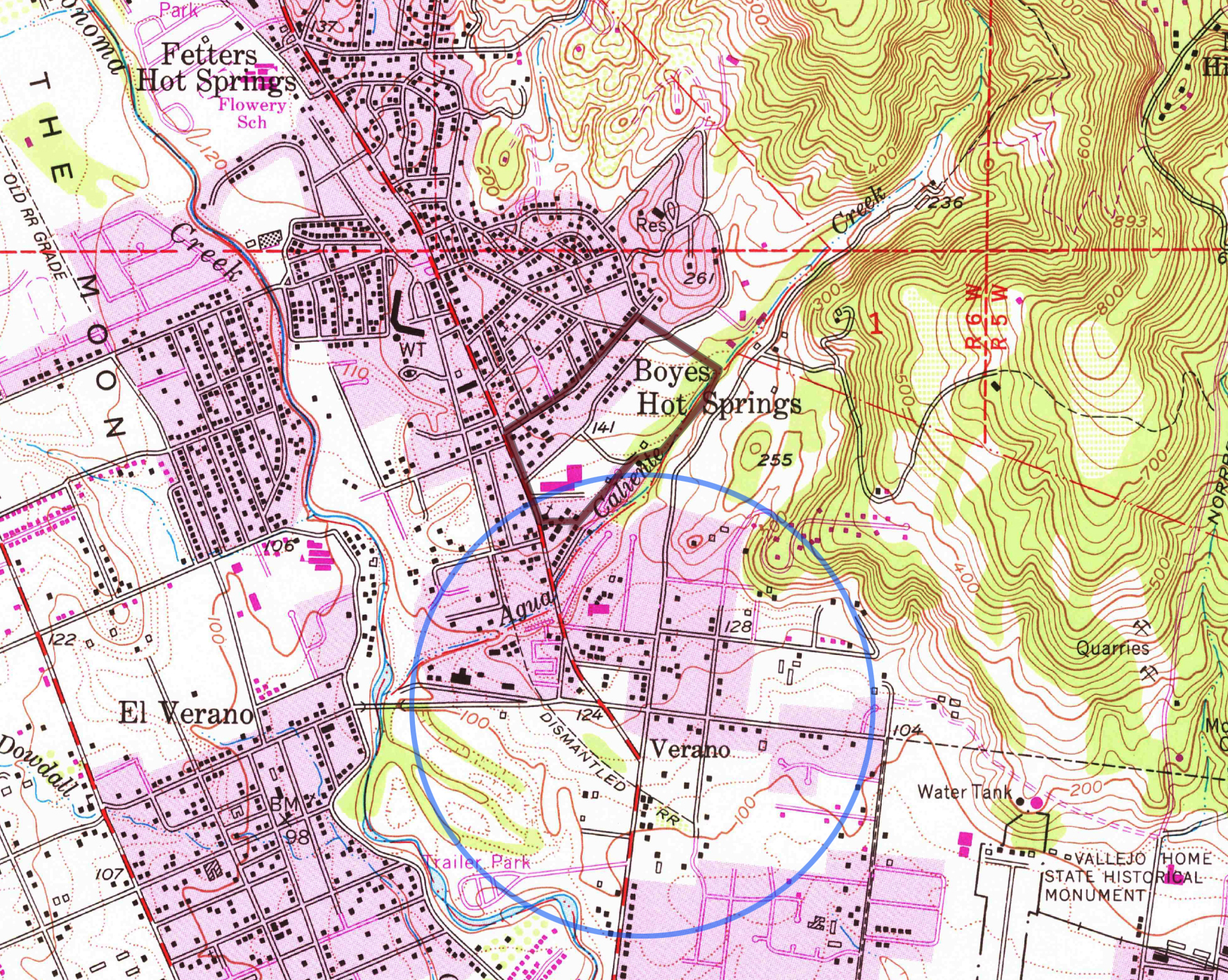
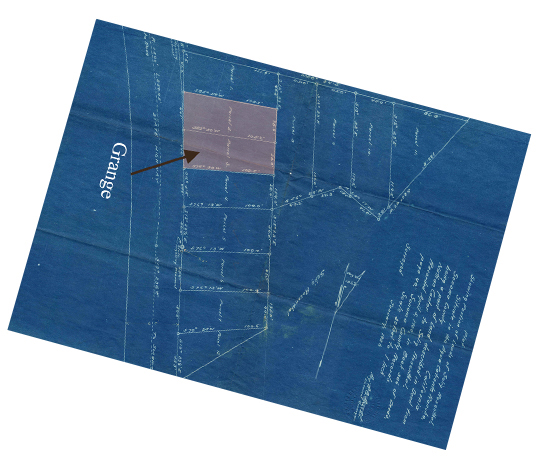
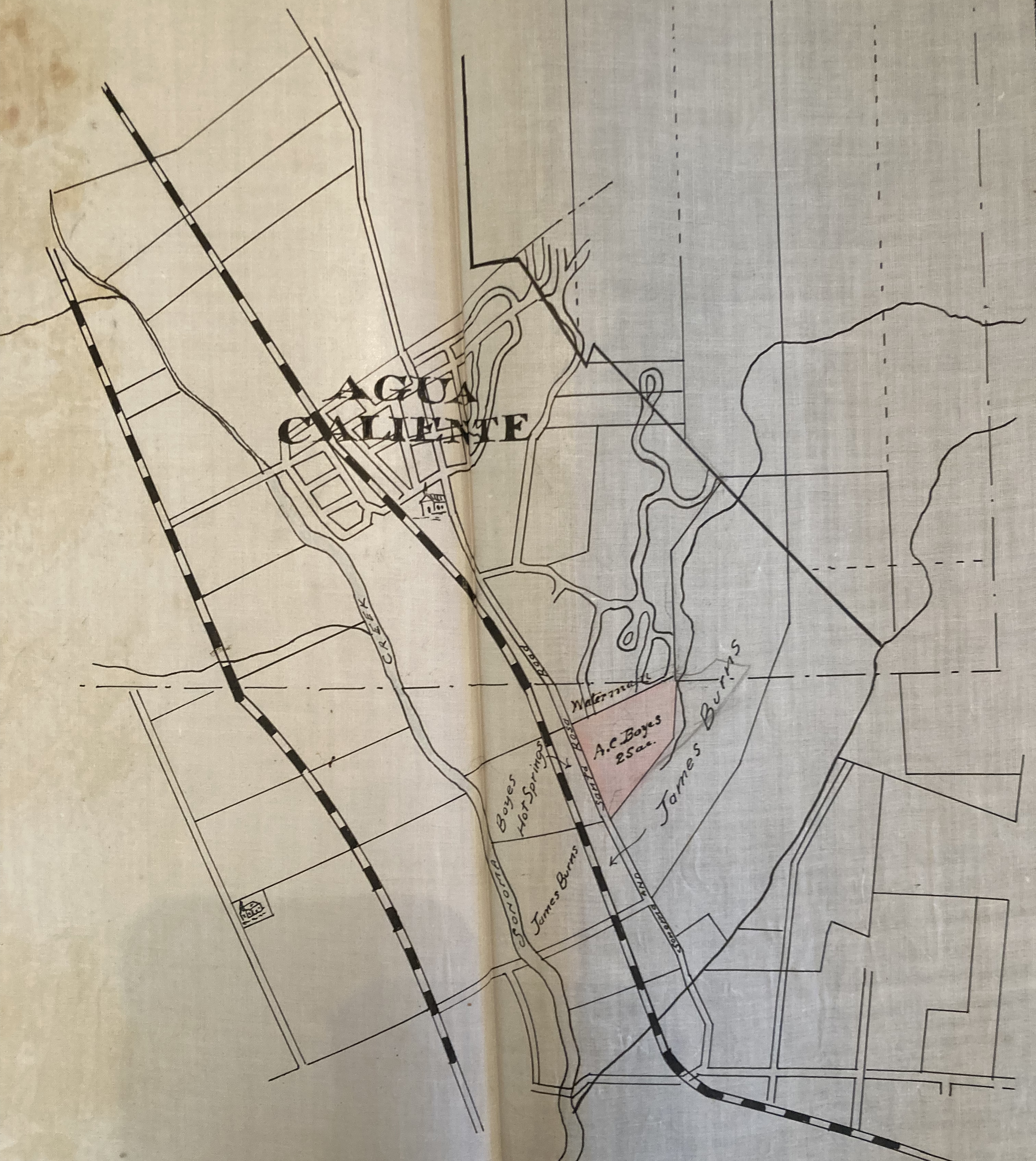
Appleton appears as a property owner on the Reynolds and Proctor maps of 1877 (65 acres) and 1889 (160 acres). (See below). According to the Index Tribune, in 1888: “Several new town sites have been laid out and surveyed in this valley the past few months…Verano is …another new town site which has lately been laid off on the Appleton and Burns places…” (see Boyes abstract map). Parts of the town of Verano (not El Verano), were later owned by Nathan Cantor and Selig Rosenthal. Some of this became the Acacia Grove mobile home park with a carve-out for the Grange in 1934. Read more about Rosenthal, et al, here.
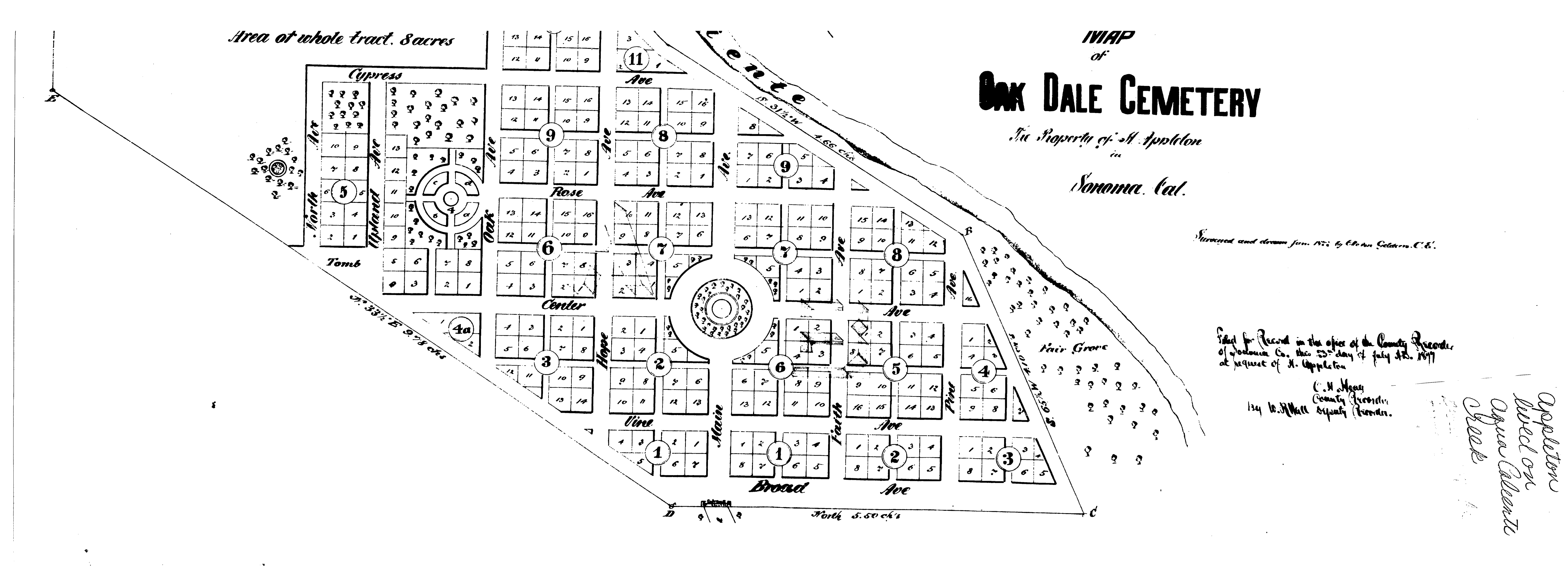
in 1877 Horatio Appleton published a plat of a cemetery on part of his land. (see below)
1877 Reynolds and Proctor map. Sonoma Highway runs through the green area. Its left boundary is Sonoma Creek. Agua Caliente Creek, the south boundary of Appleton’s ranch, joins Sonoma Creek at the bottom of the green area.1880s map of Verano, oriented to match the first map. This was a fanciful depiction of a town that never existed as such, though it did have a railroad depot. Eventually, the “Town of Verano” moved or expanded to the south side of Agua Caliente Creek, as can be seen in the quad map below. The dark line is the approximate outline of the Appleton ranch.Rosenthal’s resort, 1934, showing the lots he sold to the Grange. Sonoma Highway is at left.Map from the abstract of title to Henry Boyes’ land. James Burns land is labeled. Appleton, next to it, is not. An abstract of title was a document used to prove ownership in the days before title insurance. More here.Appleton’s Oak Dale Cemetery, 1877. Another fanciful map.
Thanks to the Sonoma Valley Historical Society, for everything, really, and to the Rumsey Map Collection.
David Douglas, the great English botanist, for whom the Douglas Fir, and many other plants is named, collected in the Pacific Northwest, the Eastern seaboard, and Hawaii, in the years 1823-1834. He also spent some time in California. (čəbidac is the Lushootseed name for D. Fir. Another Coast Salish name for the tree, used in the Halkomelem language, is lá:yelhp https://shoreline.libguides.com/treecampus/douglas_fir)
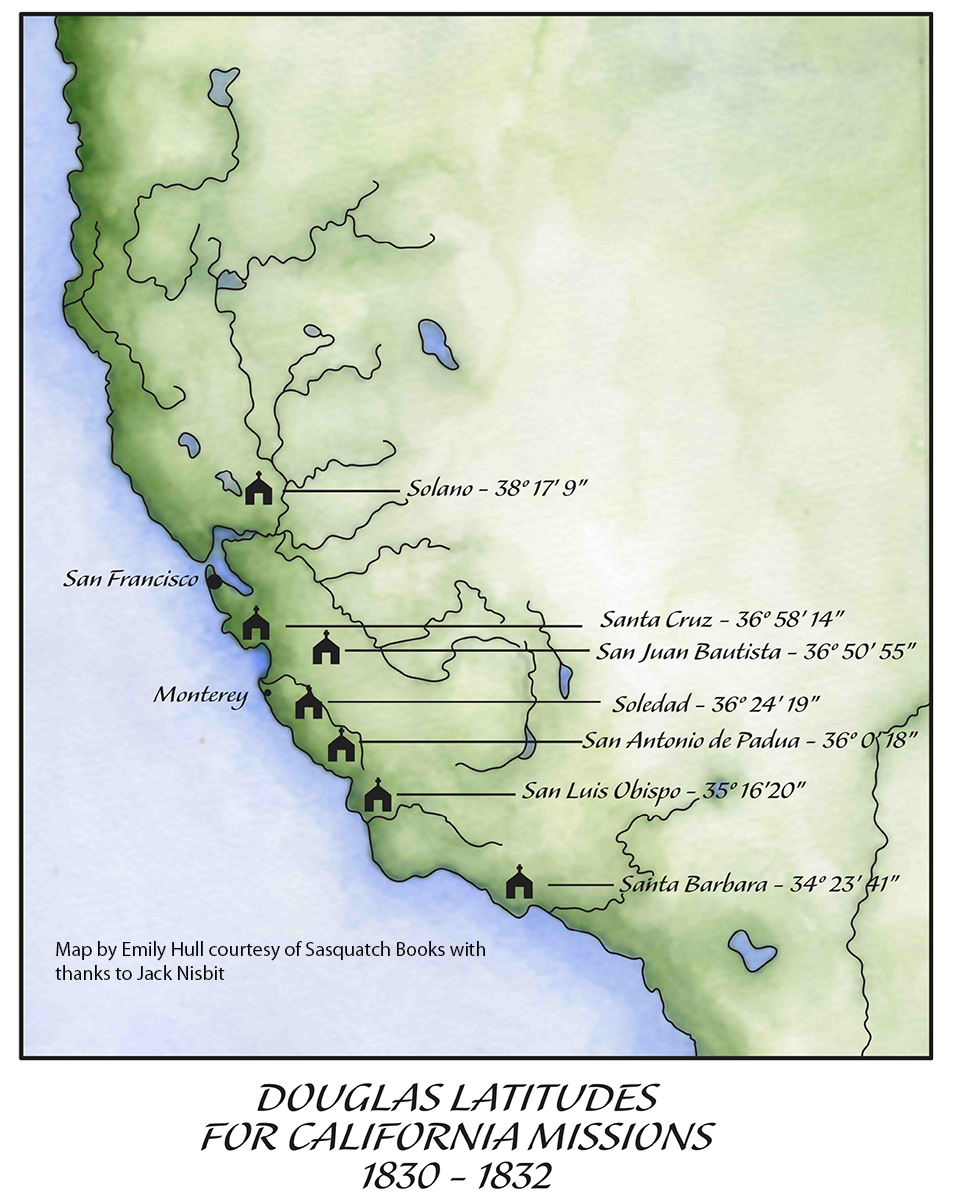
He traveled in there during the years 1830-32, collecting many species then unknown to botanists. He visited the colonial settlements from Santa Barbara to Sonoma, measuring the latitude and longitude at many of them. While in Sonoma he probably spent some time with the Mission fathers, as he had further south. He appreciated them as educated men who spoke fluent Latin.
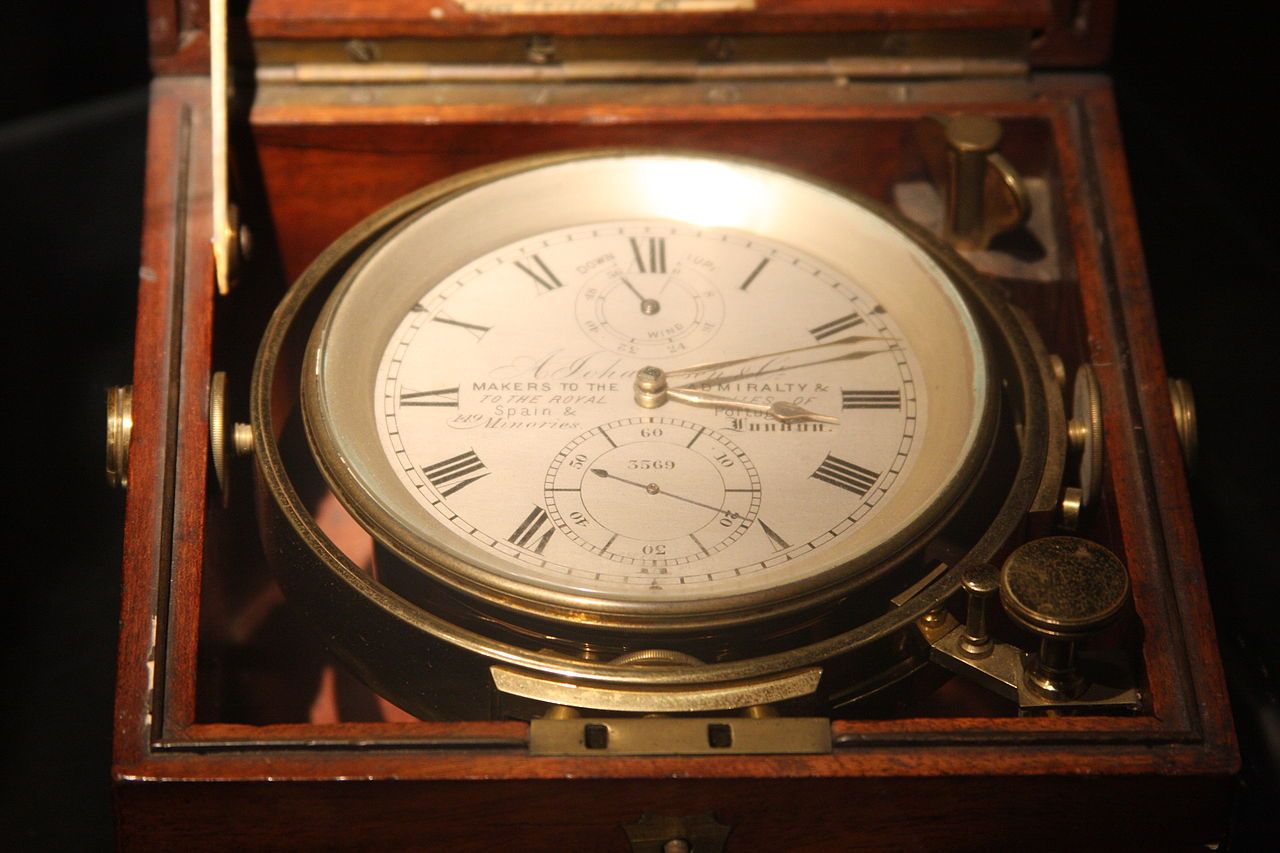
Back in London in 1827, Douglas had trained in surveying with geographer and astronomer Edward Sabine. On his 1829 return voyage around the Horn to North America, Douglas practiced with the instruments and studied the math. He became proficient at the difficult task of measuring longitude, given the unreliability of chronometers at that time.
The longitude as measured today: 38° 17′ 41.2368” N.
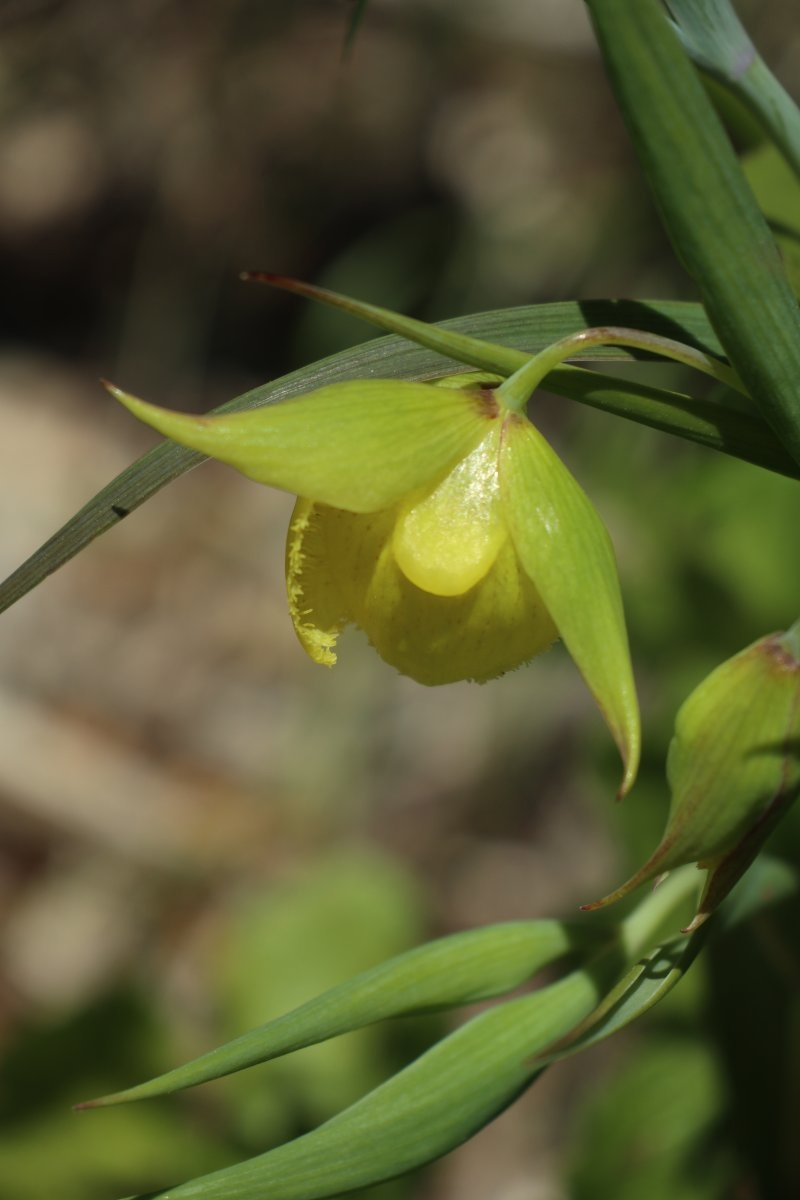
According to Willis Jepson, the dean of California botany, writing in 1933, “He was the first botanical collector in California in residence for any extended period and during this time he traveled through the Coast Ranges from Monterey north to the Mission San Francisco De Solano (Sonoma) and south to the Mission of Santa Barbara. He was not only the first traveler to collect the extensively rich and varied spring flora of the Coast Ranges, nearly all the species of which were new to botanical science, but also the first to leave some written description of it. Hundreds of new species, our most familiar plants, were based on the Douglas collection…” And “It has been suggested that Douglas visited Mt. Diablo, but the form of Calochortus pulchellus which he obtained might have been collected in the Sonoma region.”
Willis Linn Jepson was a co-founder of the Sierra Club and founder of the California Botanical Society. The oldest known California Bay Laurel (Umbellularia californica) is named after him. https://www.smcgov.org/parks/what-see-crystal-springs-trail
Calflora: Information on California plants for education, research and conservation. [web application]. Berkeley, California: The Calflora Database [a non-profit organization]. Available: https://www.calflora.org/ (Accessed: April 30, 2023).
Calochortus pulchellus is a rare species of flowering plant in the lily family known by the common name Mt. Diablo fairy-lantern or Mount Diablo globelily.
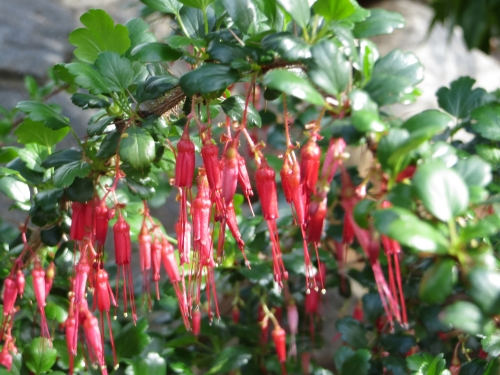
Of the first plant he encountered in California, Douglas stated (one-upping his mentor Menzies?), “Early as was my arrival on this Coast Spring had commenced. The first plant I took in my hand in full flower was Ribes Staminum, (Smith) remark able for the length and crimson splendour of its stamens, a plant not surpassed in beauty by the finest Fuchsia, for the discovery of which we are indebted to the good Sir Arch. Menzies in 1779.” The epithet Ribes staminum is way out of date. It has been suggested to me by the esteemed botanist Steve Acker, Phd. That the species described by Douglas would be Ribes divaricatum var. pubiflorum. However, given Douglas’ description it could be Fuchsiaflower Gooseberry, Ribes speciosum
My thanks to Peter Meyerhoff and Jack Nisbit for assistance. Jack is the author of two books about David Douglas, “The Collector: David Douglas and the Natural History of the Northwest” and “David Douglas: A Naturalist at Work” available from Sasquatch Books: https://sasquatchbooks.com/
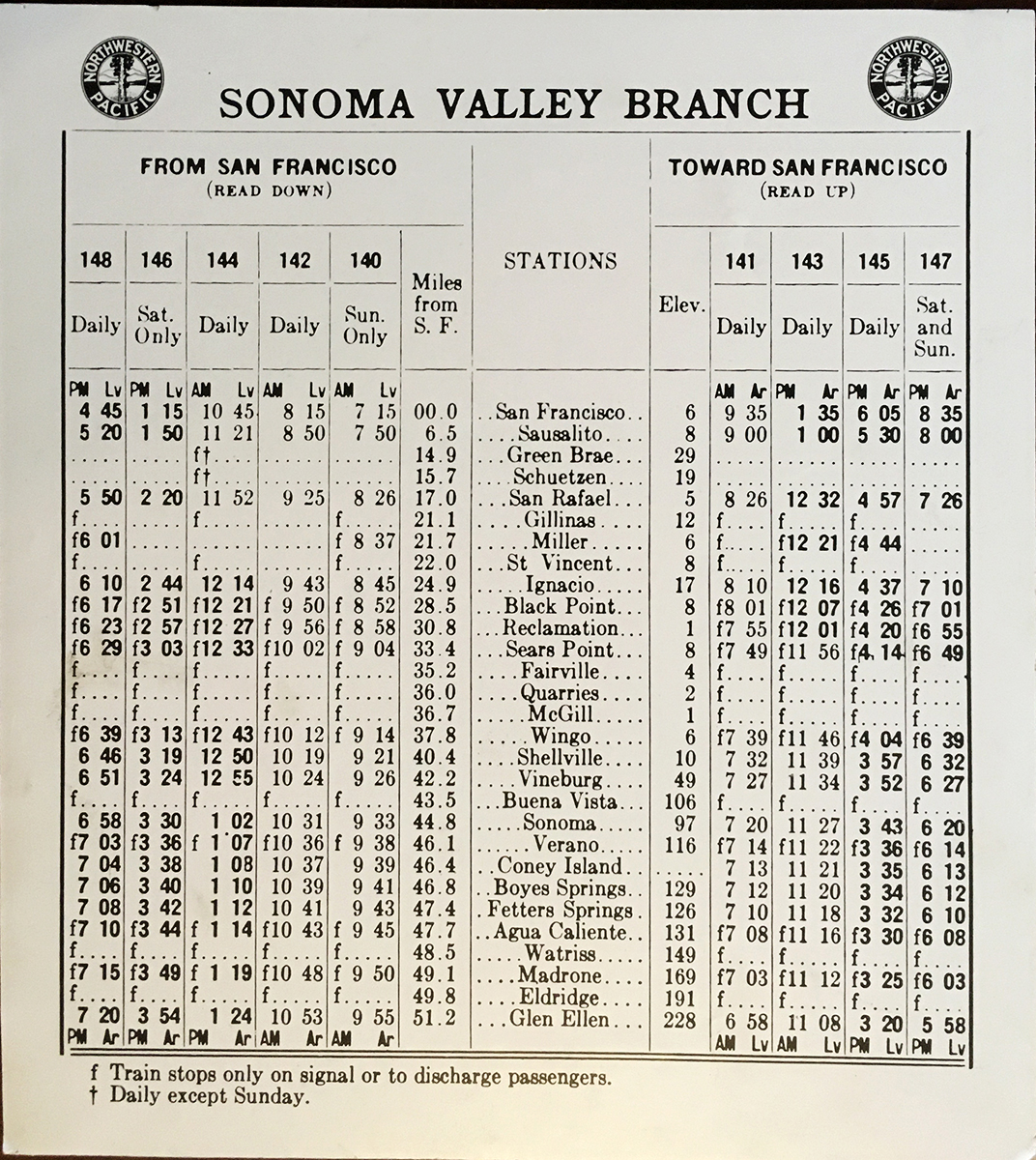
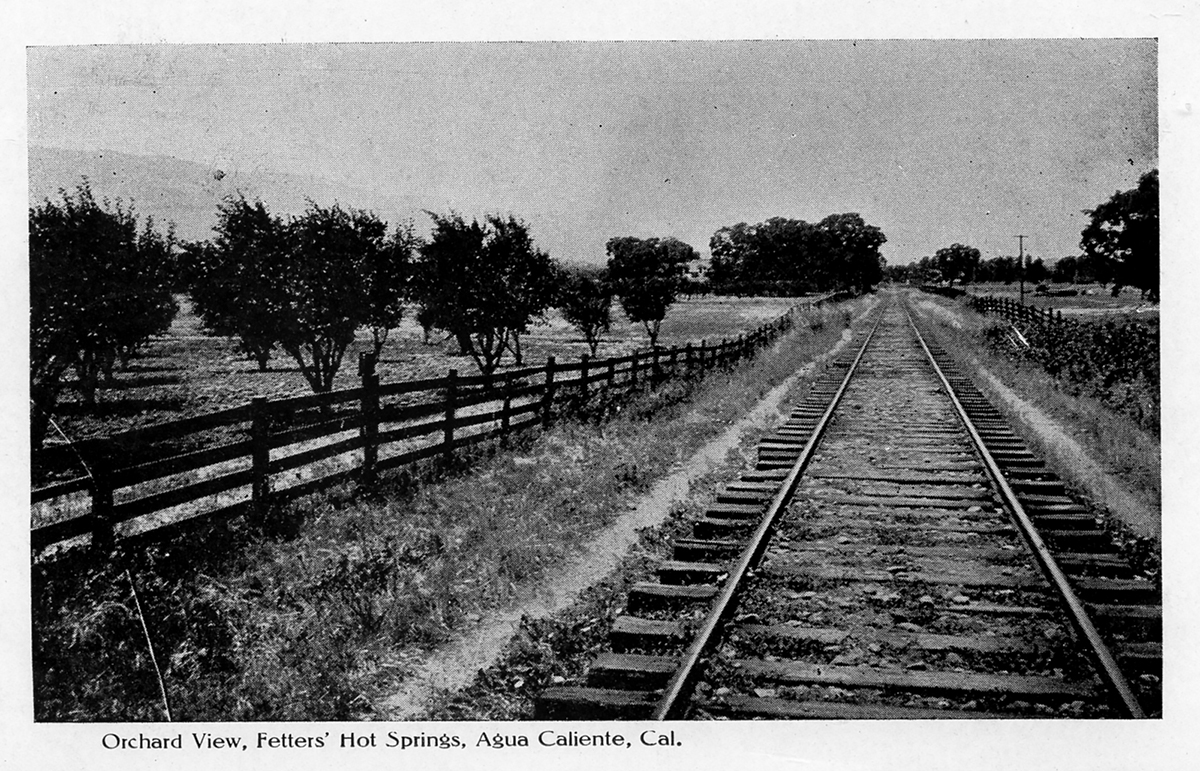
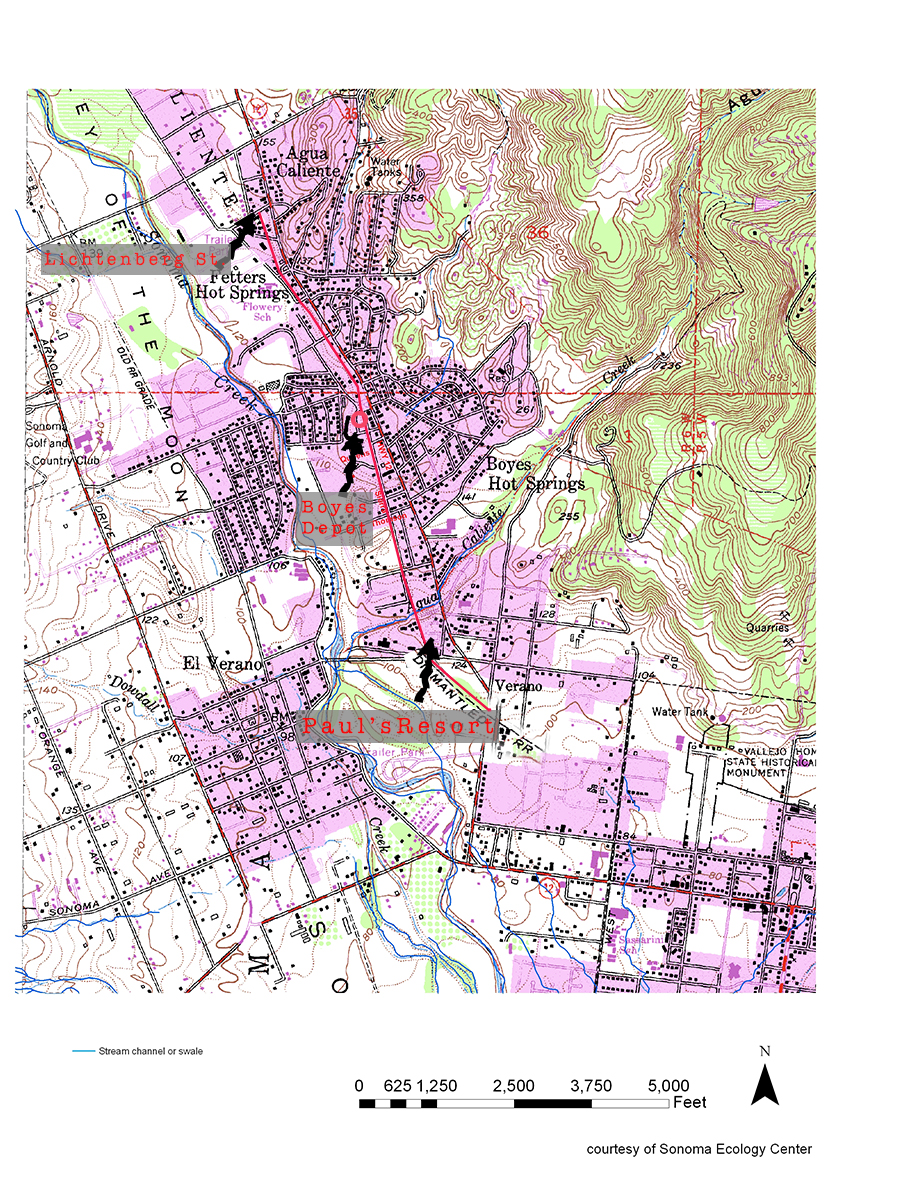
The last year of operation for the Northwest Pacific Railroad in Sonoma Valley, which ran on the east side of Sonoma Creek, was 1942. That year freight service ended, and the tracks were torn up for steel for the war effort. Traces of the right-of-way can be seen in several places in El Verano, Boyes Hot Springs, Fetters Hot Springs, and Agua Caliente.
From El Verano going north:
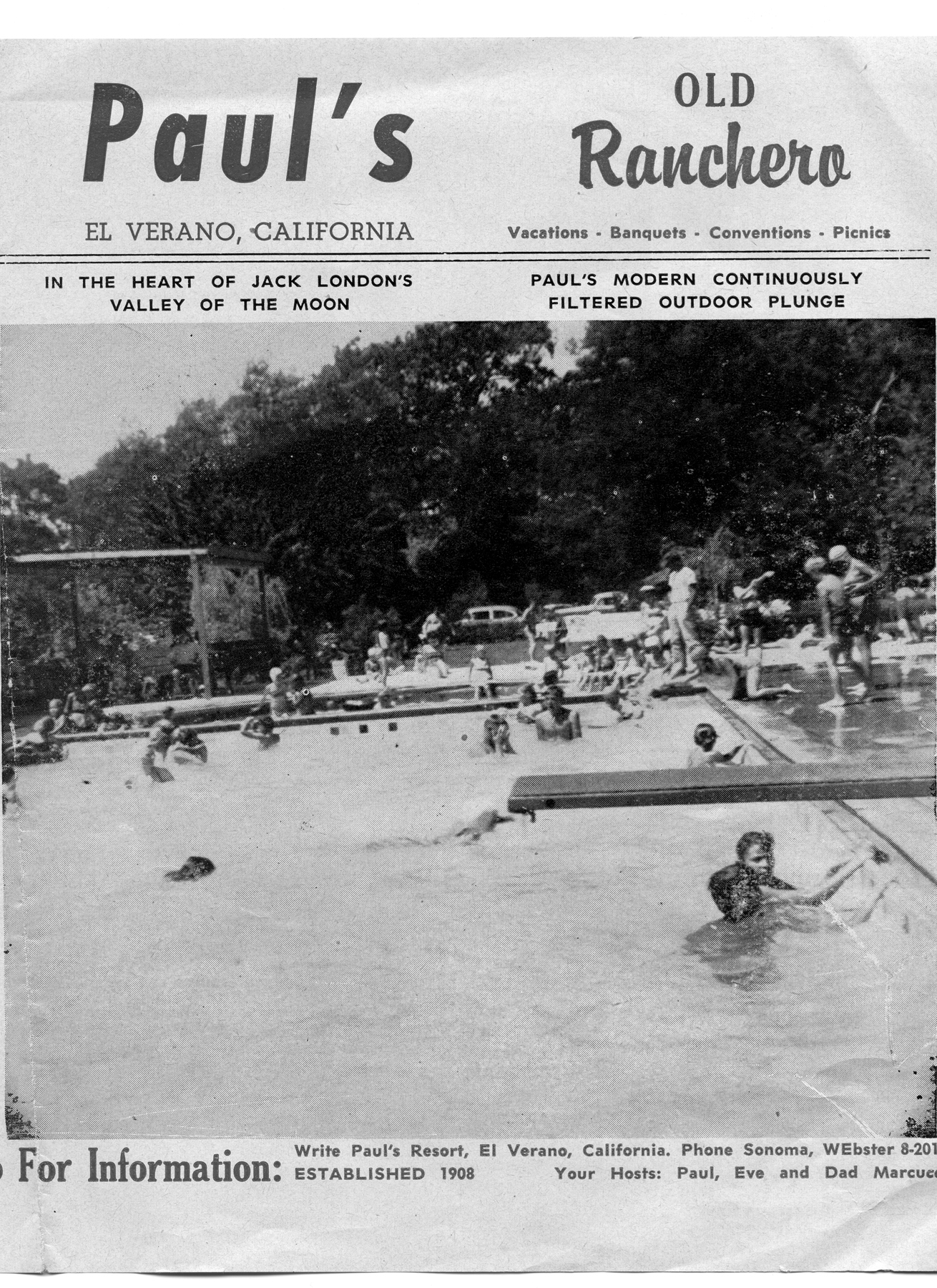
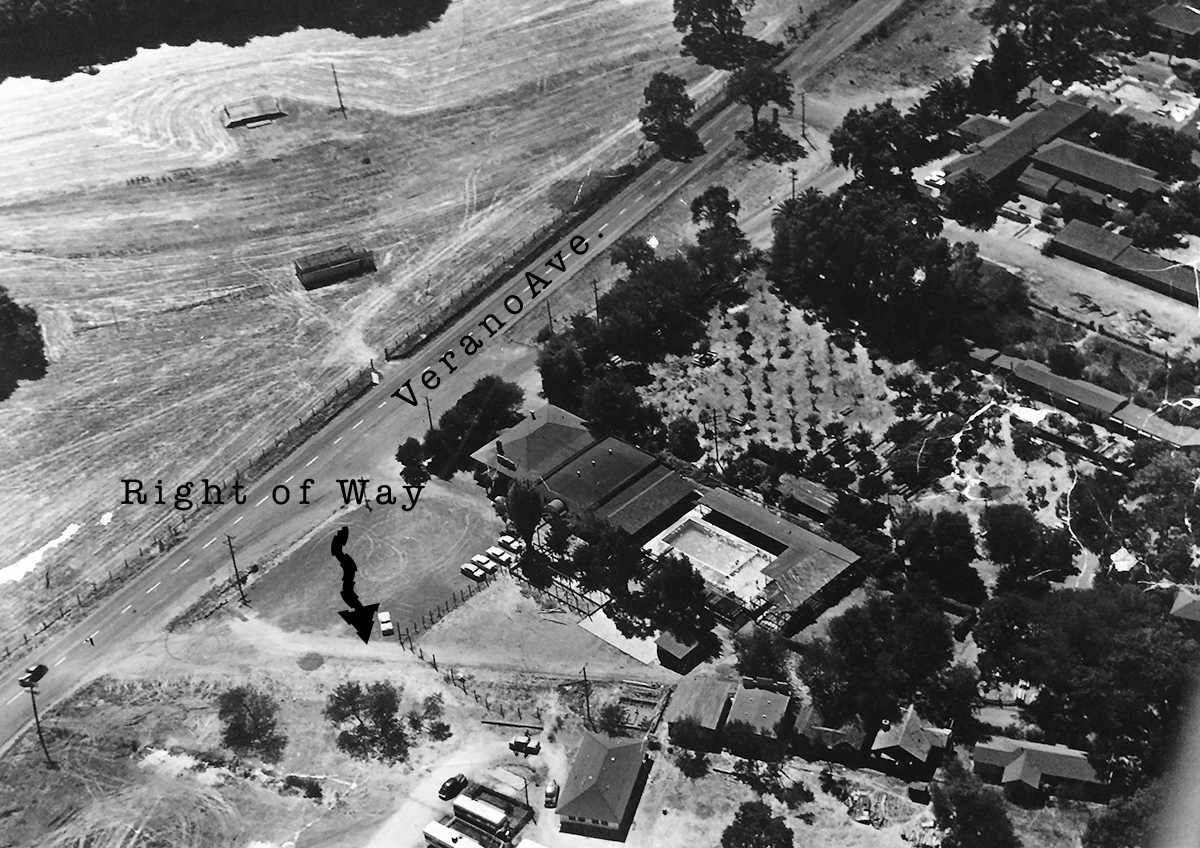
In El Verano the tracks run through the Paul’s Resort property, where the Verano (not El Verano) depot was located.
Paul’s Resort, 1960s
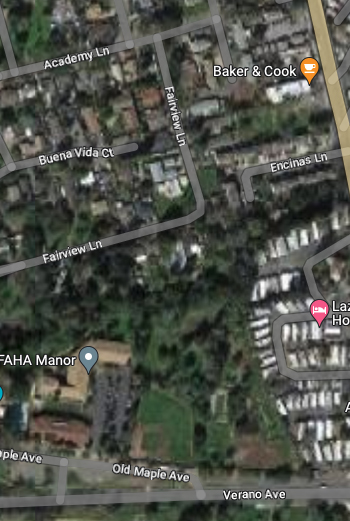
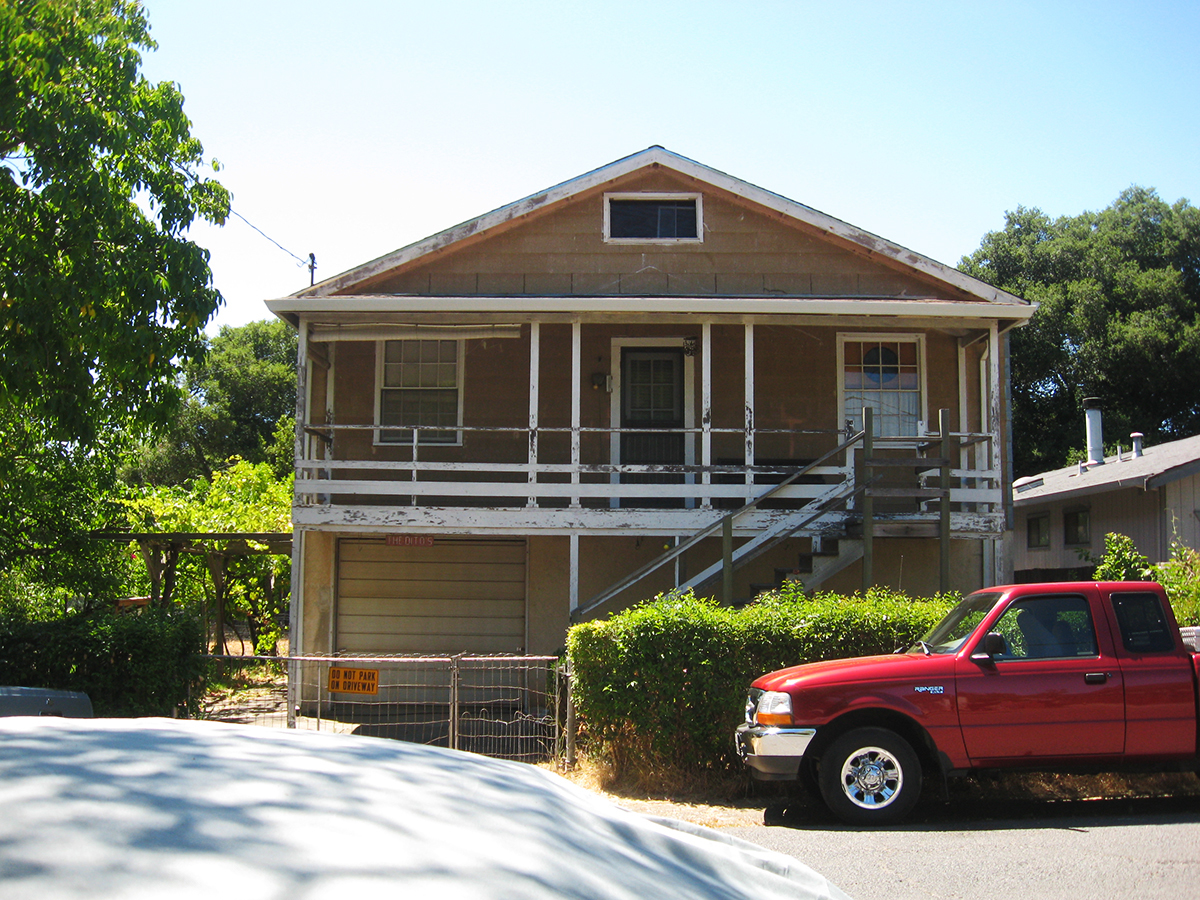
From there it parallels Fairview Ln. (which may have been right-of-way) until it gets to Thompson, where Sierra Dr., formerly Meinke Ave., takes over the roadbed. (More about Sierra and Mienke.) Manzanita St. might have been a spur. It features several buildings that look as if they could have been built by the railroad.
House on Manzanita near Academy Lane
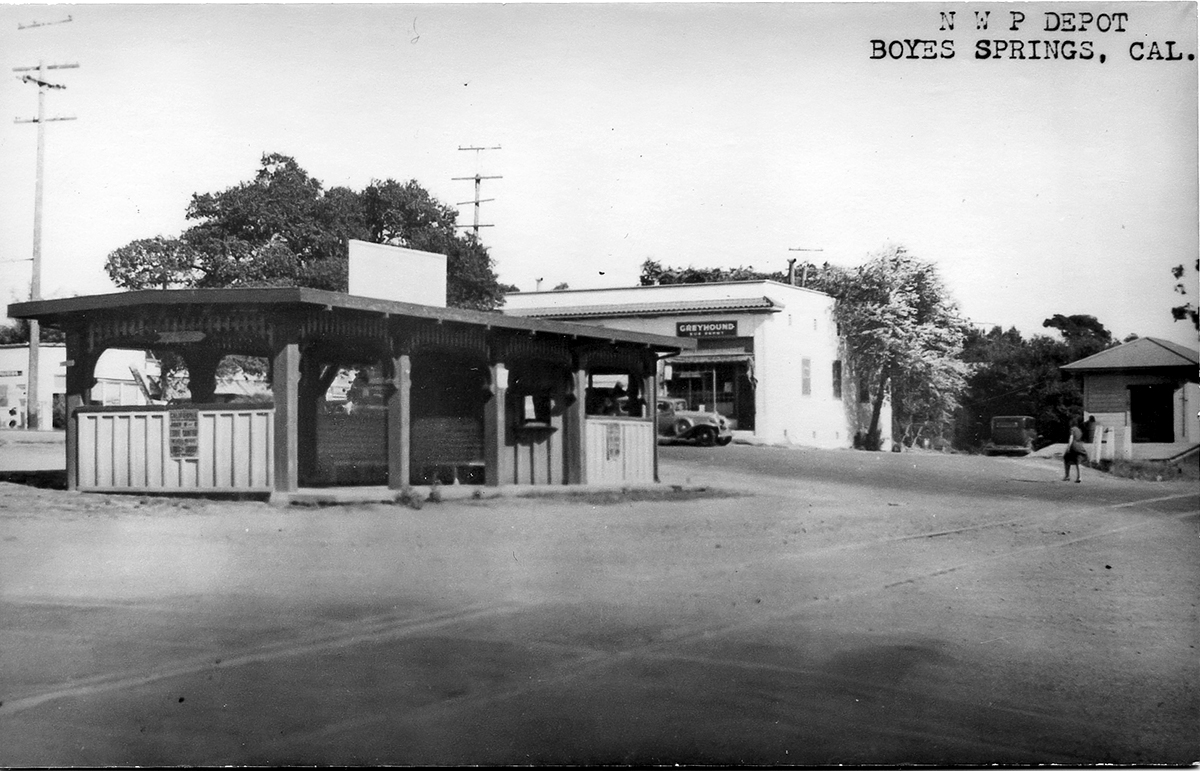
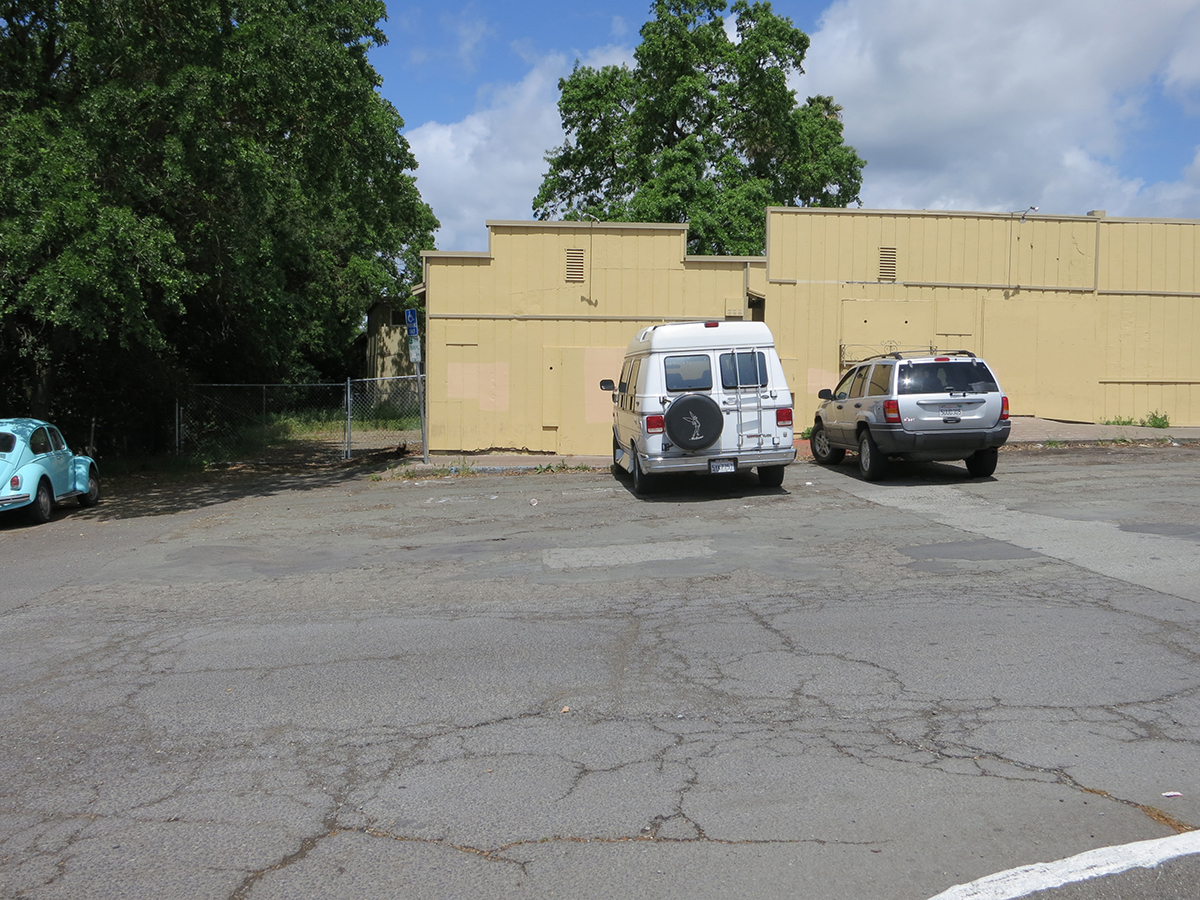
Where Sierra turns east to the Highway the right of way continues north through the Sonoma Mission Inn (originally the Boyes Hot Springs Resort) grounds and past the BHS depot, which land is now the parking lot for the Plaza Center building (More here).
Boyes Depot 1942
Right-of-way next to old commercial buildings at Boyes Plaza, which were demolished in 2018. Photo taken from the apporxiamte location of the Boyes Depot.
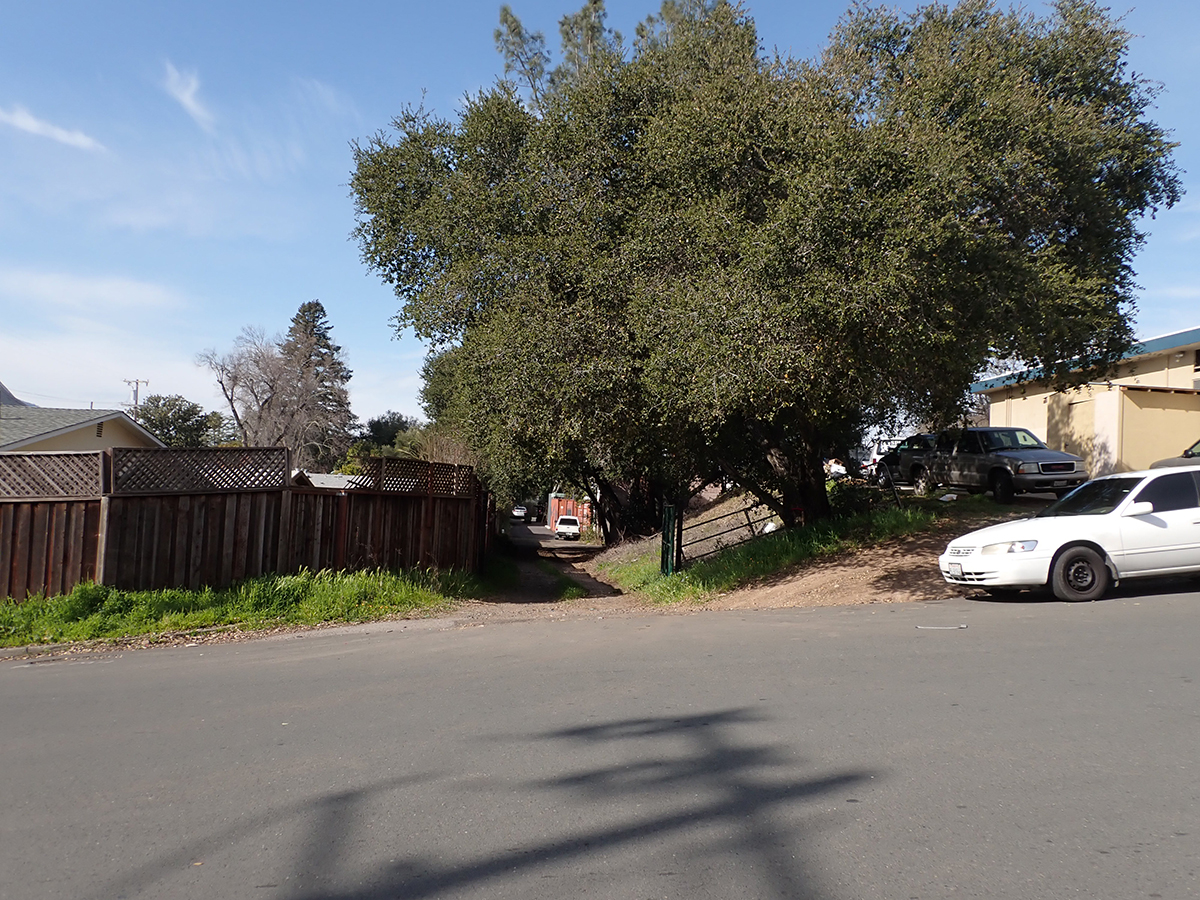
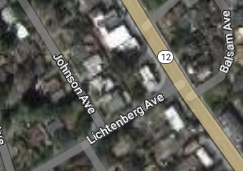
Continuing north it parallels the Highway and can be seen crossing Lichtenberg Ave, parallel to Johnson Ave.
At Lichtenberg.
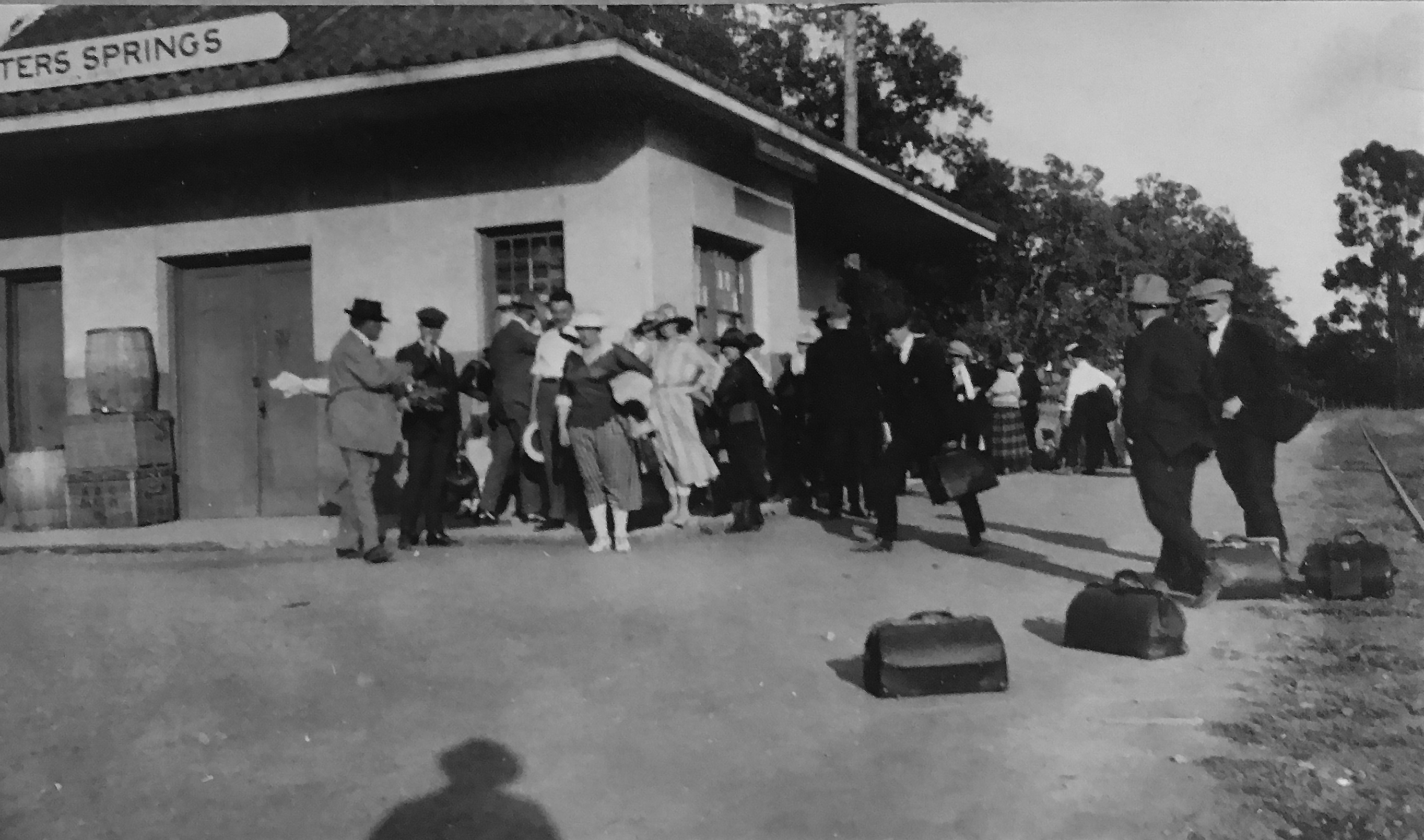
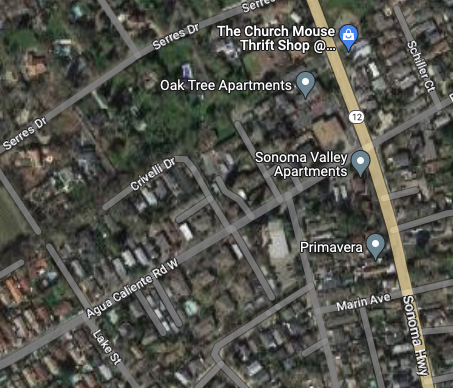
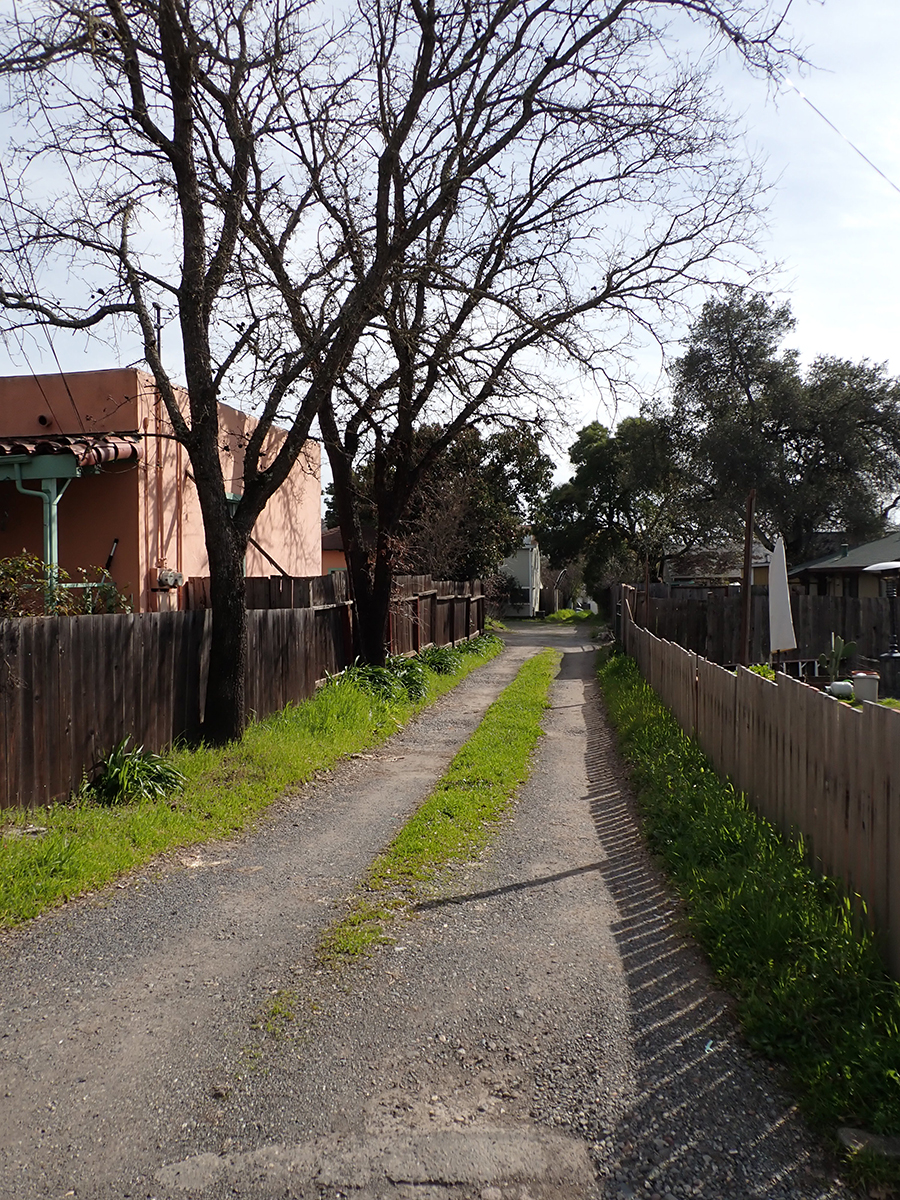
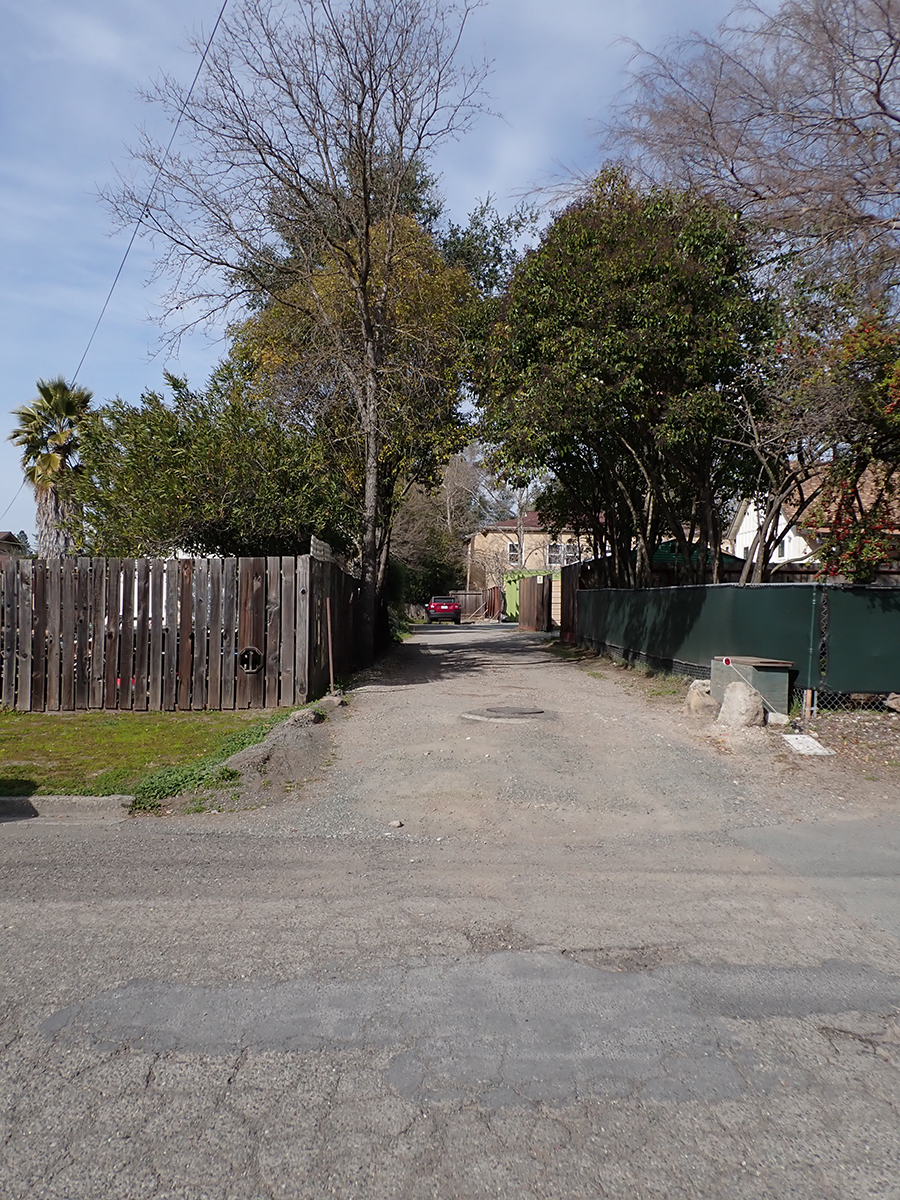
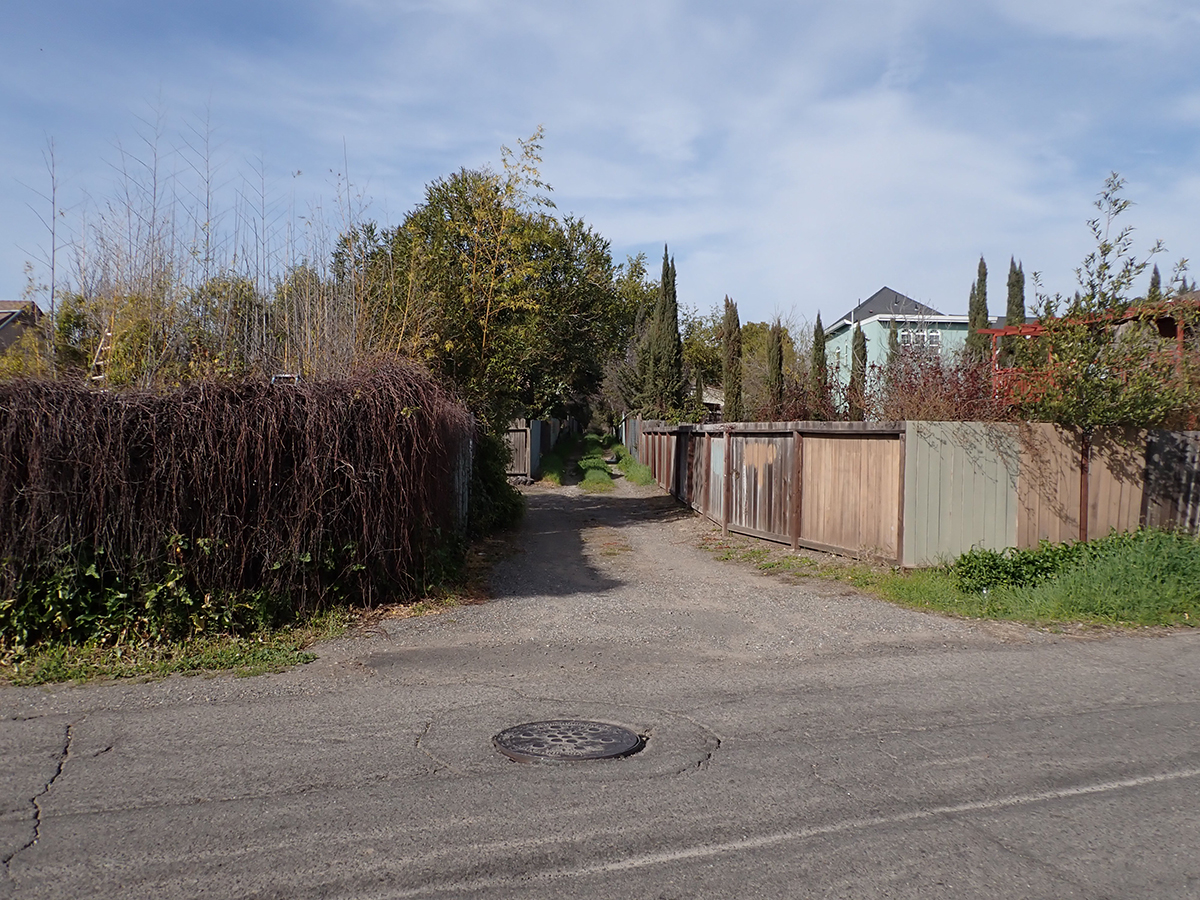
The next trace is the old Fetters Depot building on Depot Rd in front of Flowery School. It crosses the Fetters Apartments and Charter School properties and is seen again at Vialetti Dr. The old roadbed has become the alley the runs from Vailetti to Marin Ave. That is the last appearance of the right-of-way in the area.
Fetters Depot 1910s
1910s
At Marin Ave. looking south.
At Marin Ave. looking north.
At Vailetti Rd. looking north
Maps and photographs courtesy of the sonoma Valley Historical Society unless noted otherwise.
Temporary, informal, unsanctioned, cryptic. Personal expression, job related. Faded, half-obscured.
Ephemeral and permanent.
Highway 12 through Boyes Hot Springs, Fetters Hot Springs, and Agua Caliente, California, though a heavily used commercial and residential street, had almost no sidewalks until 2009/2010. Dirt shoulders for walking was not a problem when traffic was light. Even at the height of the resort era (1950s), people would ride horses down the middle of the highway. That’s how quiet it could be.
Starting in the 1980s, locals started to agitate for a safer road. They wanted sidewalks and streetlights. Along came Redevelopment to provide the funds. Part of the project was completed by 2010 (a good twenty five years after agitation began). Redevelopment was abolished by dear old Jerry Brown. Thanks Jerry! The project languished. Finally, the Sonoma County Board of Supervisors came through with the money to finish. Thanks Susan Gorin!
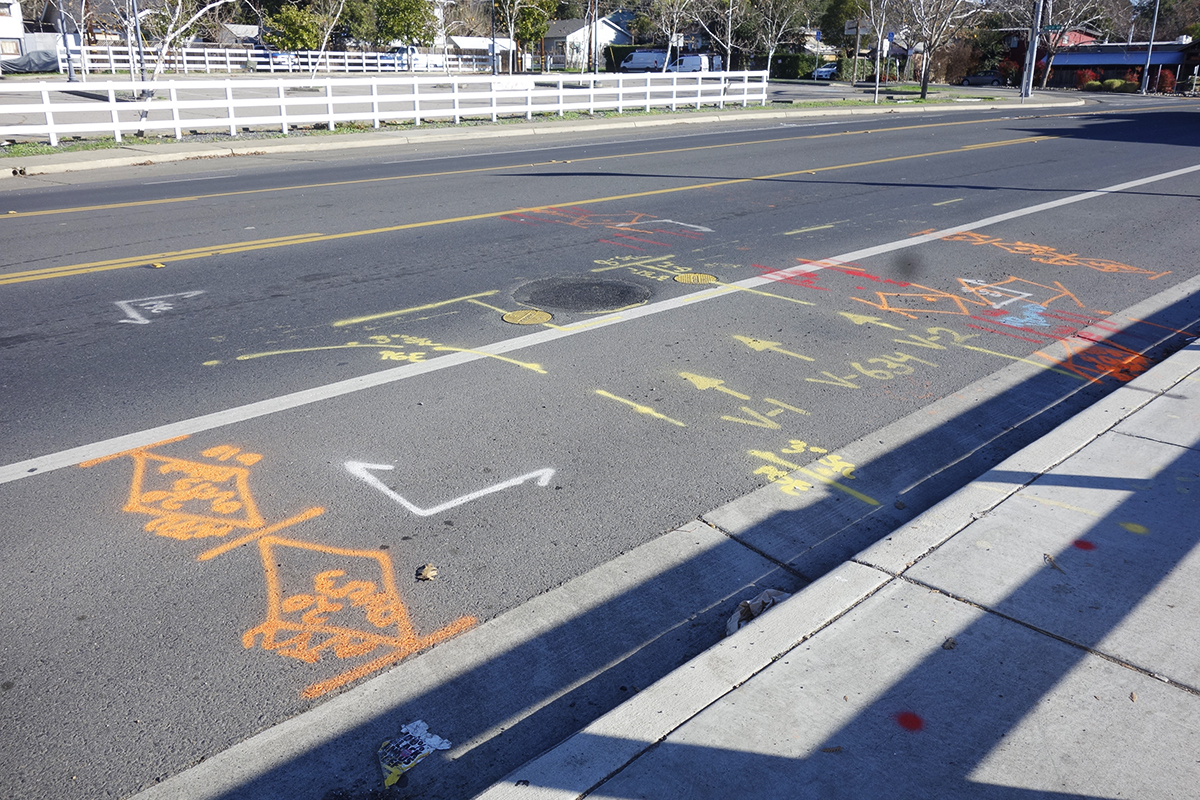
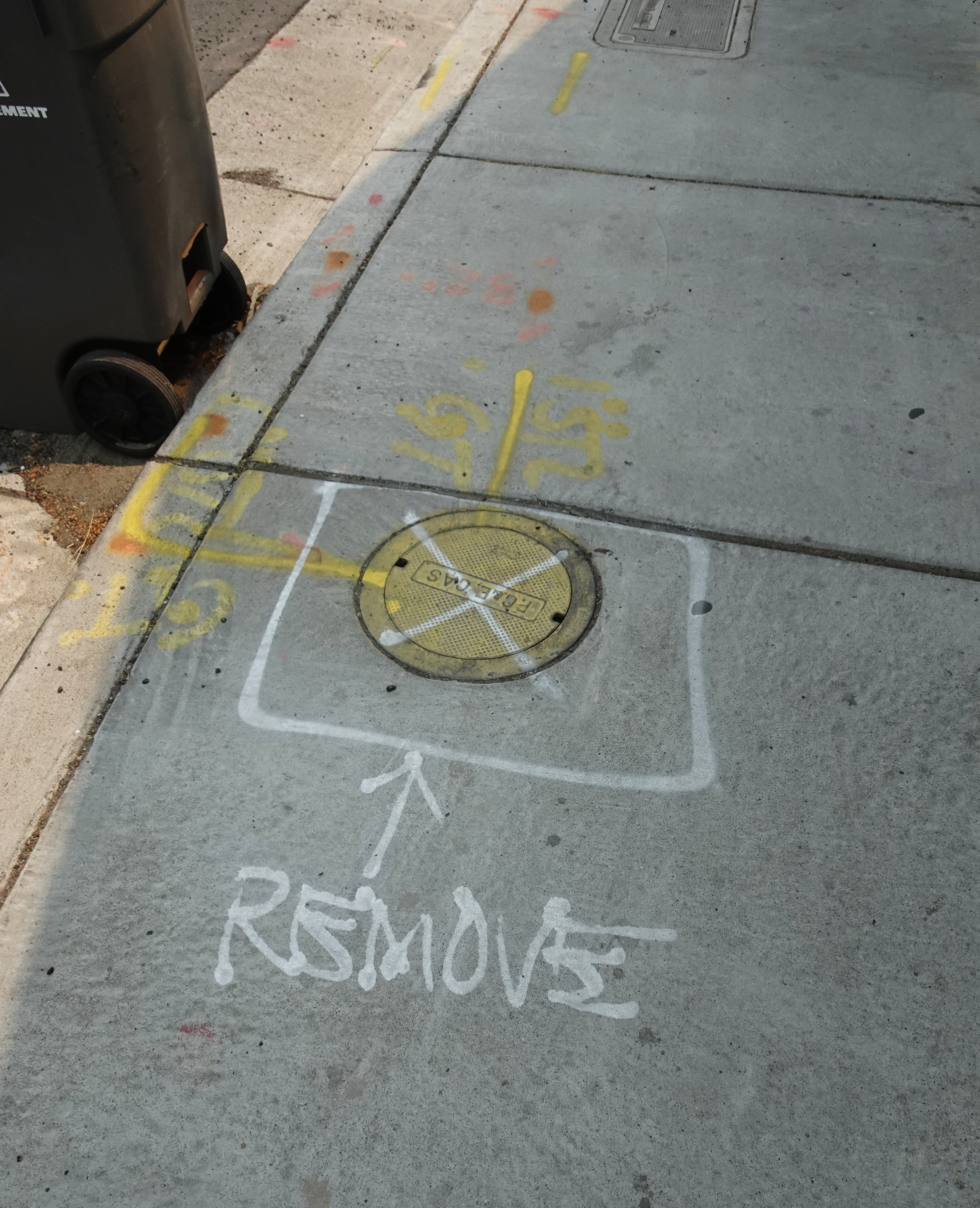
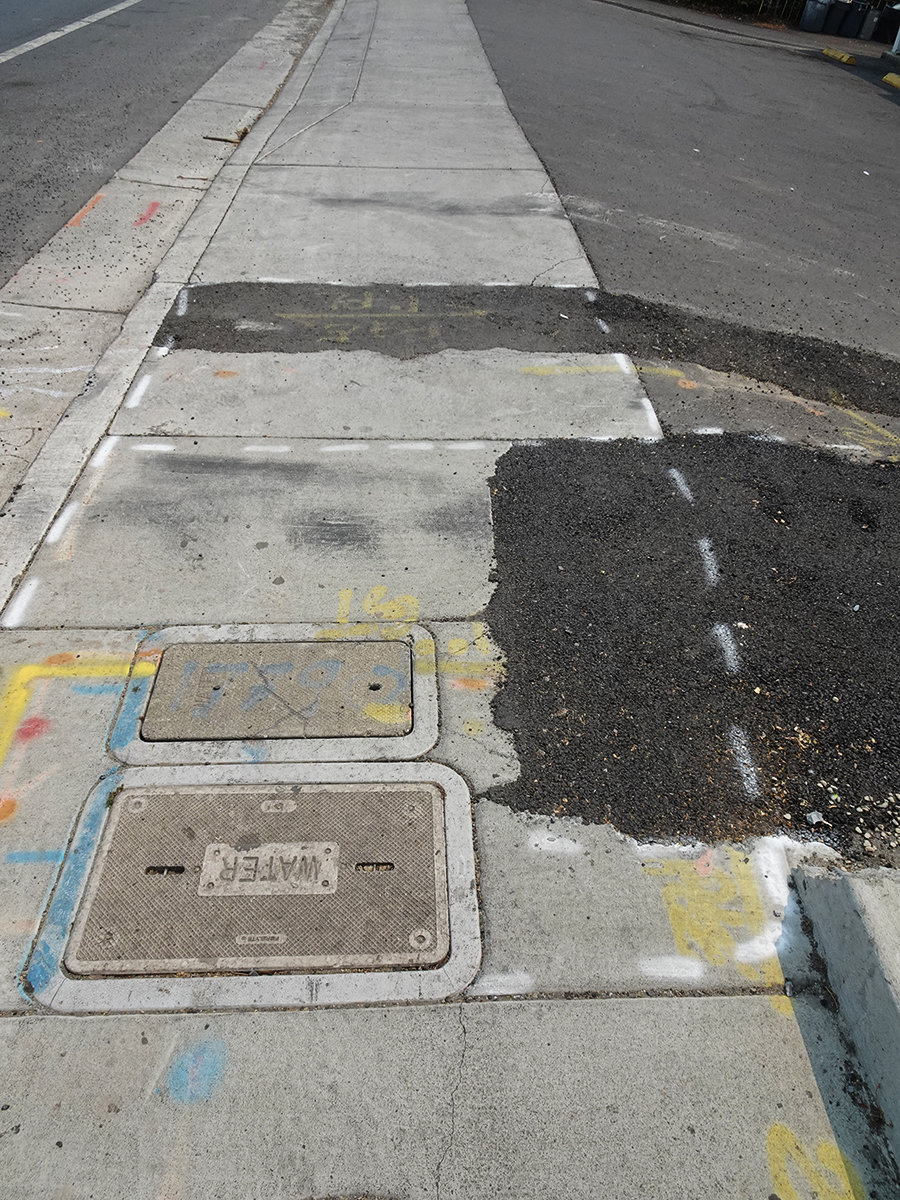
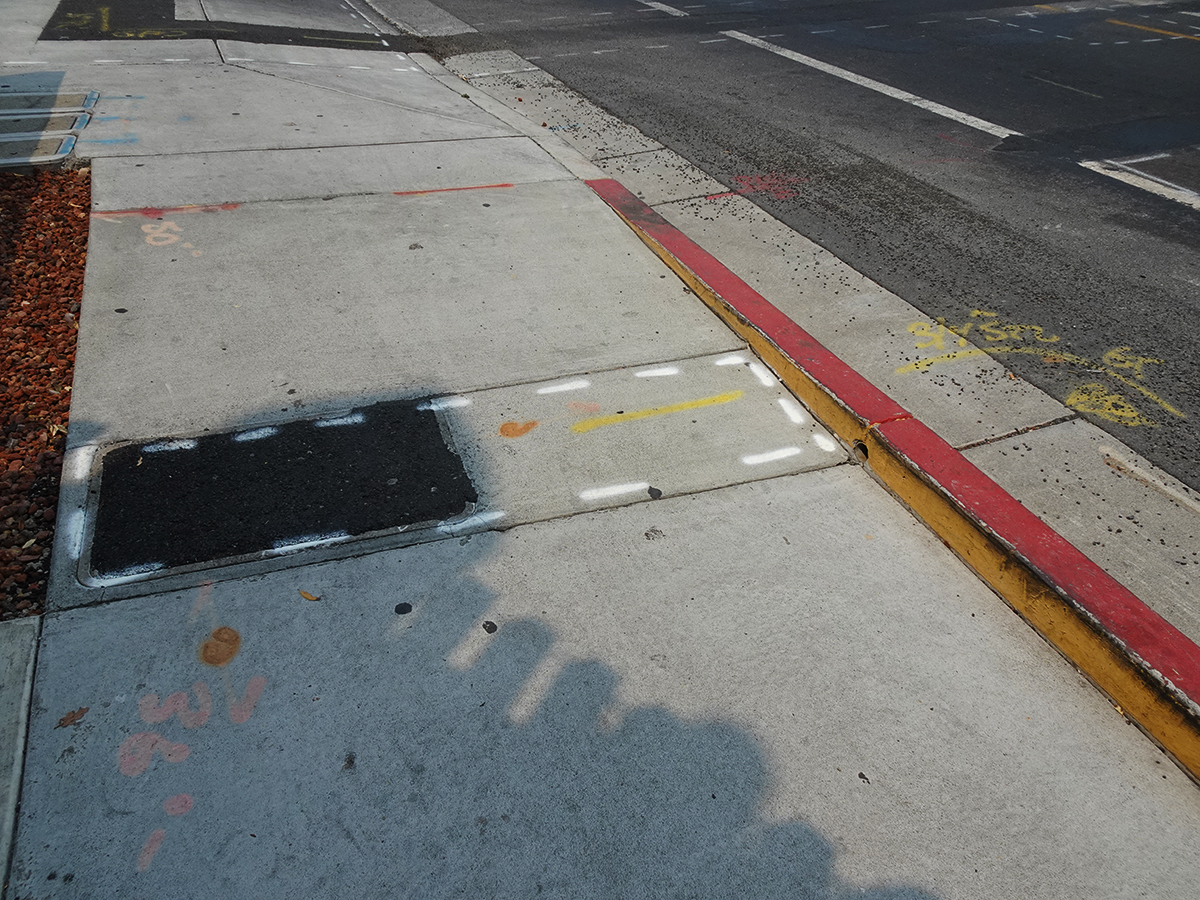
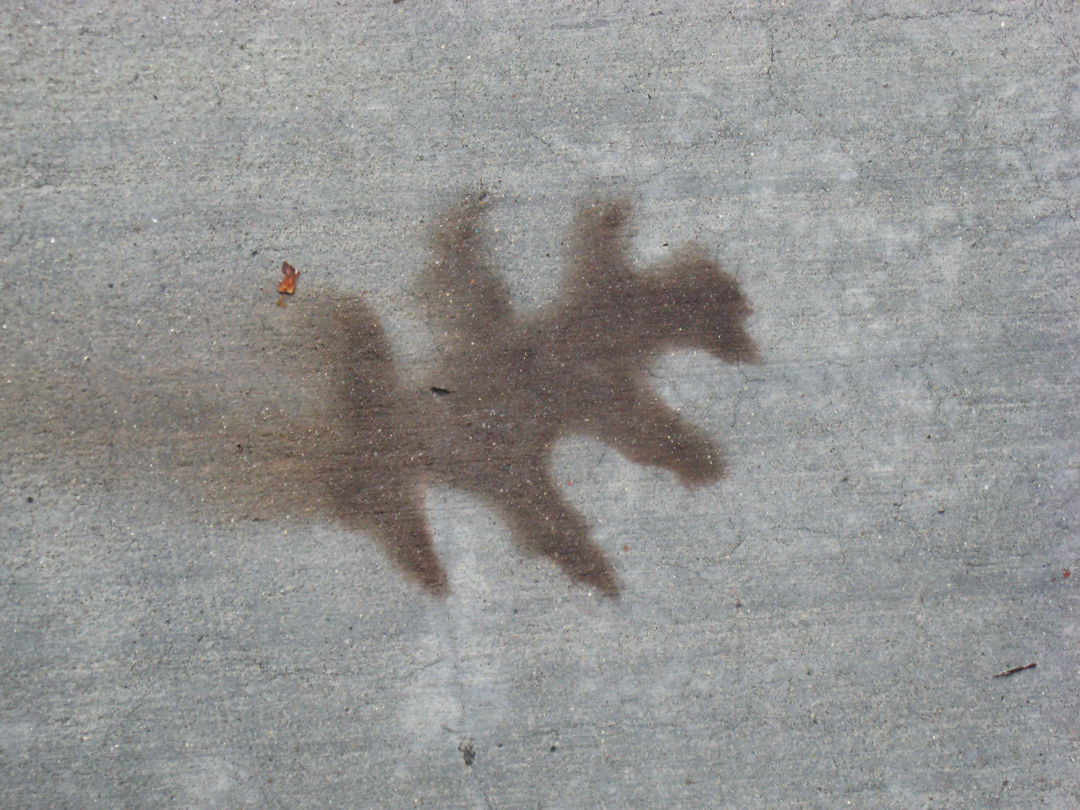
The following is a collection of street markings from before during and after sidewalks were installed. Some are the ephemeral spray paint graphics of the contractors, which can be interesting. The more enduring marks are by the people who happened to walk by when the concrete was wet. These are also interesting, even poetic at times. One example is pure nature.
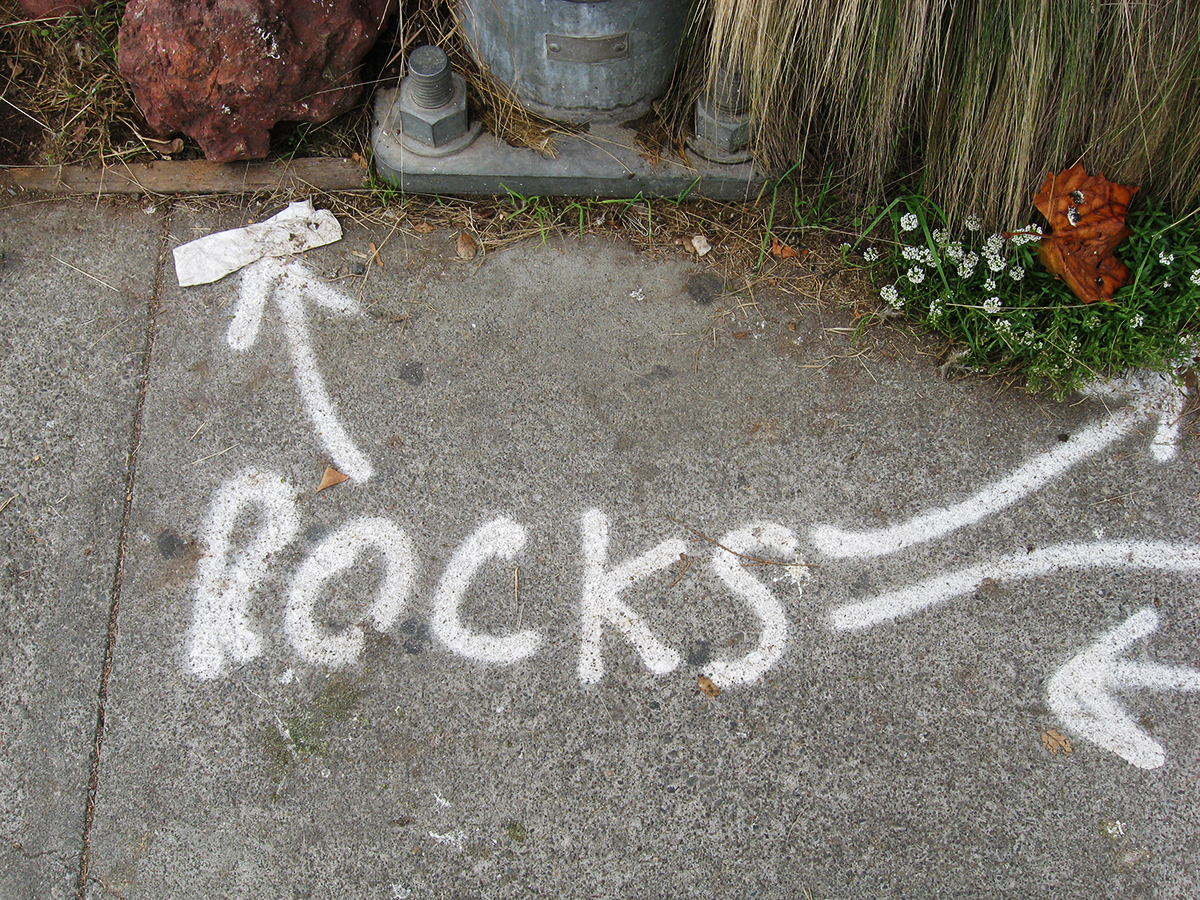
2008-Before demolition started a lot of marks went down. Why was it necessary to point out the rocks?
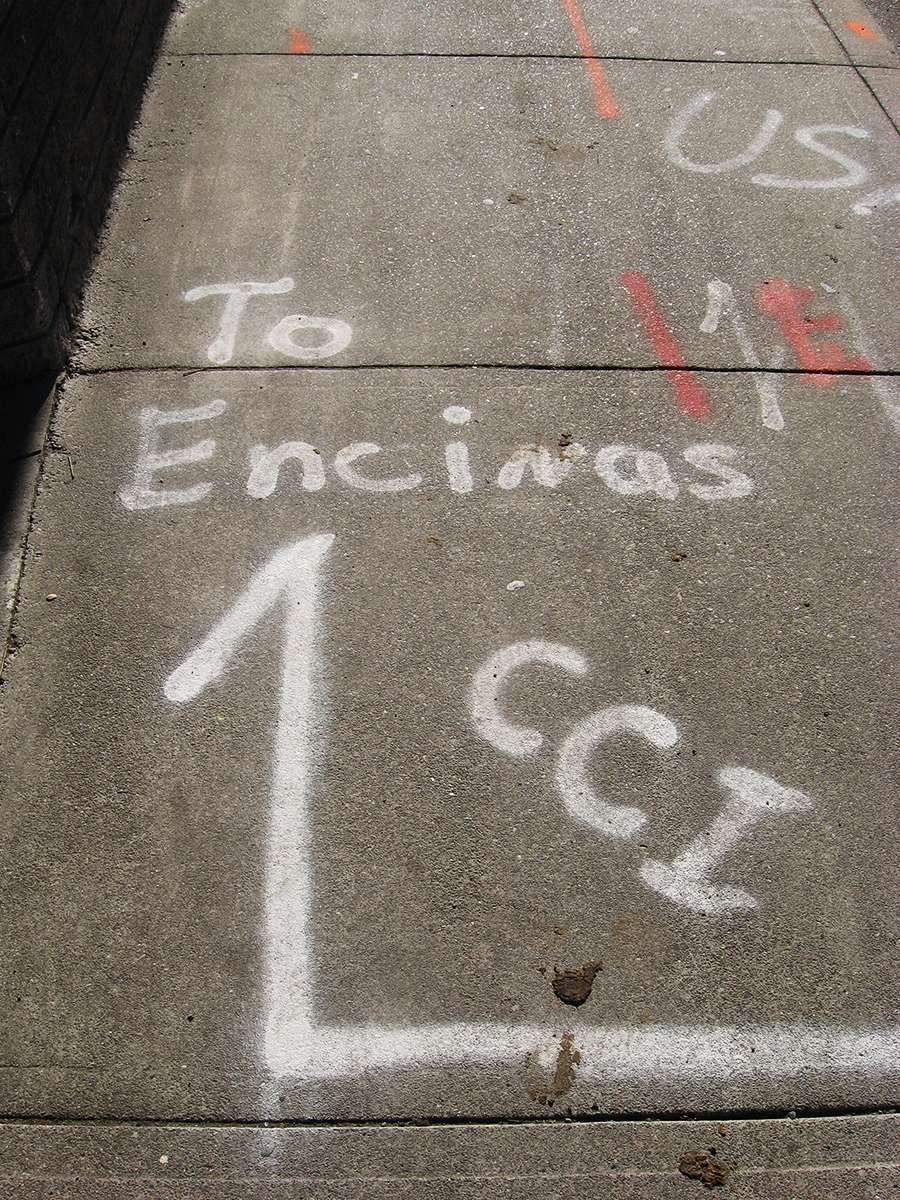
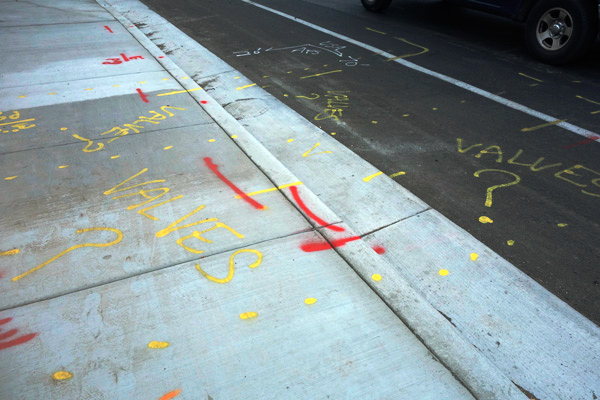
2009. Underground Service Alert (USA) finds all the pipes and wires and marks the surface. Not sure what “CCI” stands for.
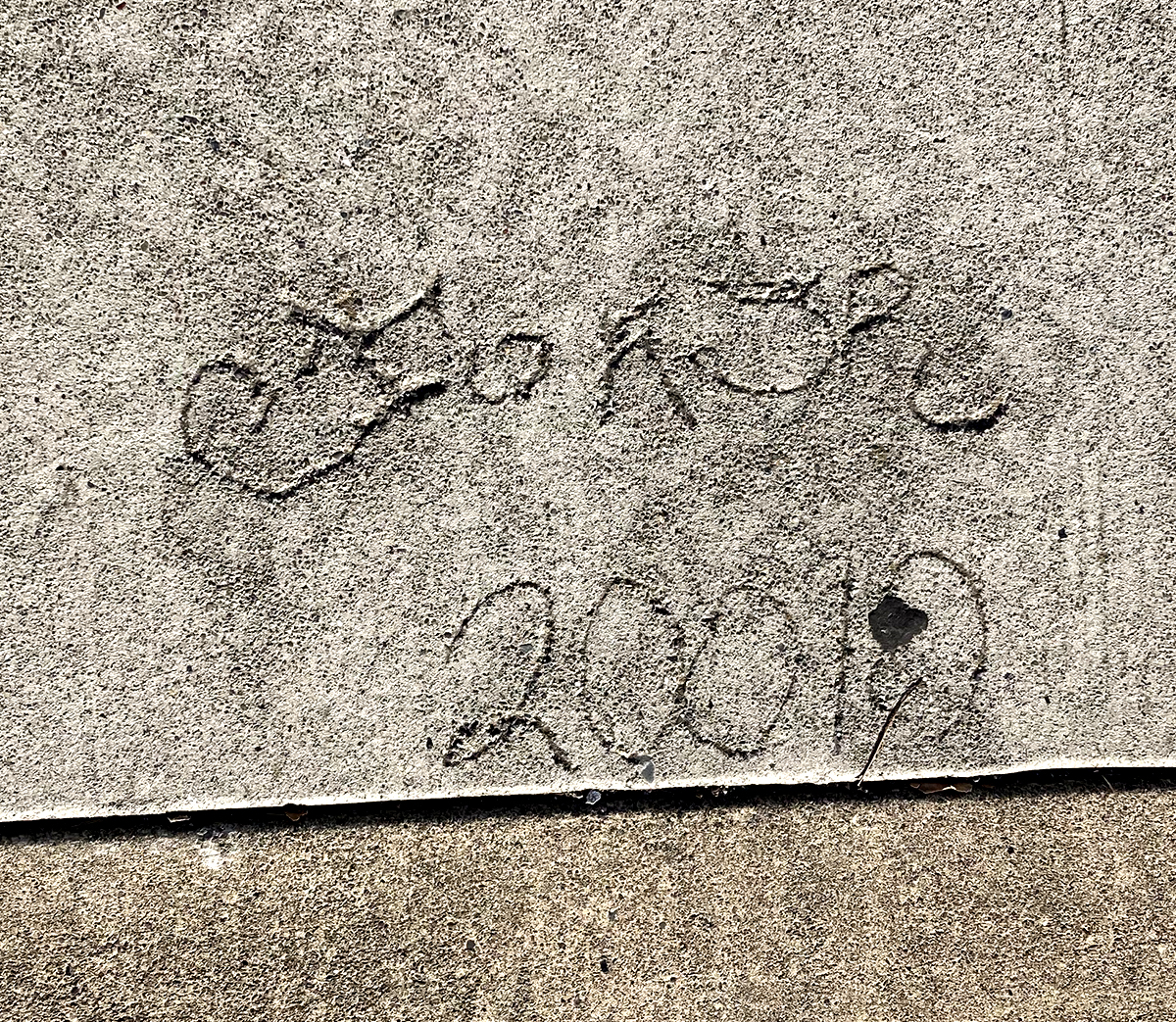
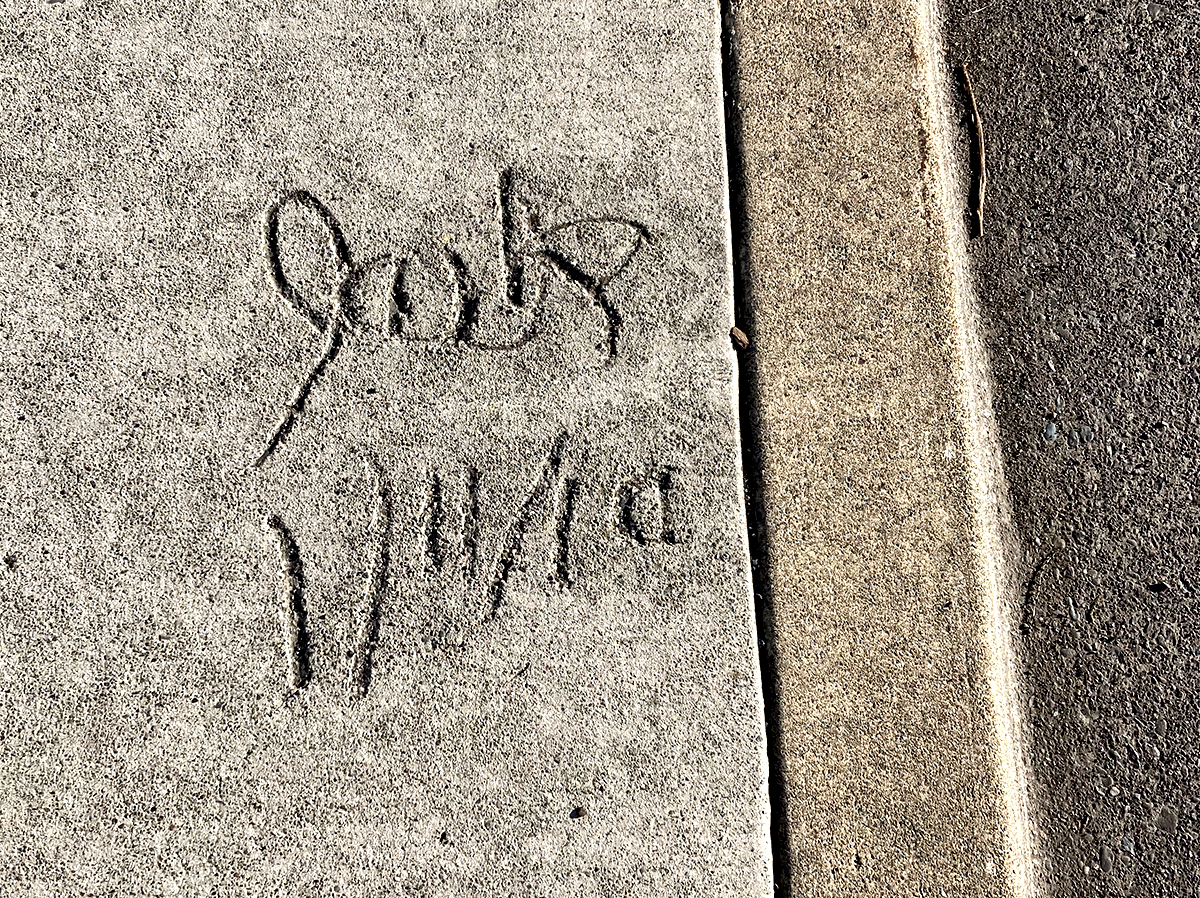
2010 or “20010”. Our first folk marks! It’s an ornate tag that is hard to read.
Jack has helpfully given us the day, month and year. I hope he went on to a career as an archivist.
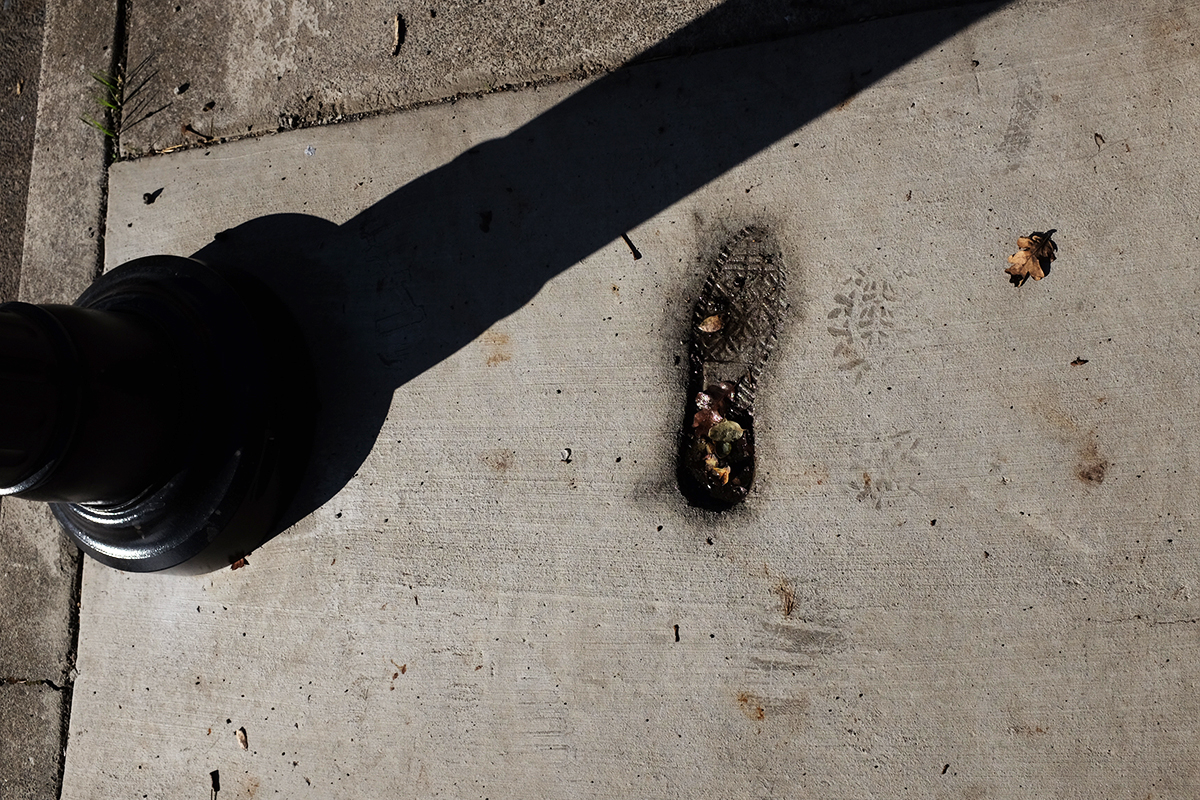
2016. Phase Two. The only actual footprint, gracefully holding leaves and water.
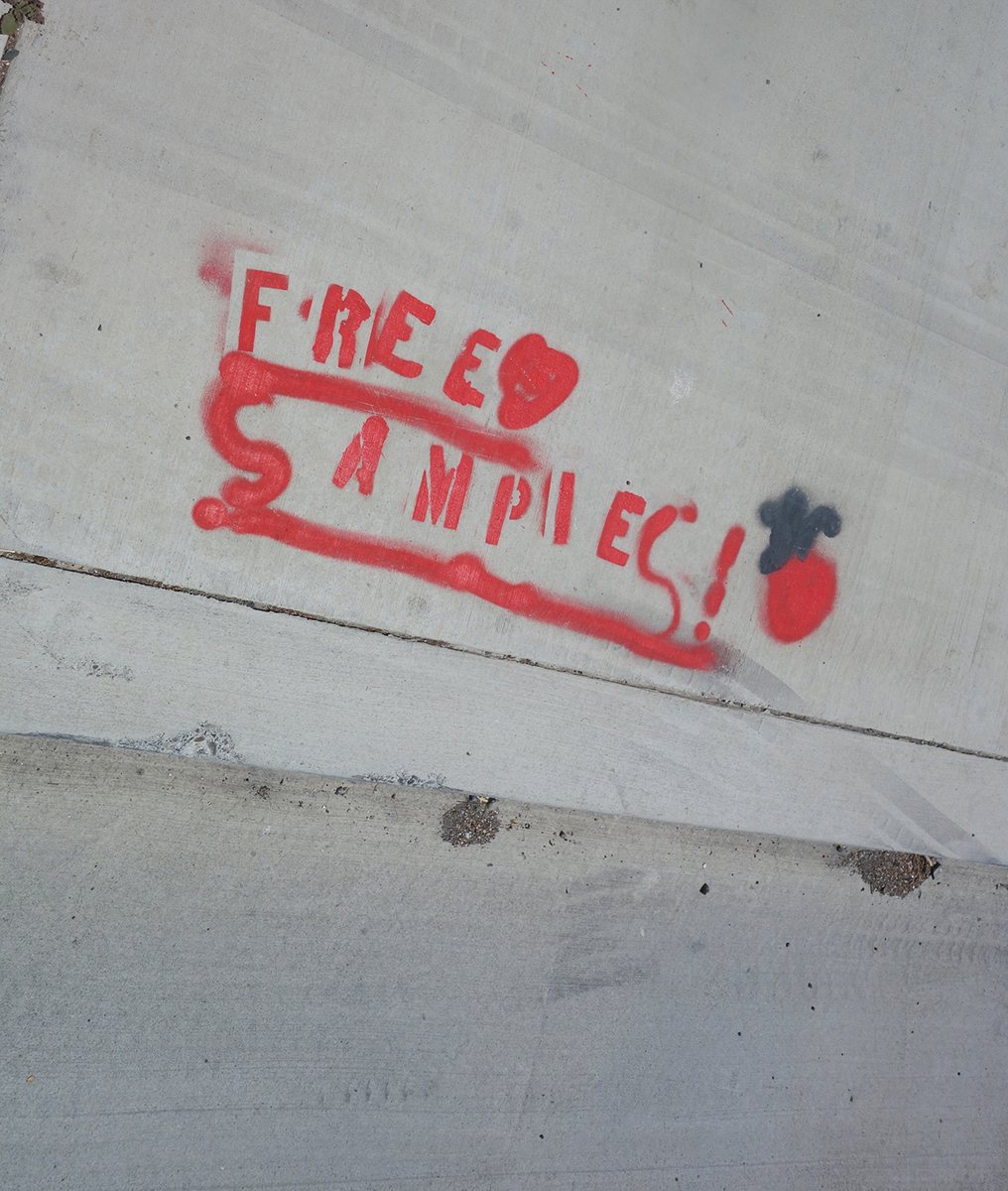
Year of mark unknown, but Phase Two. Someone is trying very hard with the use of a stencil. Is he offering free samples of tagging? Do people pay for tagging?
2019. Right after Phase Two was completed, some corrections that necessitated new concrete were needed. It looks like the left portion of this group of signifying friends was cut off.
In 2021 PGE had some business under the pavement. This tells you all about it, if you could only read it.
2021/ Nobody’s perfect!
2021. This one and the next two offer lush compositions of black and gray featuring inscribed and spray-painted lines and hard and soft textures.
2021. The lines, the colors, the textures, and, the shadows!
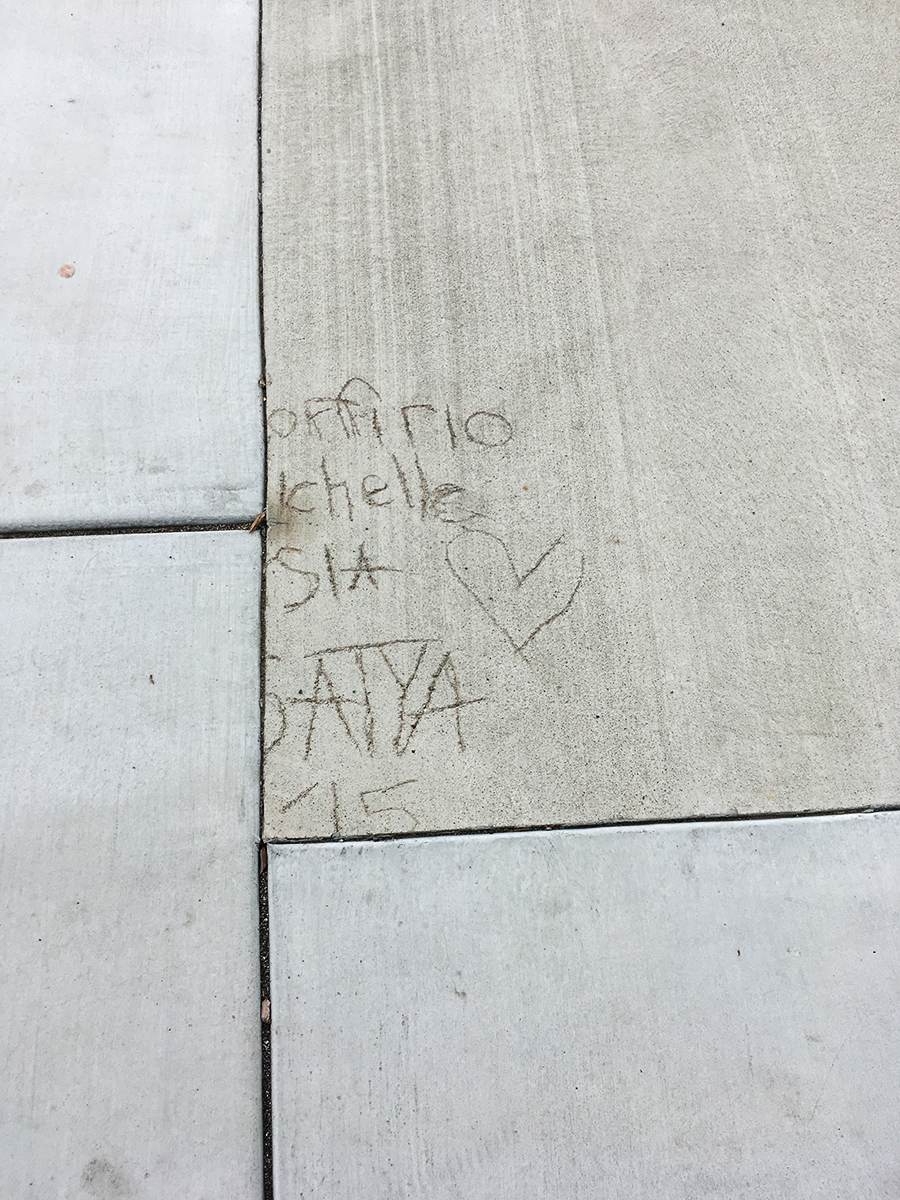
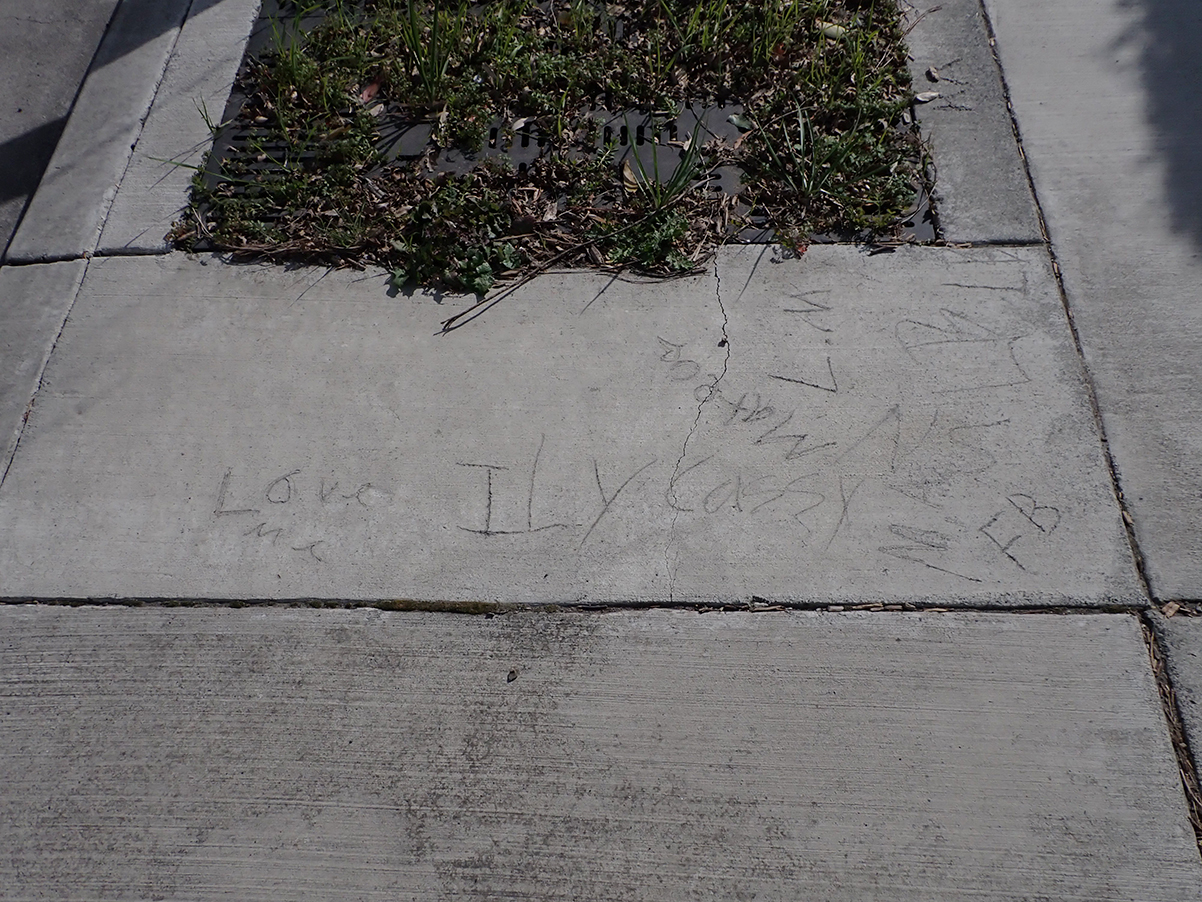
Photographed in 2023, actual date unknown, but Phase Two. “Love me.” “ILY Cazzy.” “Mateo.” “FB, LM”
2021. Dude! Where’s my valves!
A bit off the highway, but such a lovely composition!
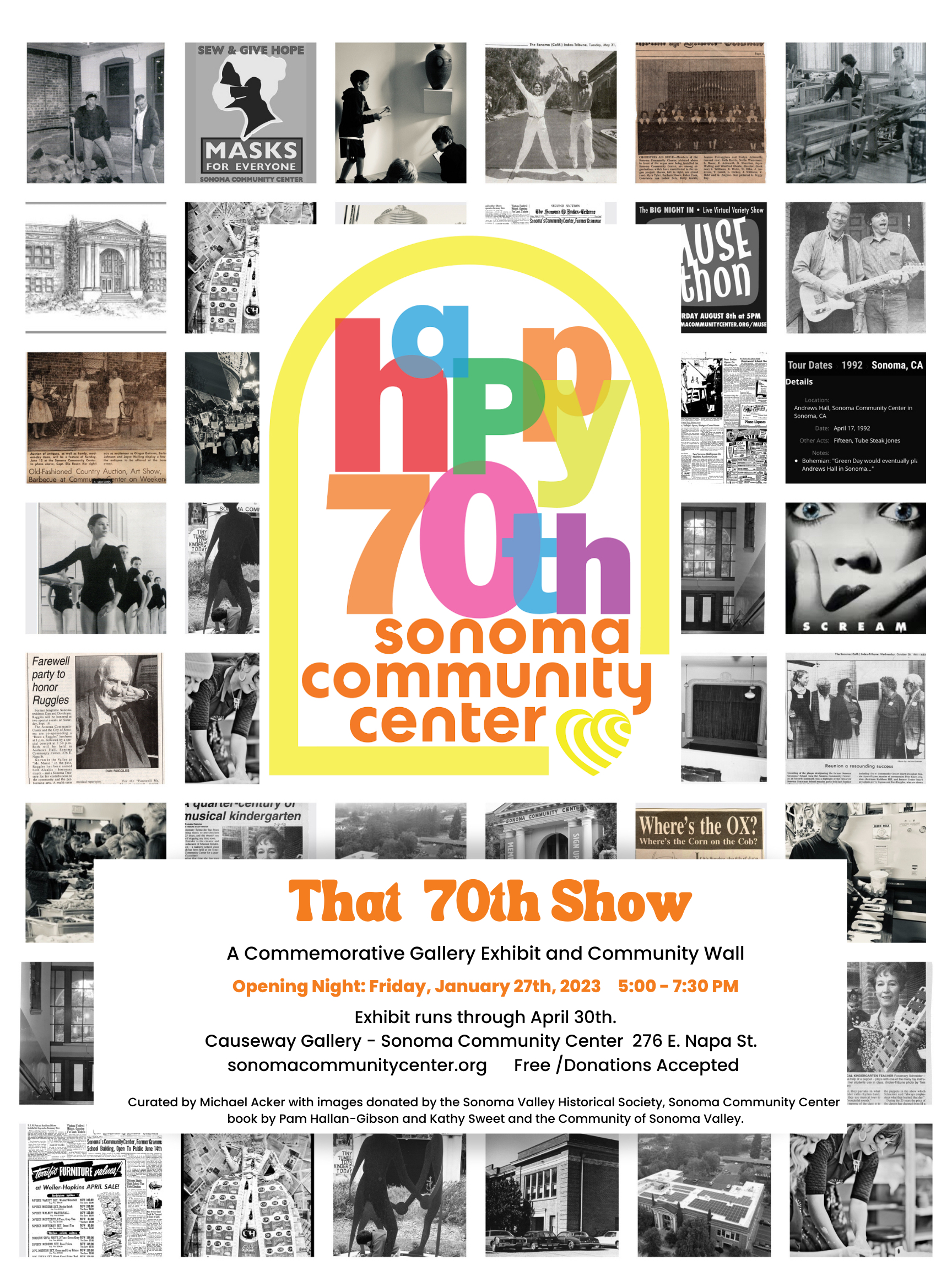
For the past three months we have been working on “That 70th Show,” the celebration of seventy years of Sonoma Community Center history. Viewable through April. And…
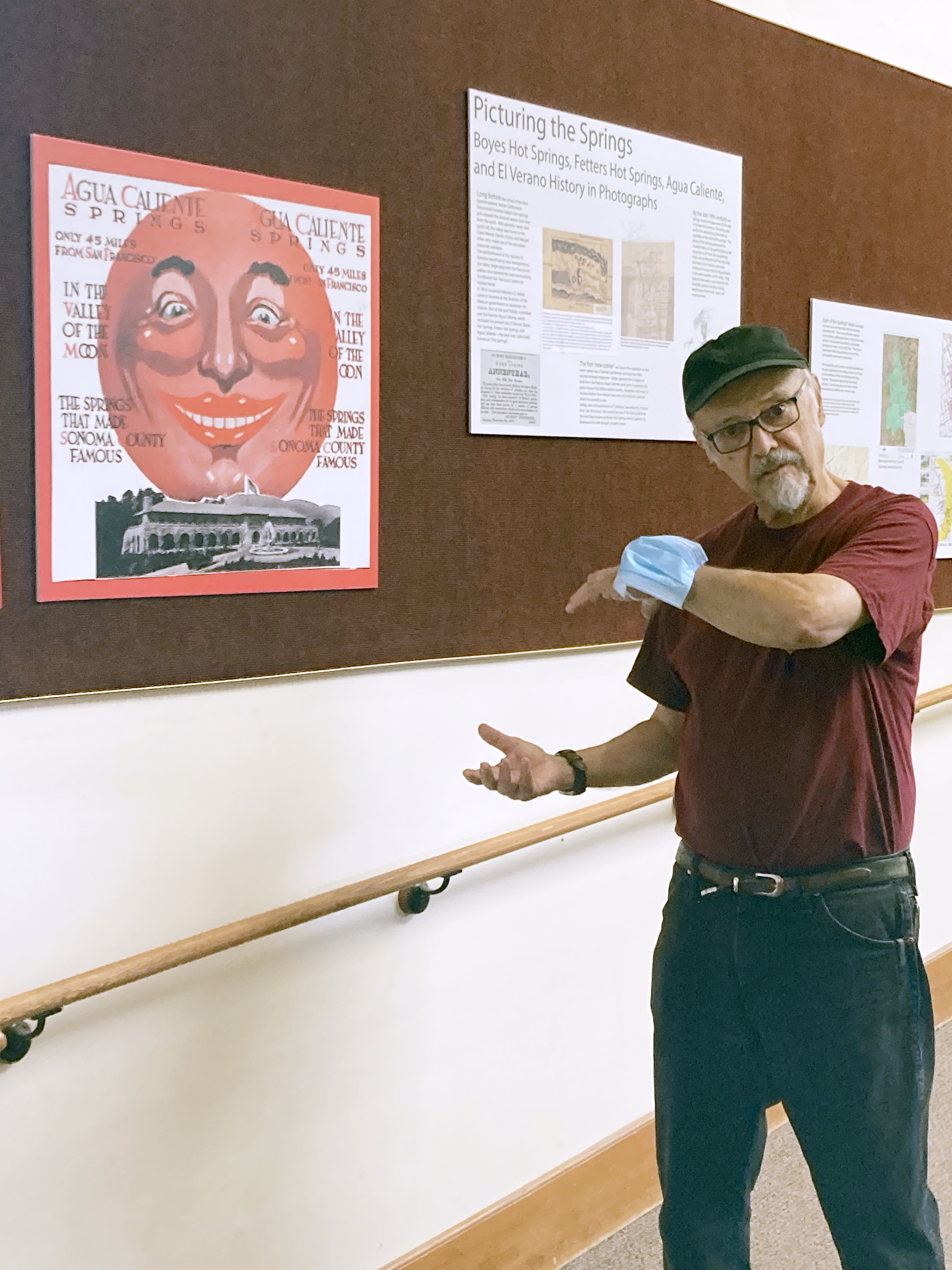
“Picturing the Springs” is going to be up for at least the month of February, maybe longer. Go here to keep up to date with the Sonoma ValleyHistorical Society.
In 1964 a disastrous fire swept through Boyes Hot Springs, destroying many homes.
“ A cluster of five residences at the intersection of Central Ave and Las Lomas was leveled. The Larson home…was one of them.
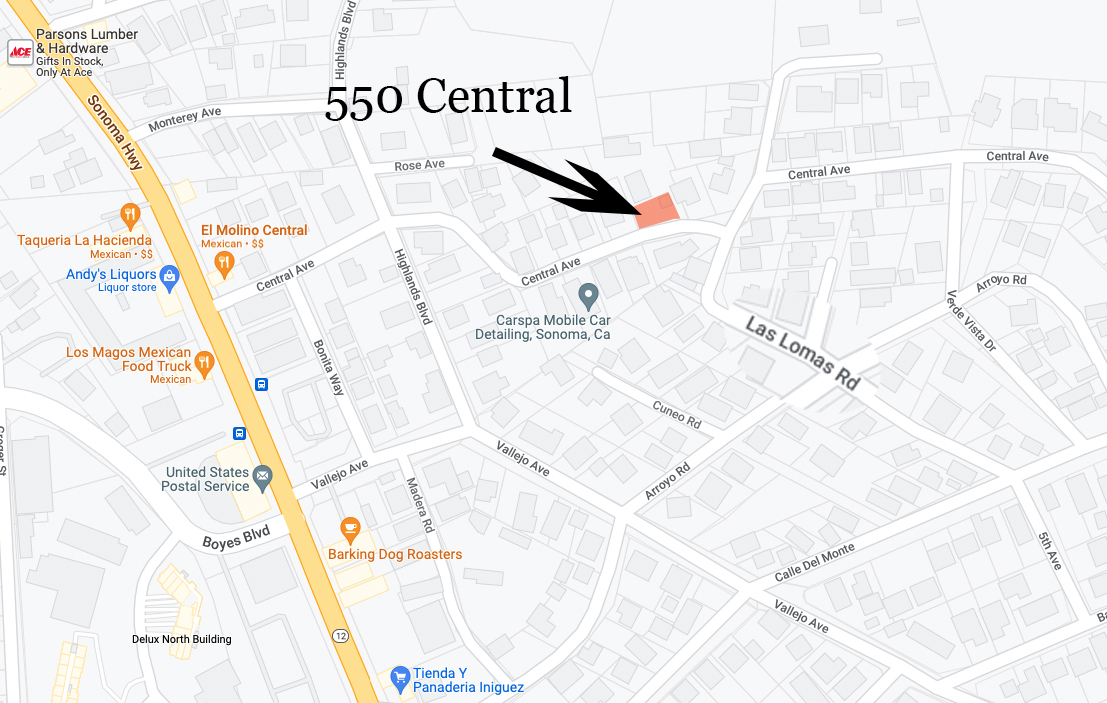
While the Cohn home was leveled, the Tom Codellos house right next to it was untouched. Oddly enough, the home of Mr. Cordellos’ grandmother, several blocks away at 550 Central Avenue in Boyes Springs, was also saved, while the ones next to it were destroyed.”Sept. 24, 1964 Index Tribune.
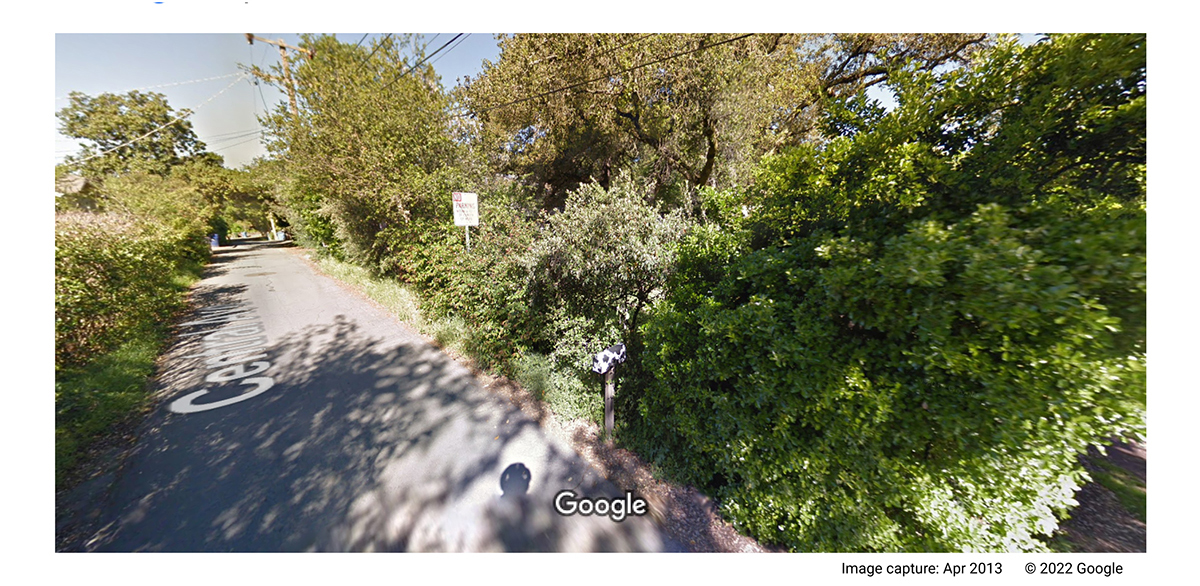
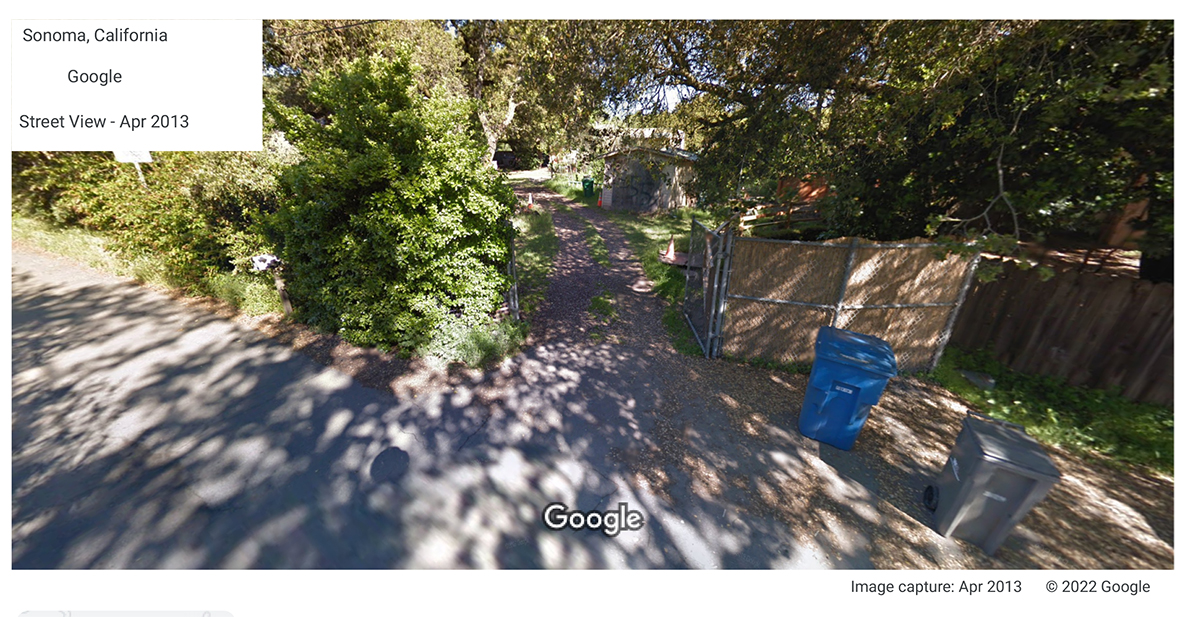
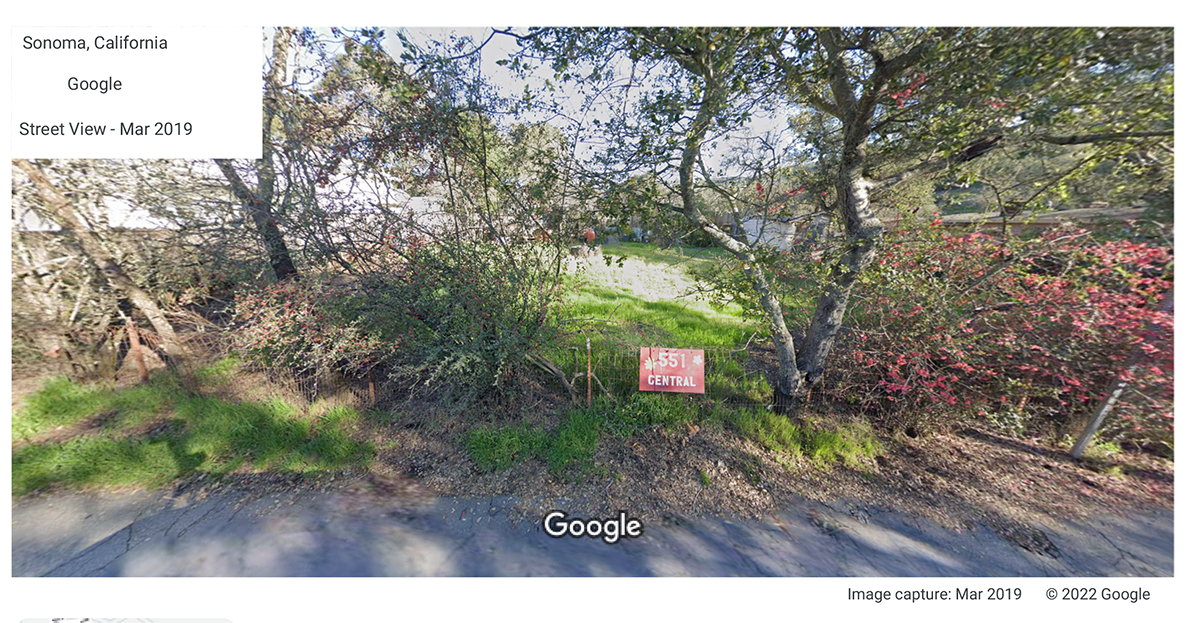
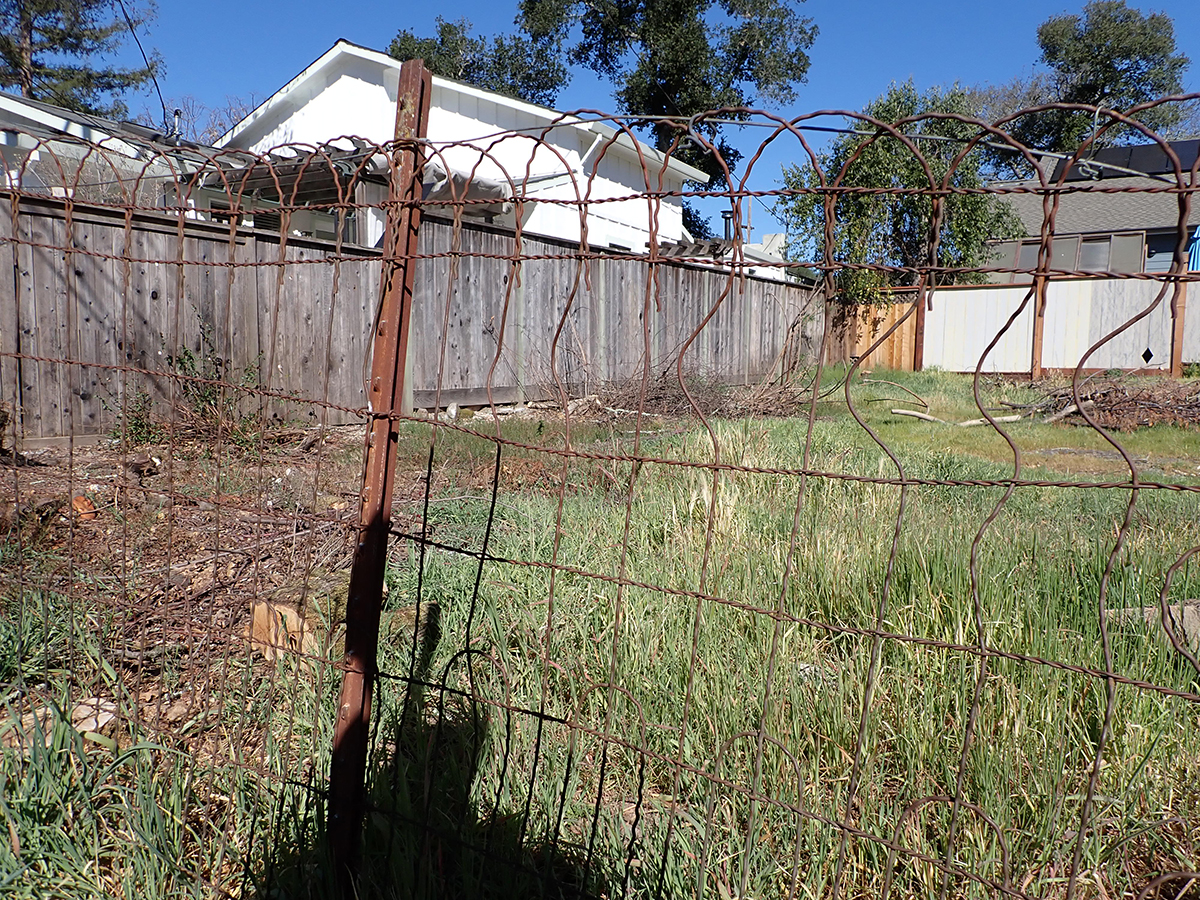
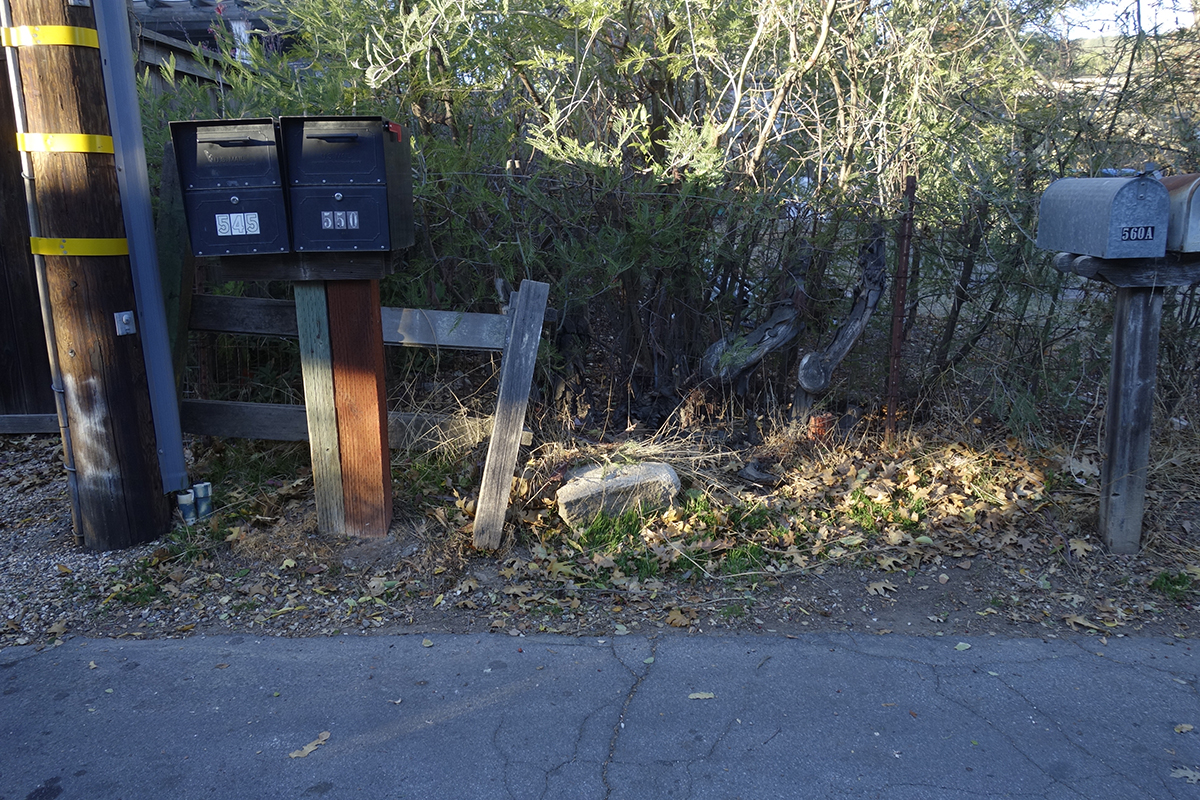
This was across the street from our lot, apparently, although the normal logic of addresses, odd one side, even the other, often does not apply in Boyes.
2013
2013
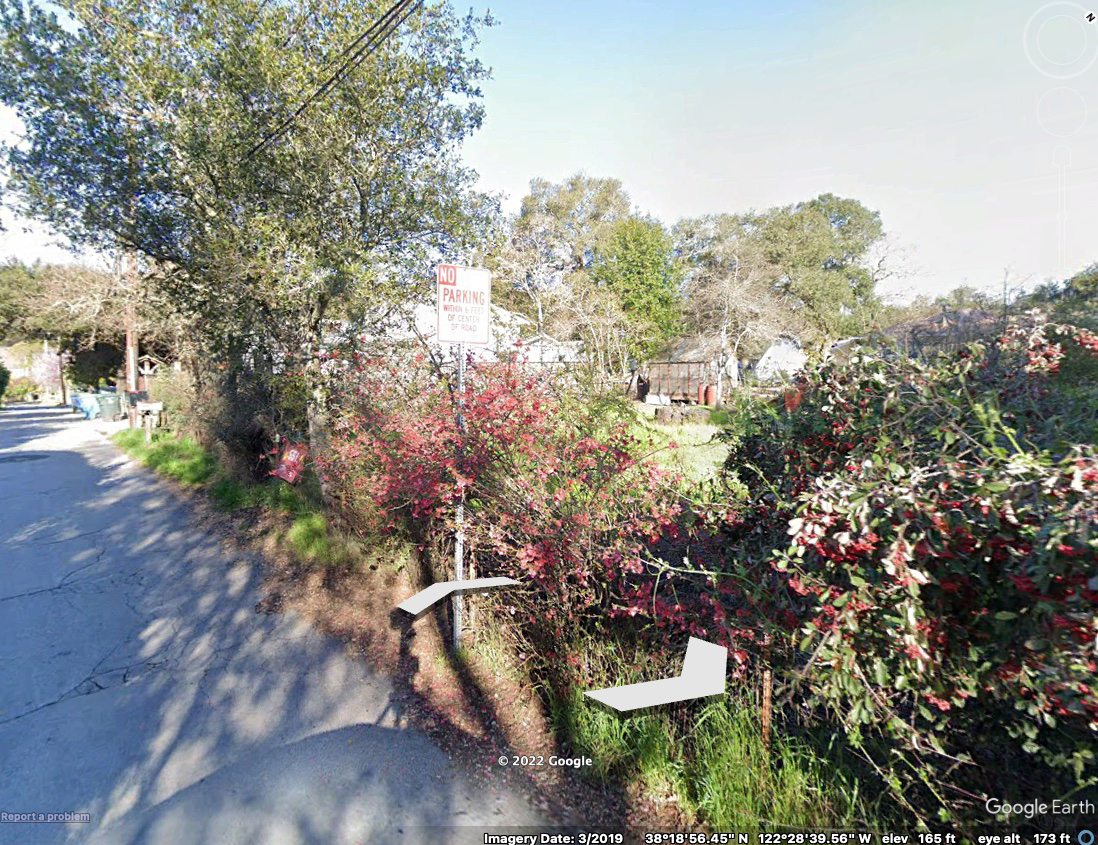
March 2019 showing a nice growth of quince, which always blooms at Lunar New Year.
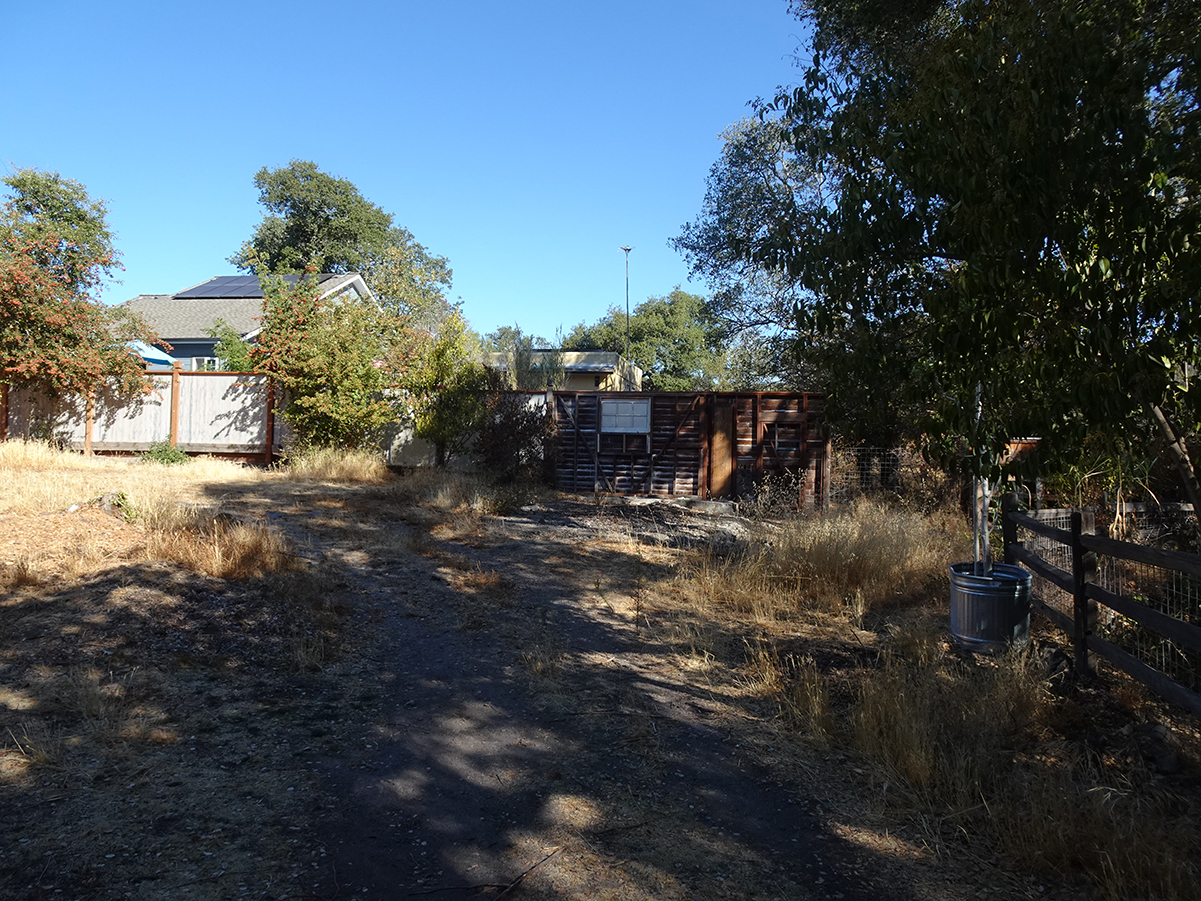
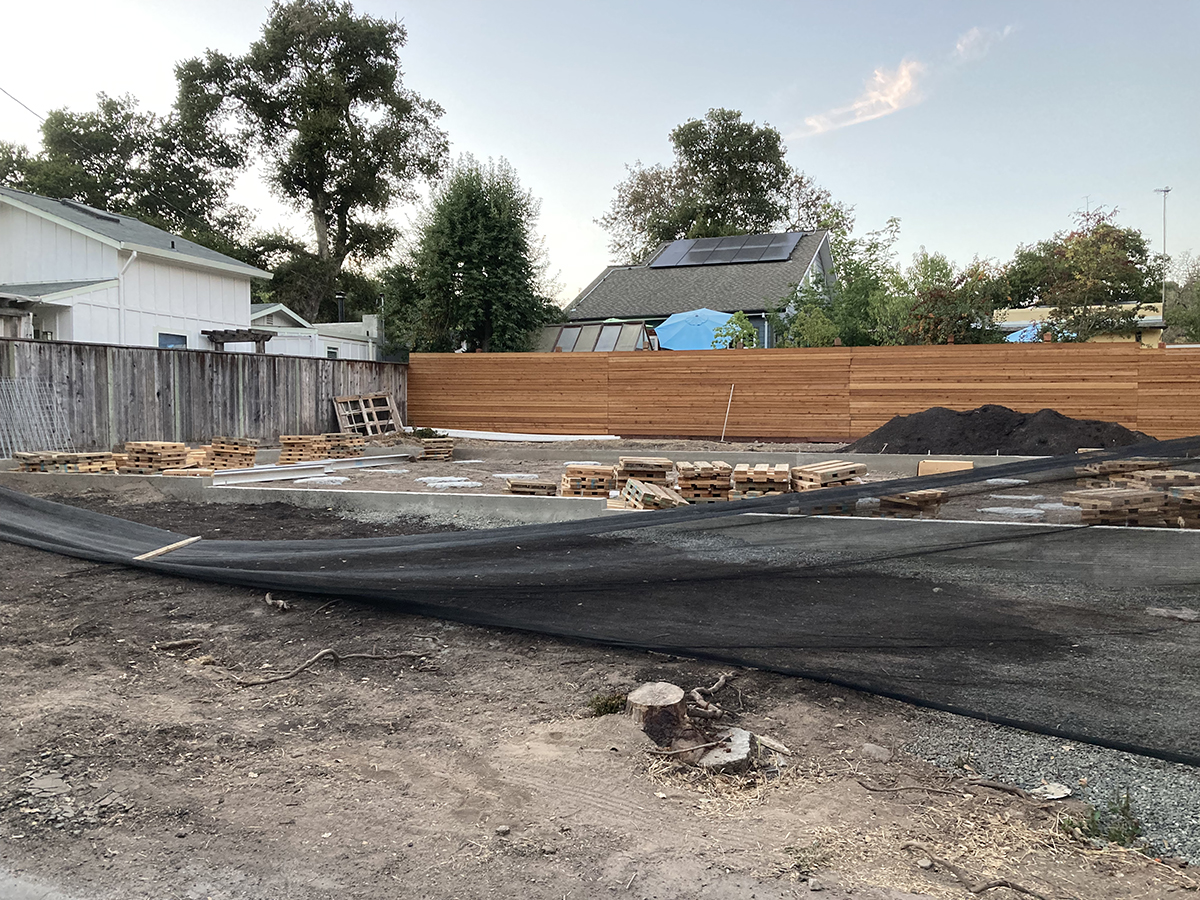
The lot remained without a house (I don’t like to say “vacant” because it was home to plants and animals and the occasional human) until mid 2022, when clearing started and a foundation was built.
2022
The fence at back was built before the foundation. The setbacks for this house are the minimum.
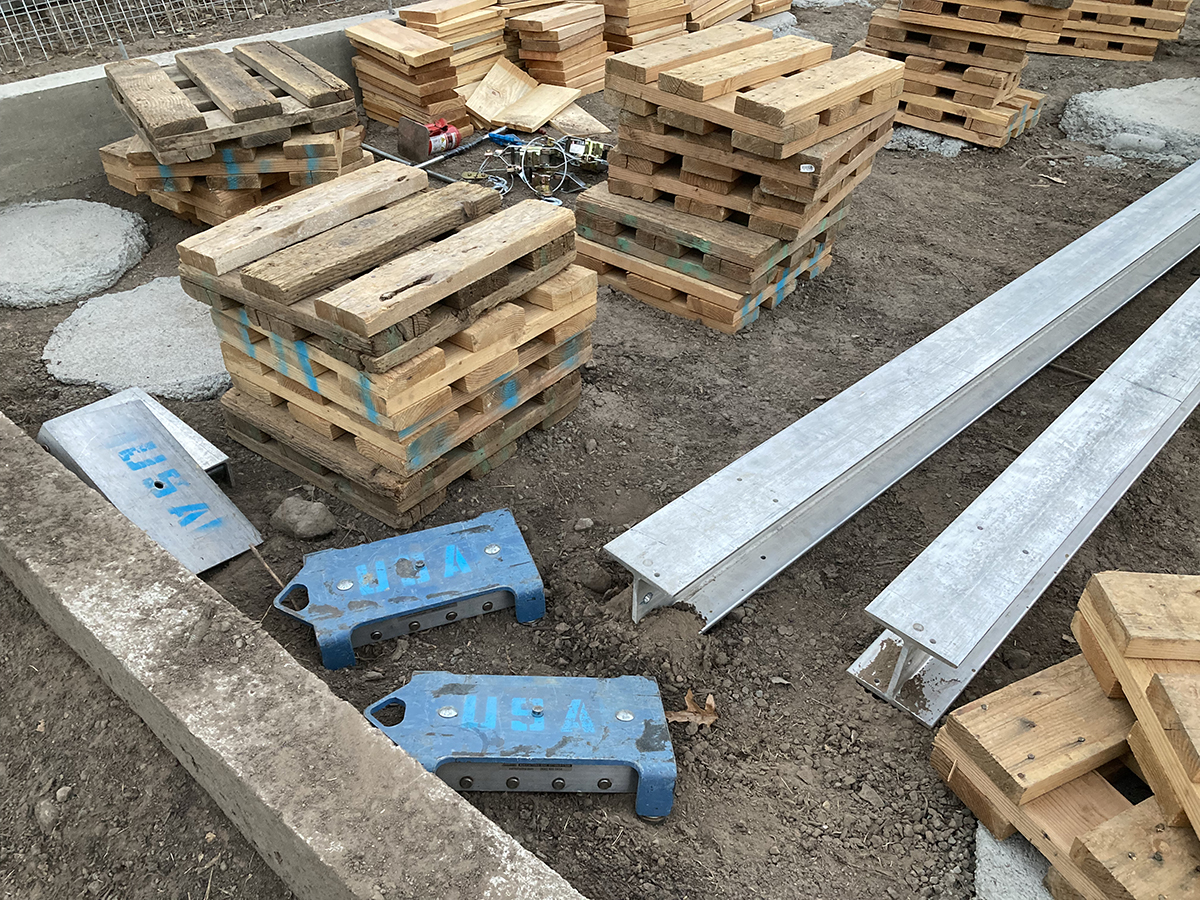
2022-The house mover’s implements.
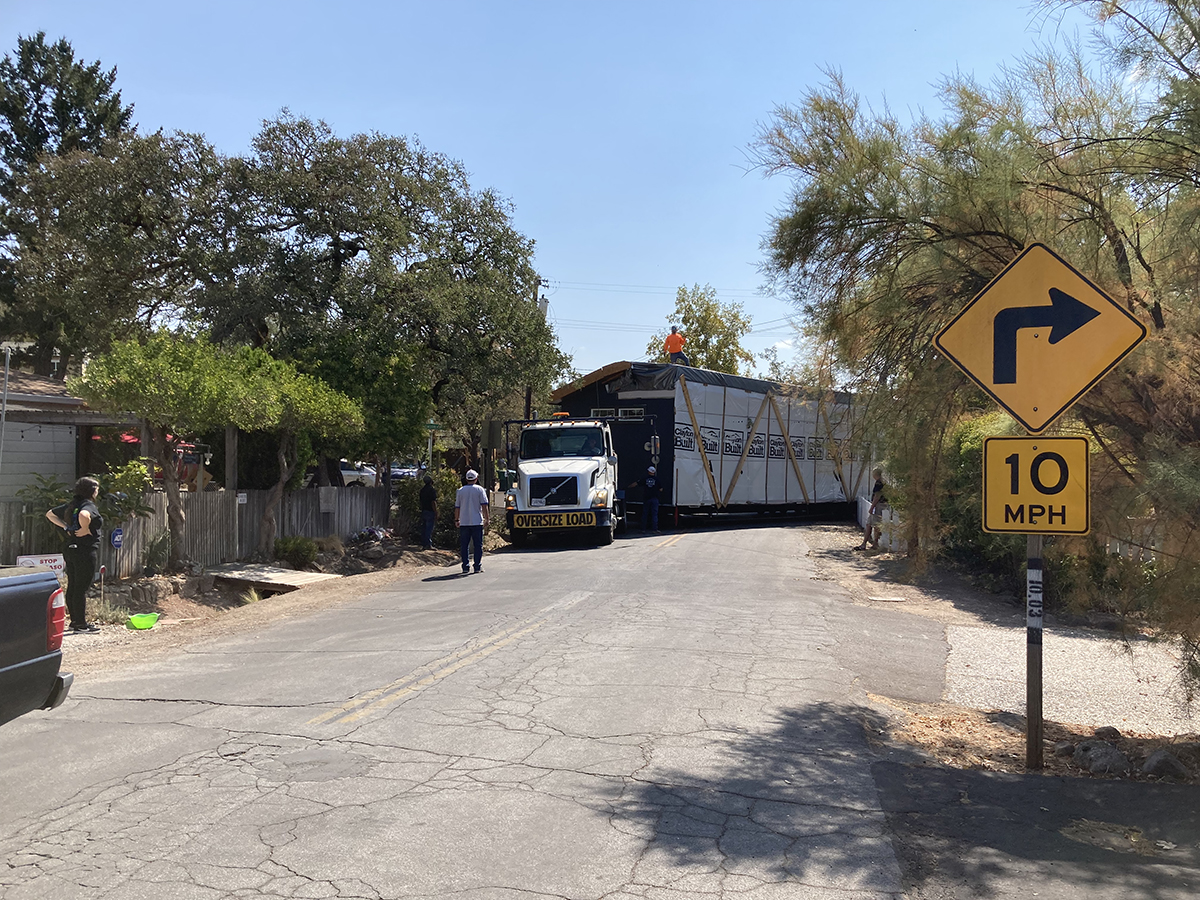
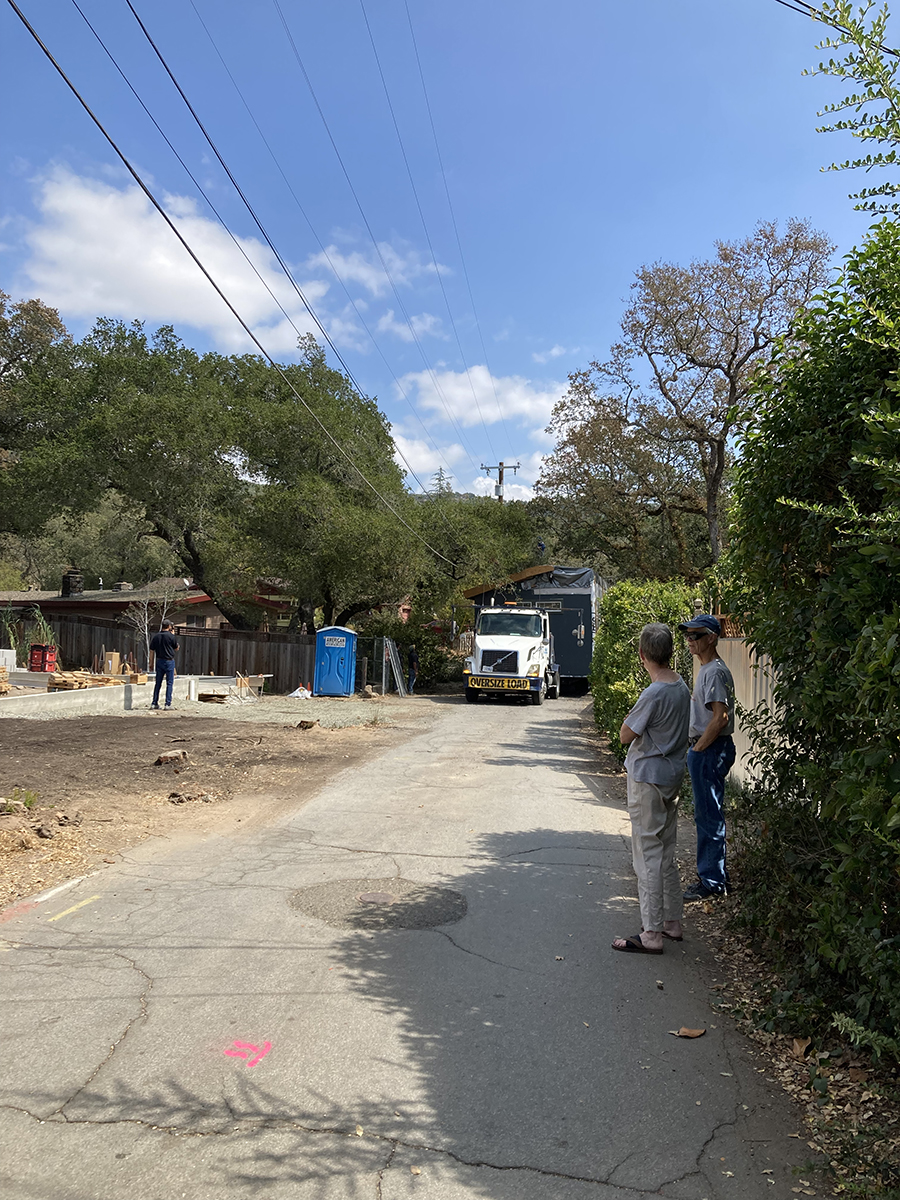
One day in September 2022, we heard the cry, “There’s a house a-comin.” And indeed there was. (Apparently manufactured houses are cheaper than ground-up construction, though not actually cheap; and the time required to get permissions from the County is still onerous.) Many were skeptical the huge, wheeled vehicle could make it down the narrow streets and around the tight corners of the area the fire department calls “the Maze.” Progress was very slow and the crew had to prune trees as they went along.
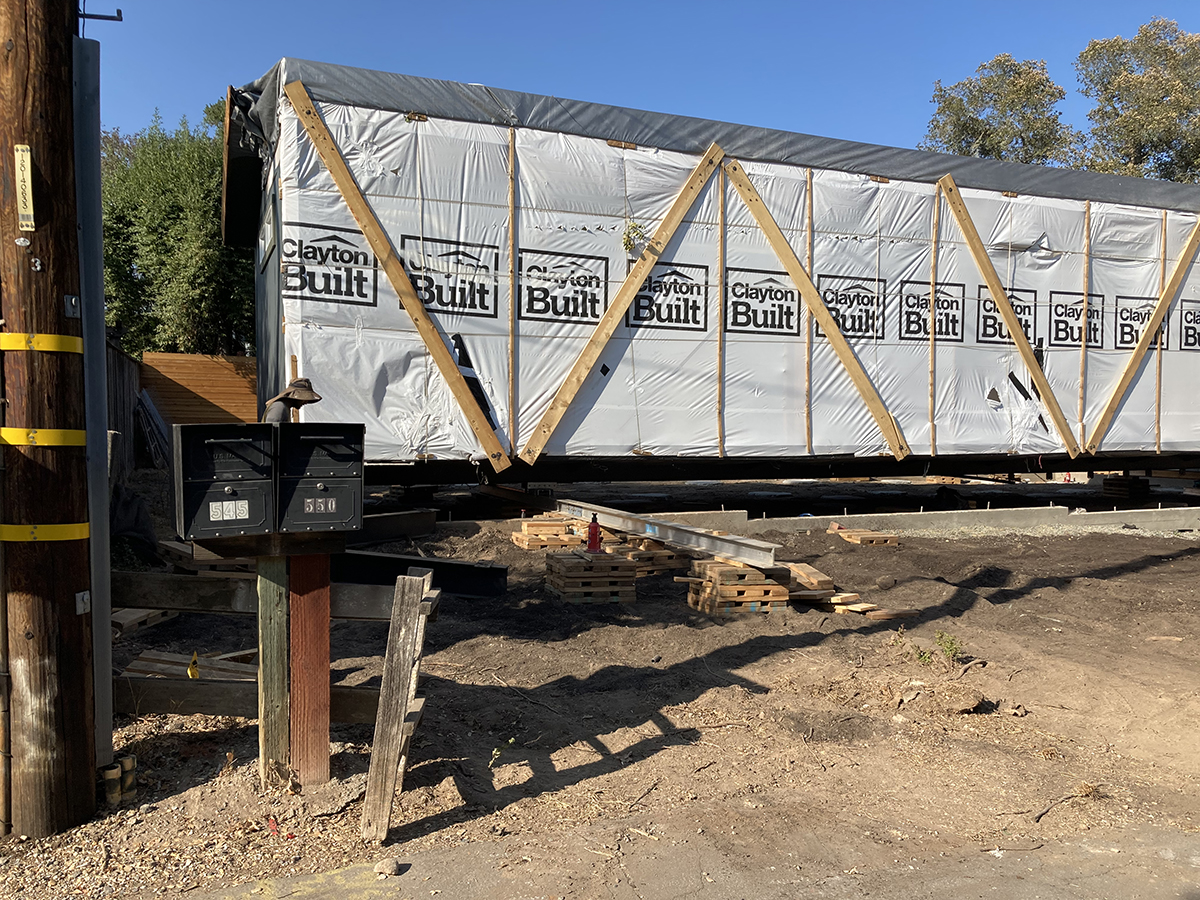
Of course, this is only one half of the building. They delivered and got the sections in position in one day.
Almost there.
The old (2019)…
and the new.
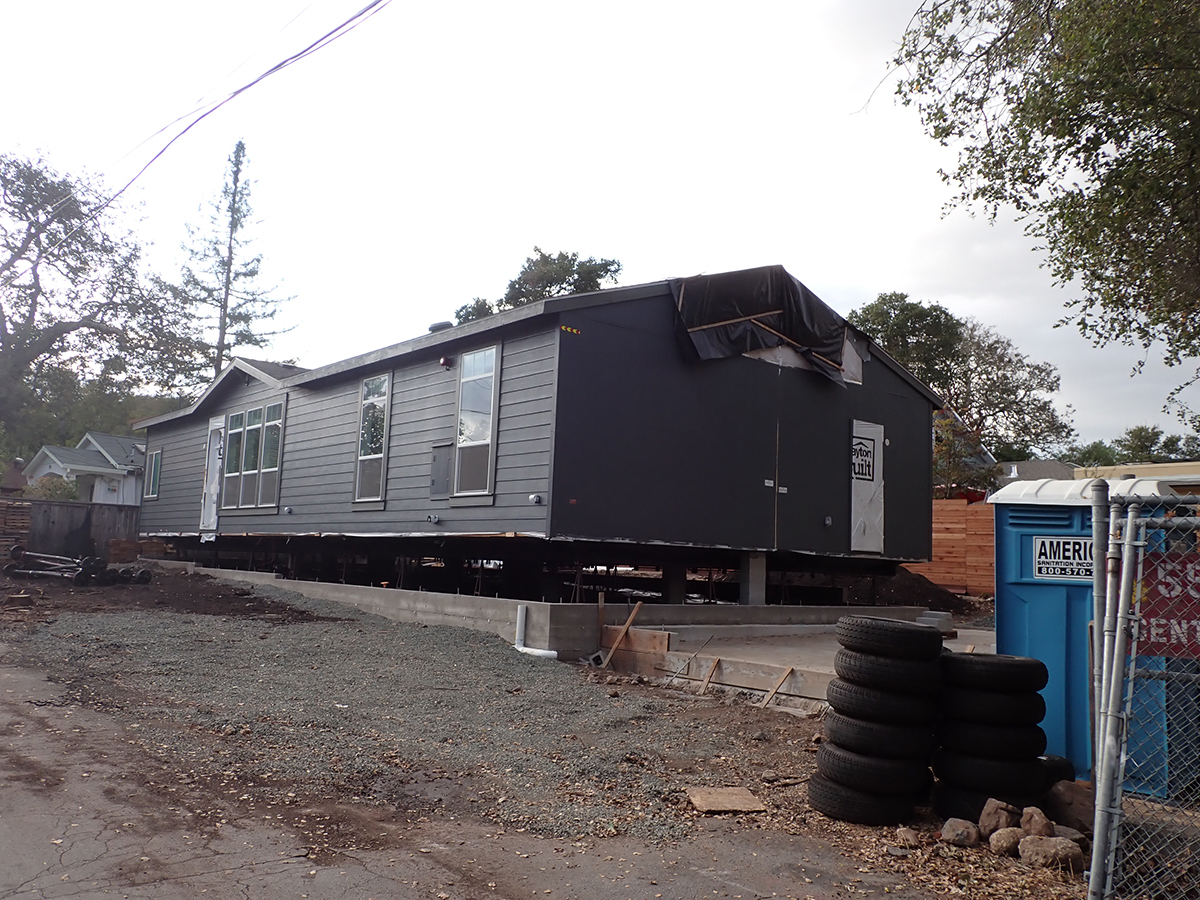
House is home at last. Now for the foundation framing, front porch, and everything else.
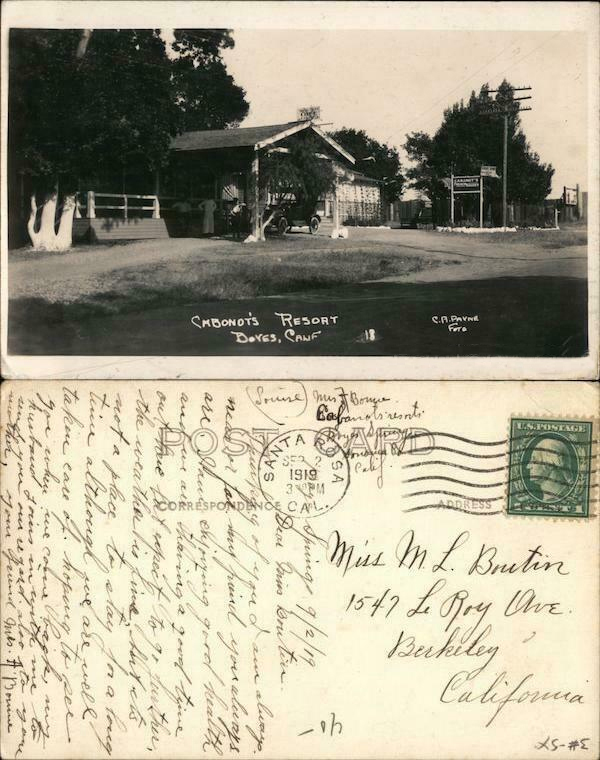
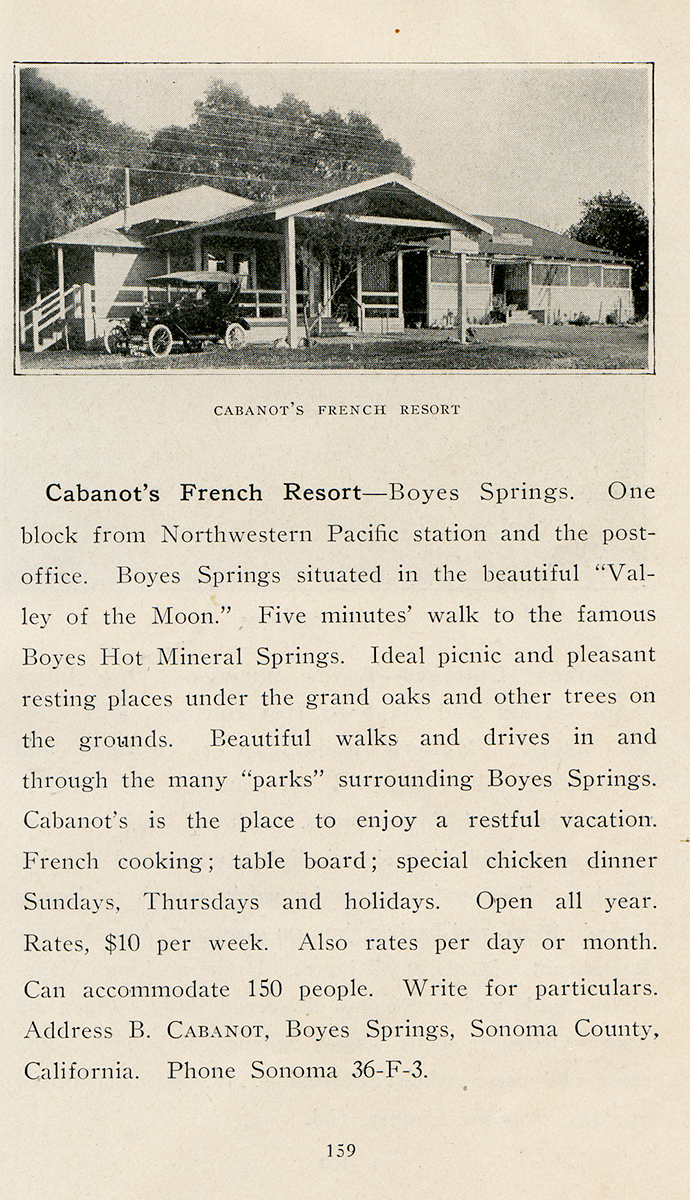
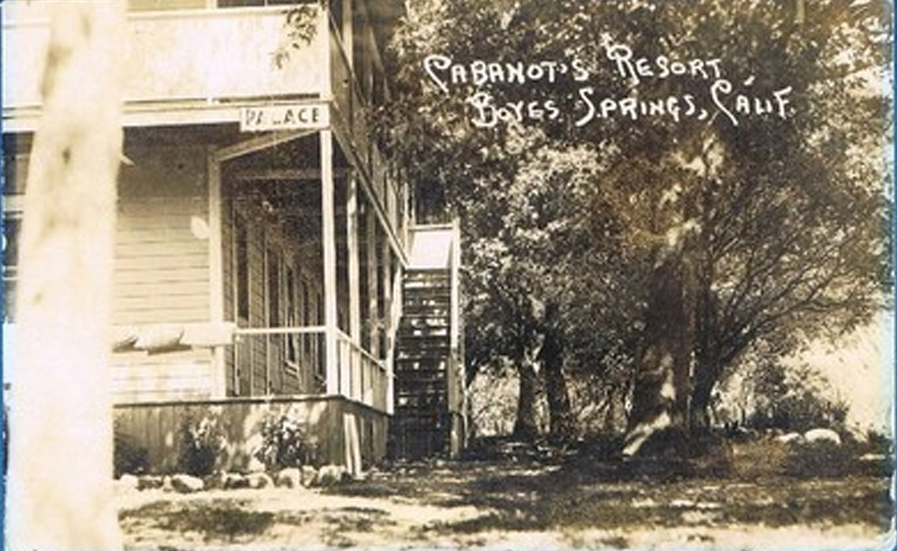
Bernard Cabanot was born in France in 1861 and came to the US in 1876. He lived and worked in San Francisco and Redwood City until 1914, when he came to Boyes Hot Springs and opened his French Resort. (There was another French Resort operated by the Dutil , Lounibos and Verdier families in El Verano. Please see: https://springsmuseum.org/2020/12/13/dutil-french-cottages-verdiers/)
“One block from the Northwestern Pacific station and the post office,” refers to the P.O. located at the Woodleaf Store.
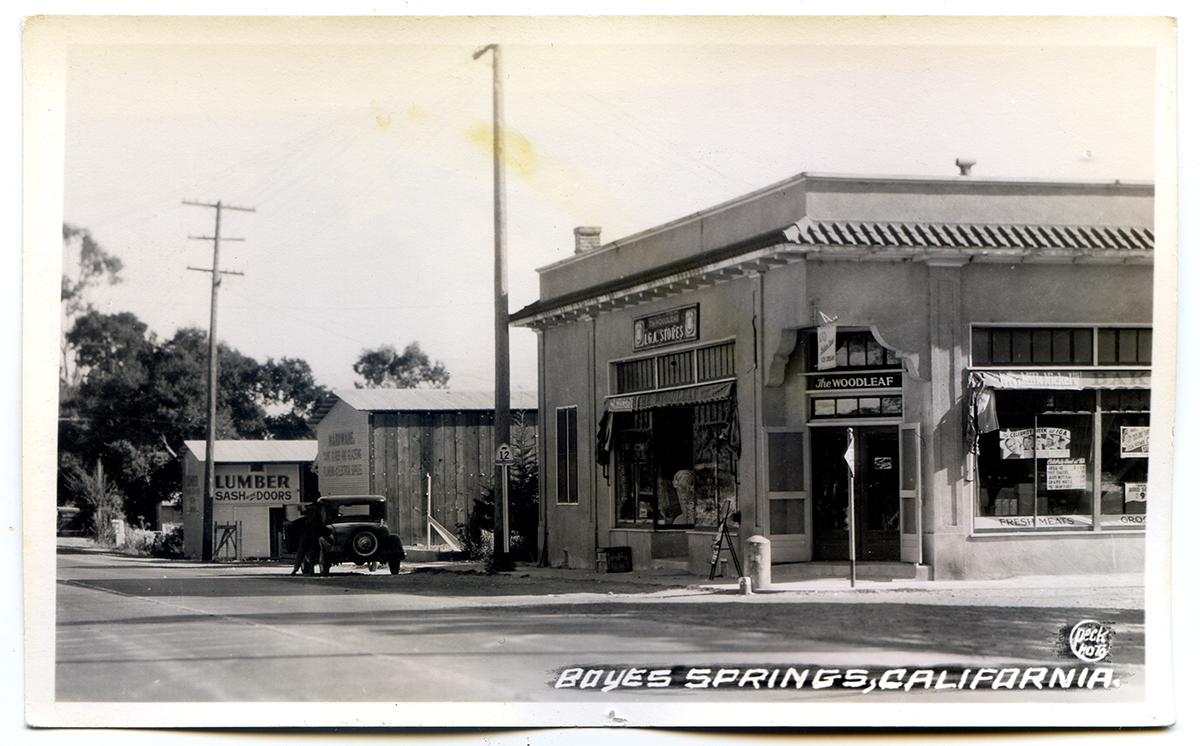
He built several buildings in Boyes, including the Woodleaf Store, which was constructed in 1921 and rebuilt after the 1923 fire.
Woodleaf Store, Boyes Blvd. and Sonoma Highway, 1930s. This building still stands, part of the Sonoma Mission Inn.
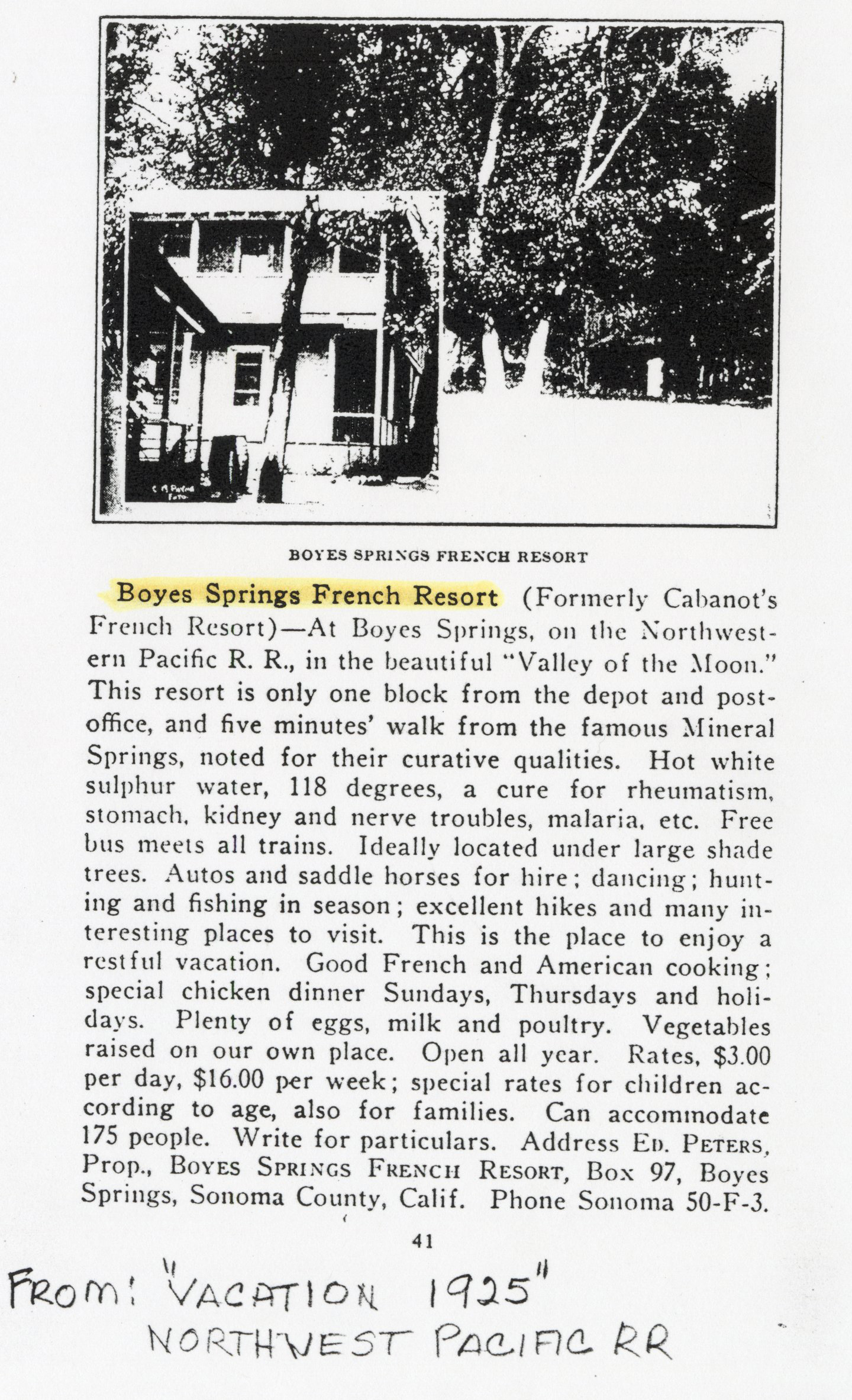
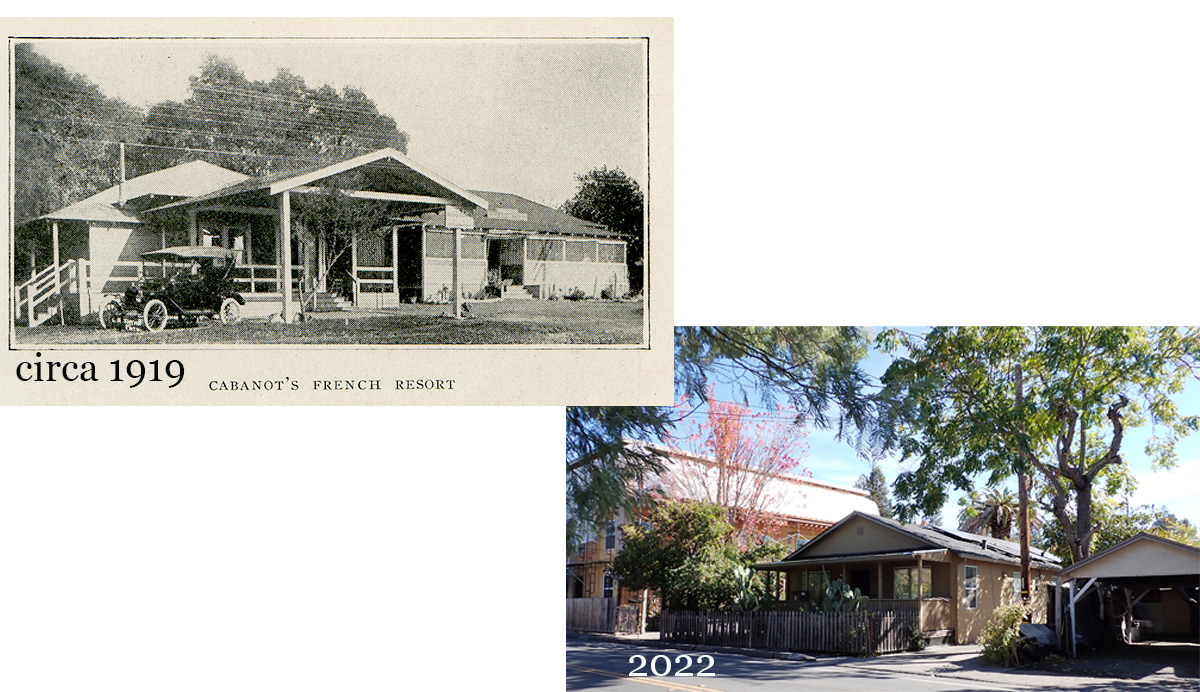
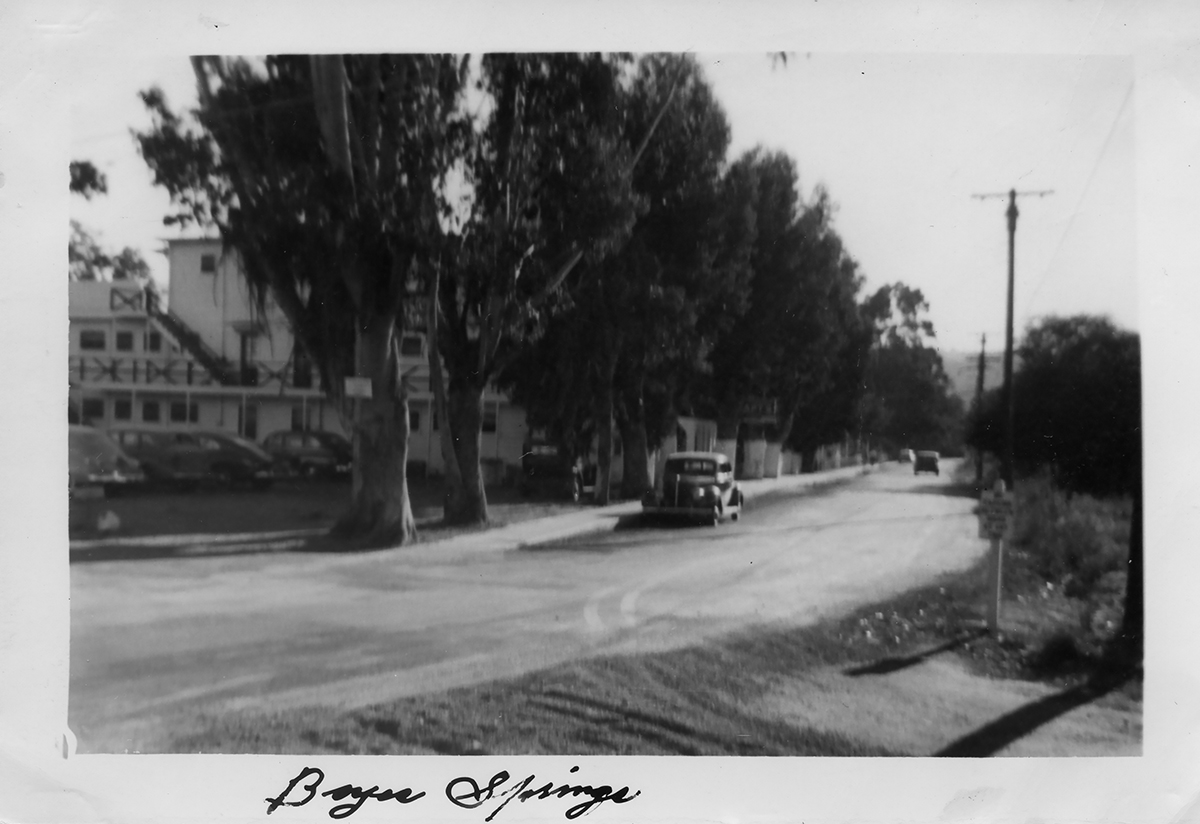
We have images of two different buildings for the resort. The oldest ones are of pleasant one-story bungalows, dated 1919 (first two images). The second building is two stories and dates from 1925 (above).
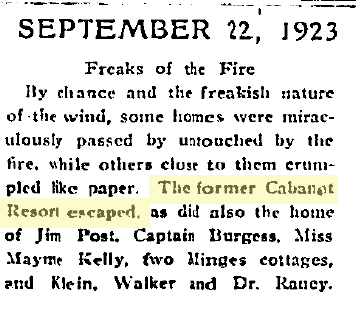
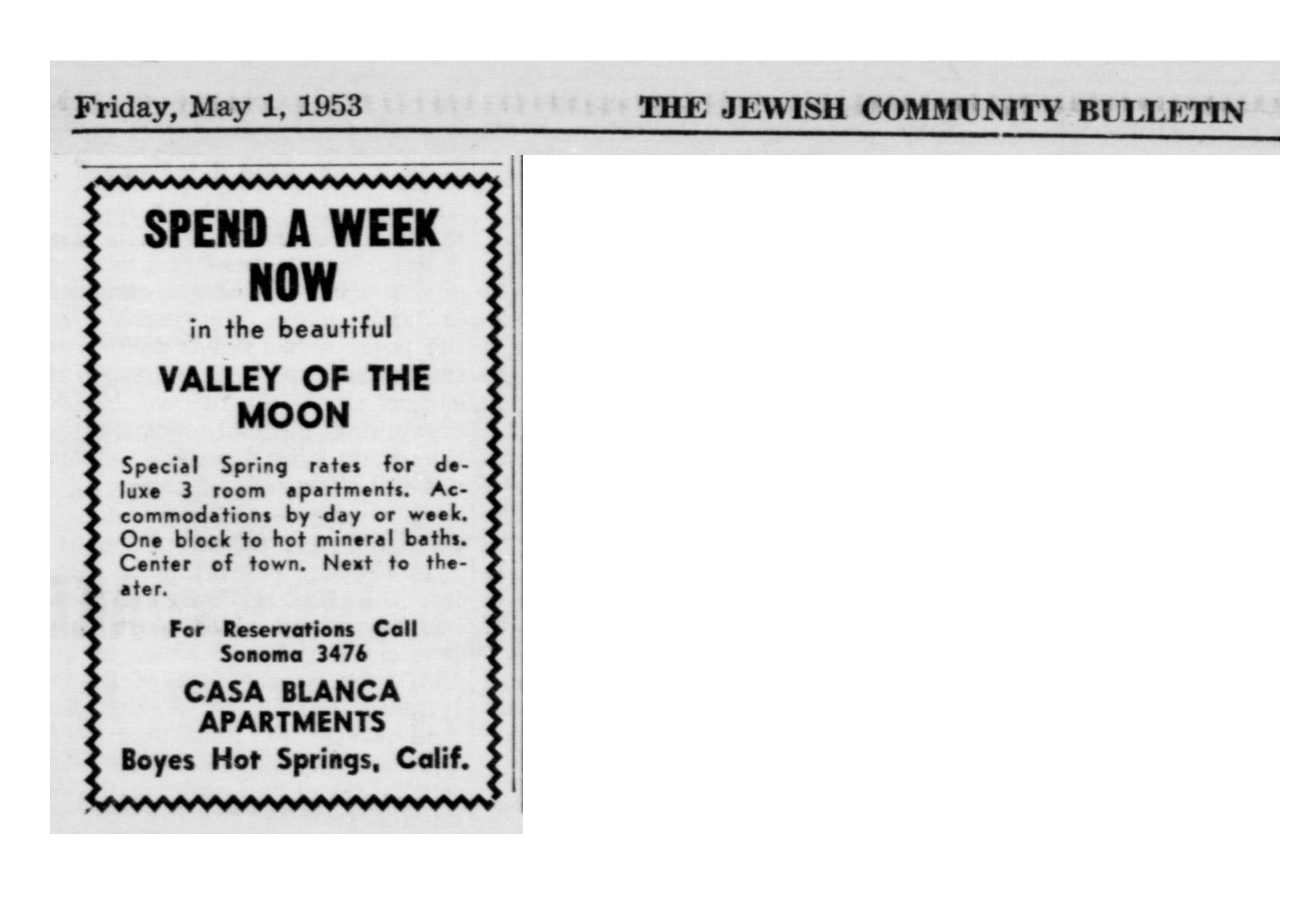
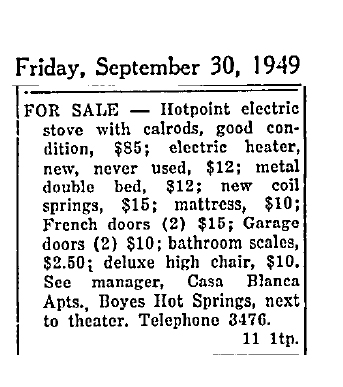
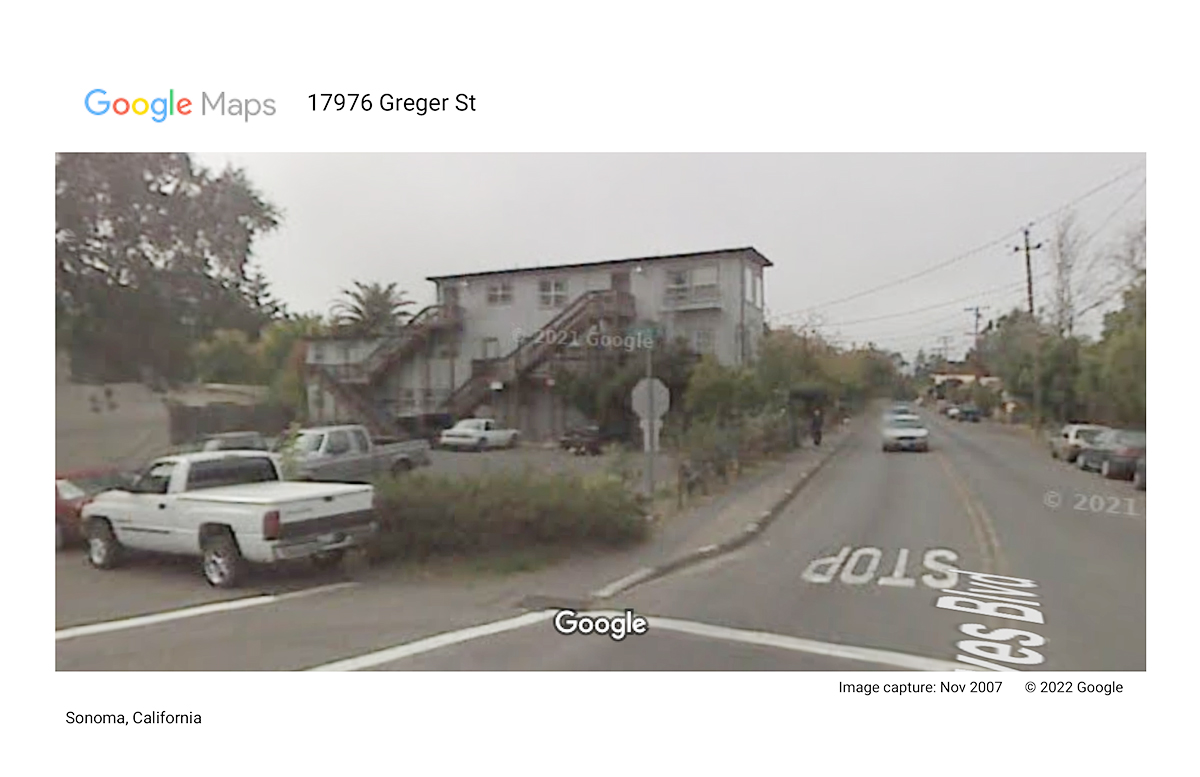
According to the Index Tribune, Cabanot’s Resort was not destroyed by the great fire of 1923 so it’s possible the larger building was built along side of the smaller ones. Both places are described in ads as being “next to the theater,” which was at the corner of Boyes Blvd. and Gregor Street, where the apartment building is today.
The original Cabanot’s?Index Tribune
The two story became the Casa Blanca Apartments, by which name it is still known today (2022).
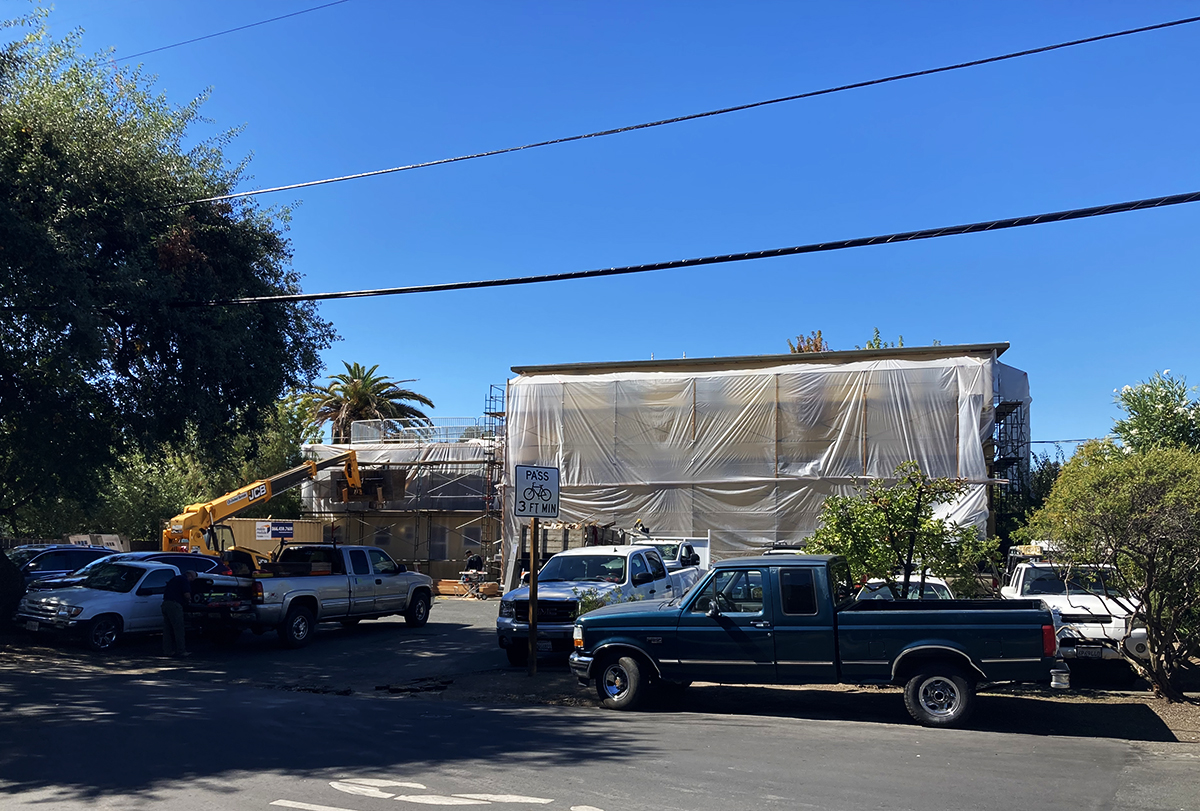
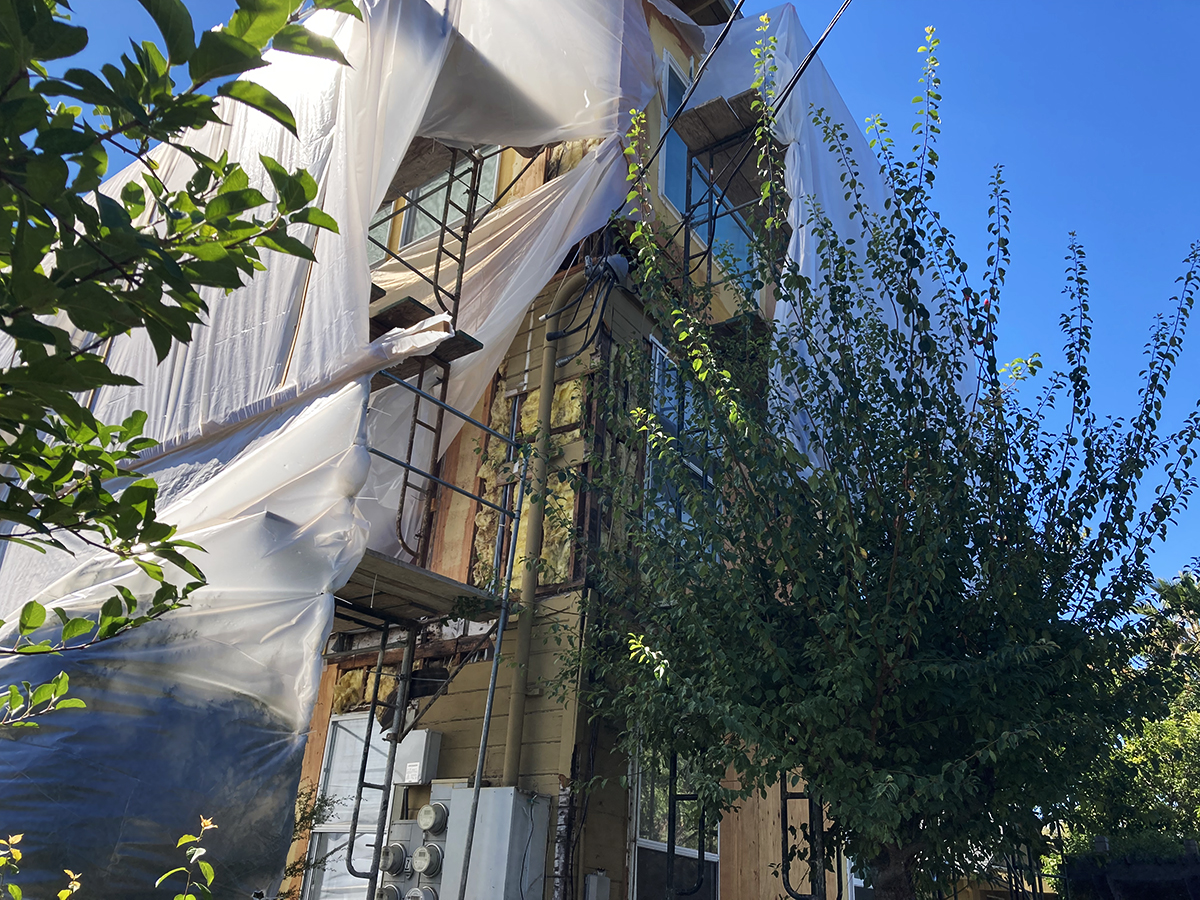
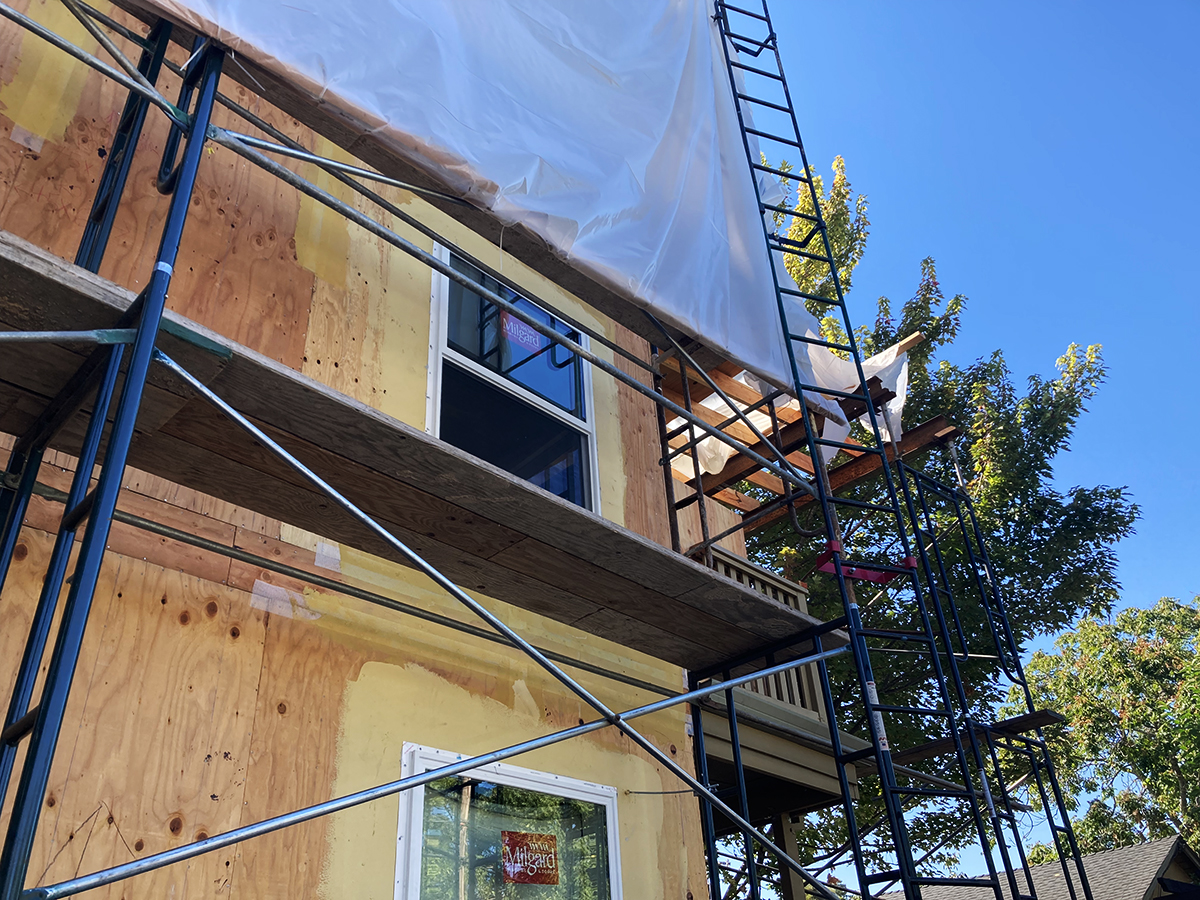
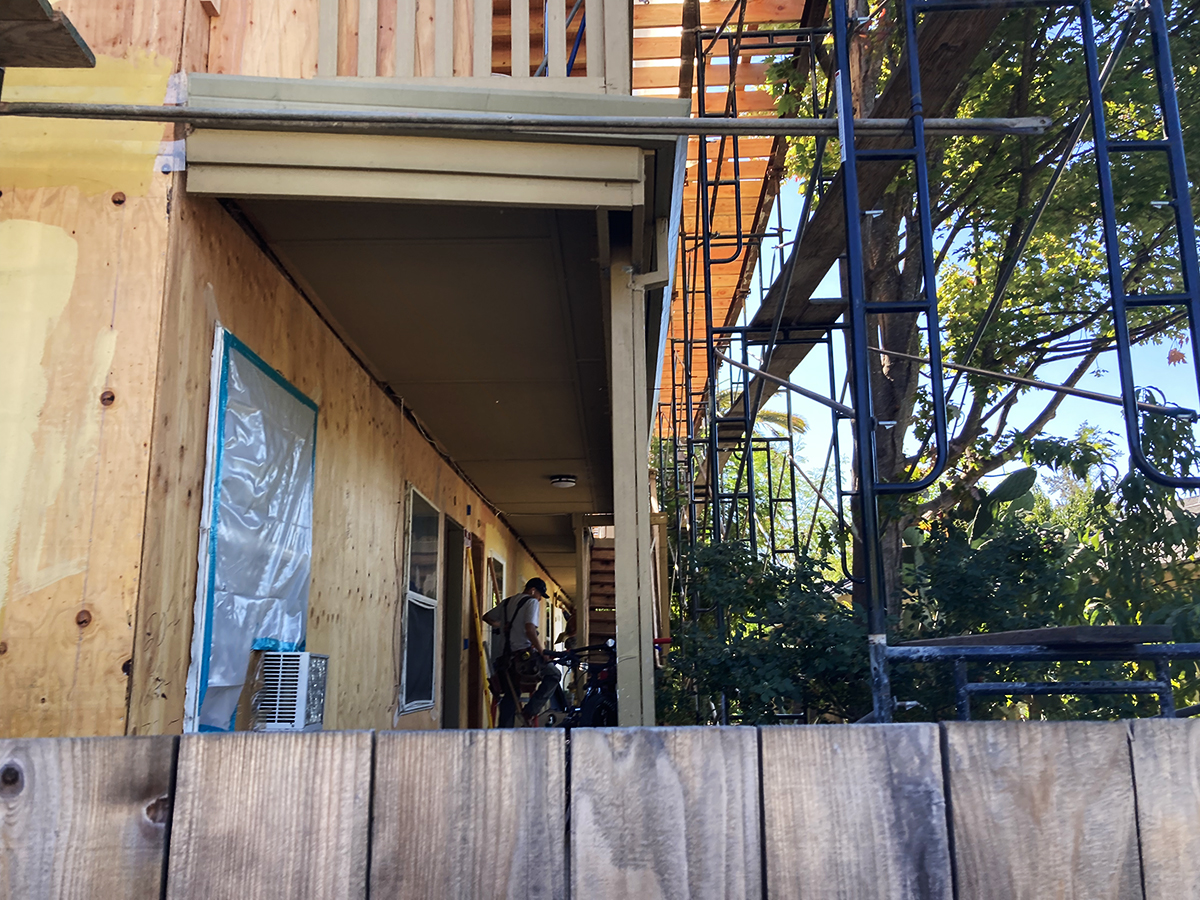
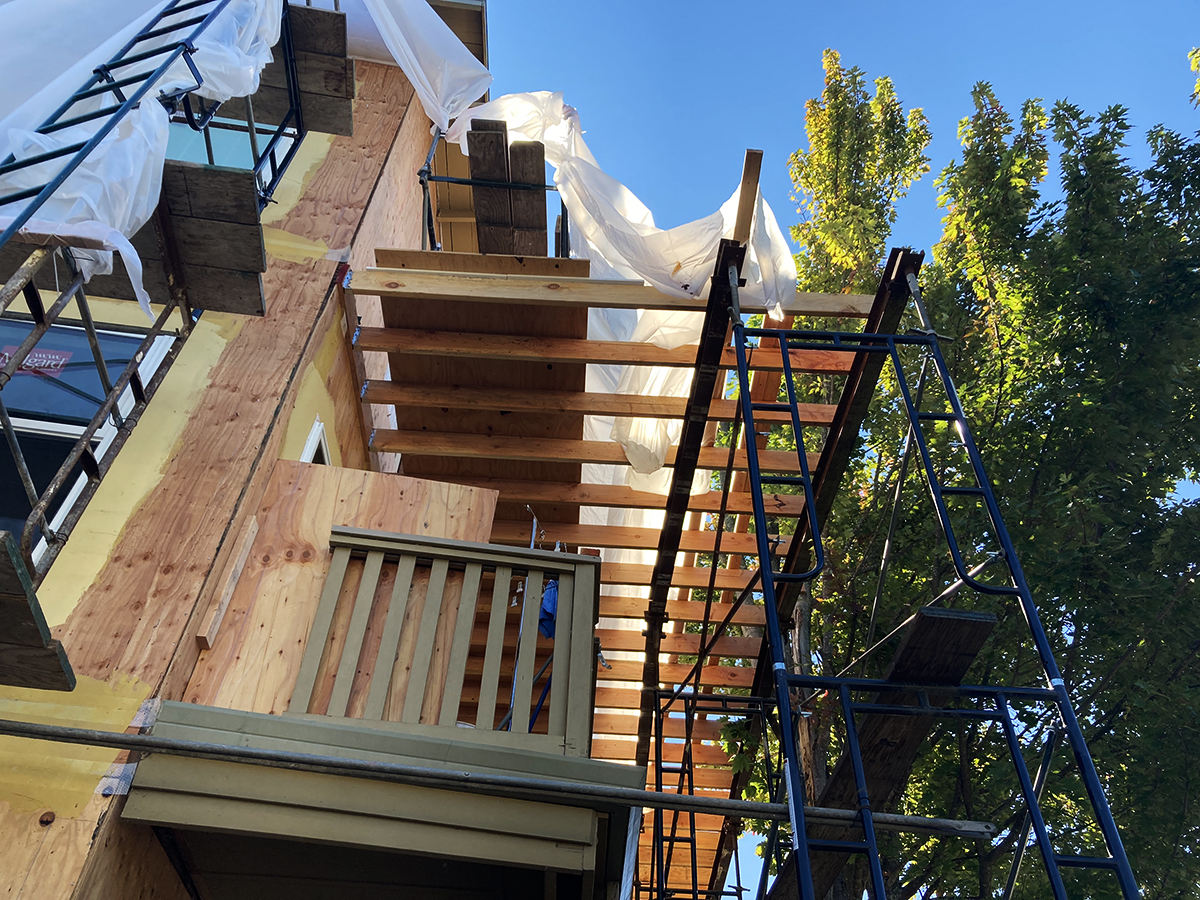
As of September 2022, major repairs were taking place. All the exterior siding was removed, plywood was applied as earthquake bracing, and new doors and window were being fitted. Not historic preservation but perseverance. With several nearby historic buildings being bulldozed recently, we will take what we can get.
Under Construction 2022
Thanks to Lorrie Baetge Fulton of the Sonoma Valley Historical Society for research help, and to the Gordon Lindberg Collection of the Sonoma Valley Historical Society, who also provided the Index Tribune material.




 springs museum