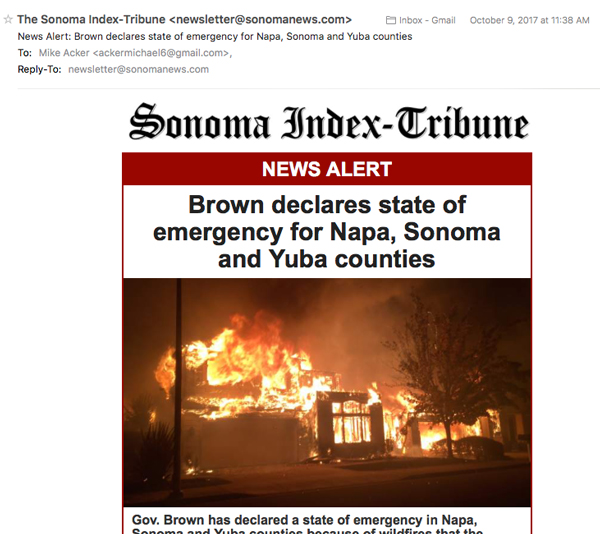
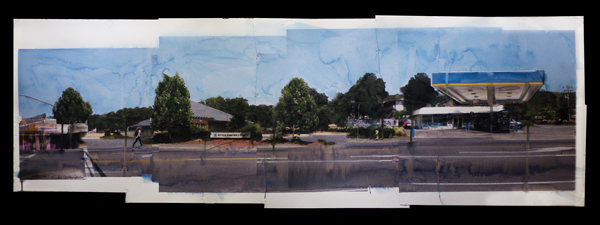
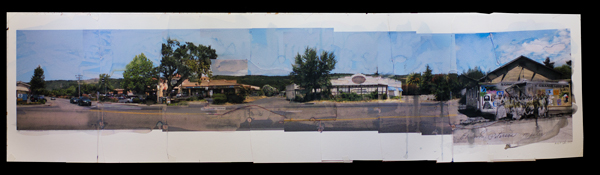
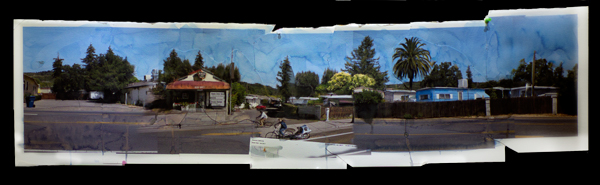
A chronological sampling of e-media from the first two days of the fires. Please open the pdf.
Caution: may trigger post traumatic stress symptoms!
A chronological sampling of e-media from the first two days of the fires. Please open the pdf.
Caution: may trigger post traumatic stress symptoms!
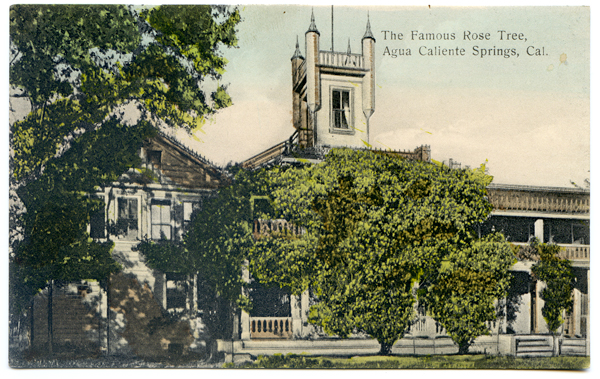
Thanks to the diligent work of Roy Tennant and Mike Acker, 78 images of Sonoma Valley by Alexander Stark have been digitized and are availalble online at https://searchworks.stanford.edu/?f%5Bcollection%5D%5B%5D=9157694
Some are well known, and some not.
We thank archivist Franz Kunst and the rest of the staff at Special Collections for their kind assitance.
For more about Zan, read Frank Sternad’s wonderful article Stark for the San Francisco Post Card Club newsletter: ZanMonograph
In Sonoma Valley, as in many parts of California, fire is an important part of the environment. Before European settlement, the inhabitants of the area used fire as a tool of landscape management. In fact, what the early Spanish and American colonizers saw as an unaltered wilderness had been shaped and husbanded by humans for millennia, using fire and many other methods.
“At the time of Euro-American contact, California was more densely populated than any area of equal size in North America, north of central Mexico. Long before Europeans mapped the region, California’s tallest mountain peaks, its largest lakes, longest rivers, and its oldest trees all had names. The state’s promontories, declivities, and unusual rock formations were infused with human meaning. What is labeled as “wilderness” in today’s popular imagination and on current topographical maps actually harbored human gathering and hunting sites, burial grounds, work sites, sacred area, trails and village sites. Today’s wilderness was then human homeland.” (A World of Balance and Plenty, Land, Plants, Animals and Humans in a Pre-European California. M. Kat Anderson, Michael G. Barbour, and Valerie Whitworth; in Contested Eden, California Before the Gold Rush, UC Press, 1998.)


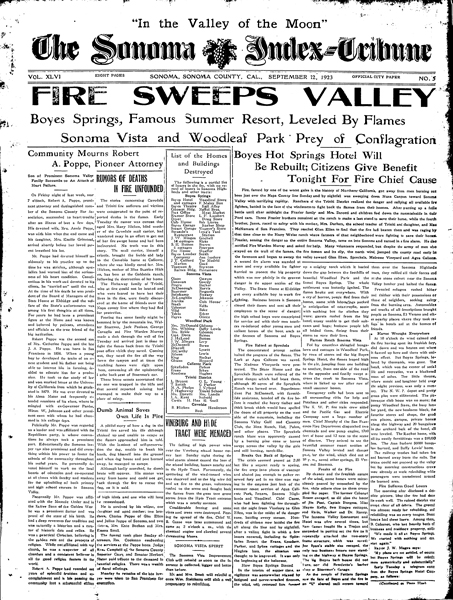
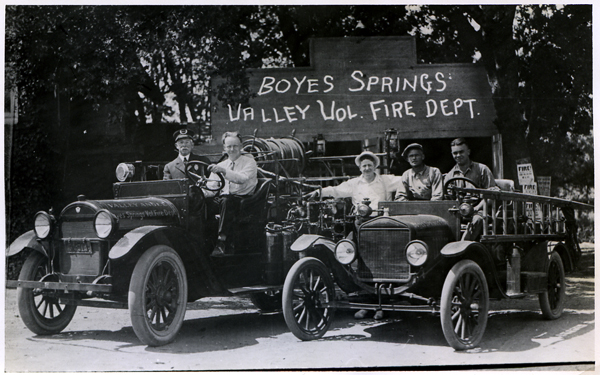
The “Boyes Springs Valley Vol. Fire Dept.” was about all they had in the way of first responders in 1923.
In 1964 and 1996, air tankers were vital to suppressing the fires. None existed in 1923, of course, but the Northwest Pacific Railroad sent a fire fighting crew, and mutual aid came from as far away as San Francisco.
It’s often stated of the 1923 fire that Boyes Springs and Fetters were completely destroyed. This is not the case. Many buildings survived. Since rebuilding was so urgently done, starting in October of 1923, it is often difficult to determine if a house or business survived the fire, but there is documentary evidence for some, such as the Sam’s Grill building. Please see https://springsmuseum.org/history/photographs/boyes-hot-springs/
In 1936 the community built, partially with Federal funds, a new fire station.
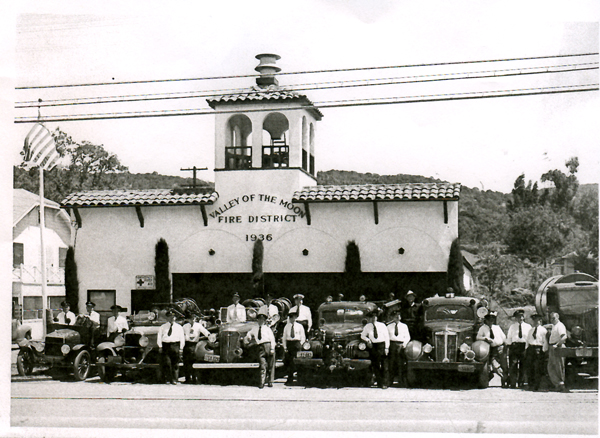
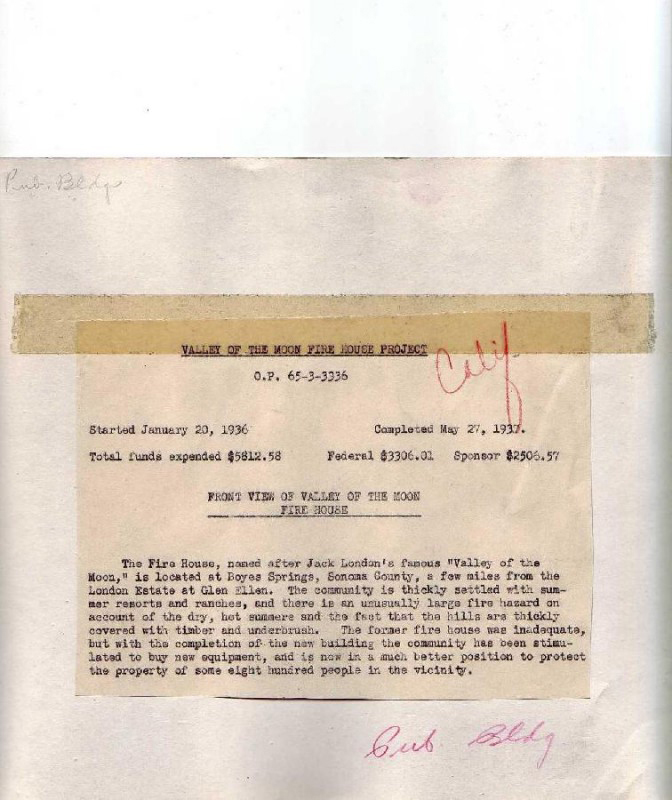
The text on the back of a WPA photo of the fire house inaccurately says it was named after the Valley of The Moon (it is so named because it is in the Valley of the Moon). However, it accurately states that the area has an “unusually large fire hazard…” See “The Living New Deal” https://livingnewdeal.org/projects/boyes-springs-sonoma-county-fire-station-sonoma-ca/ . It is a great project.
The building still stands in 2017, though greatly altered.

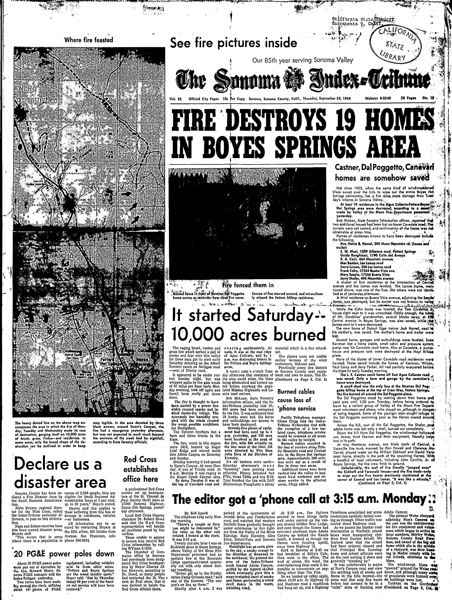
The 1964 fire was the worst since 1923. Hundreds of firefighters with dozens of engines and a lot of air support kept the damage lower than it would have been earlier in the century.

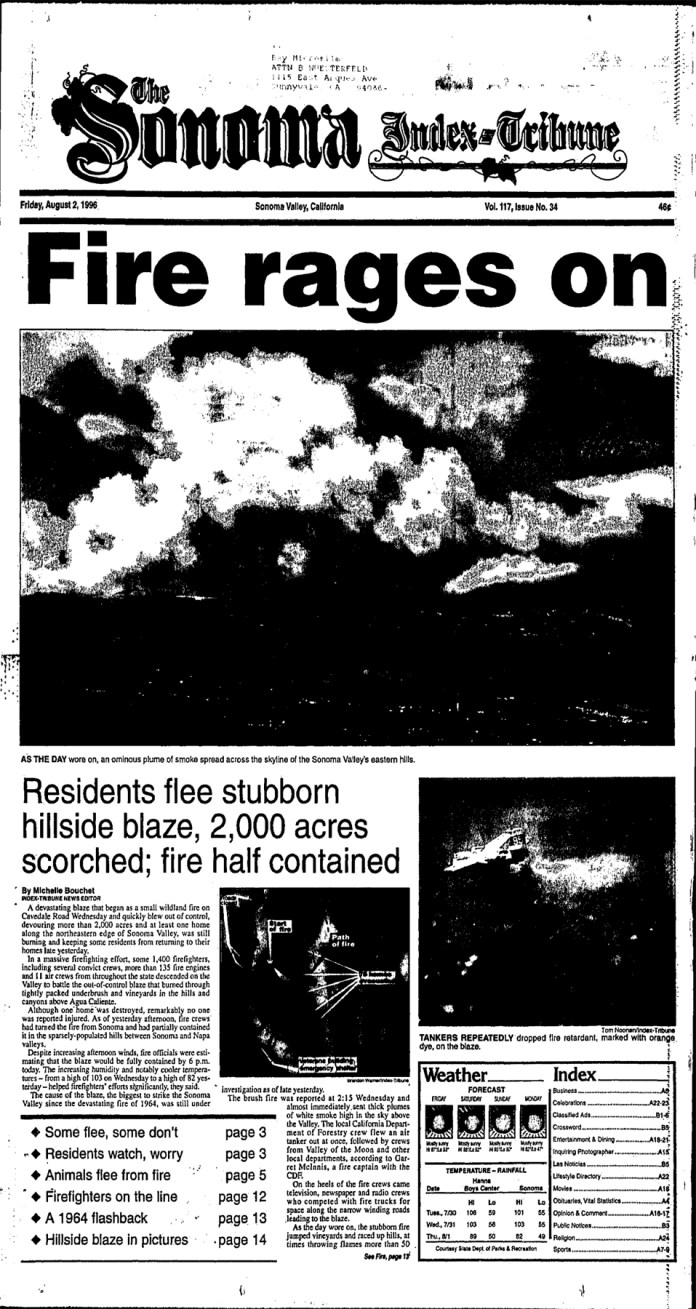
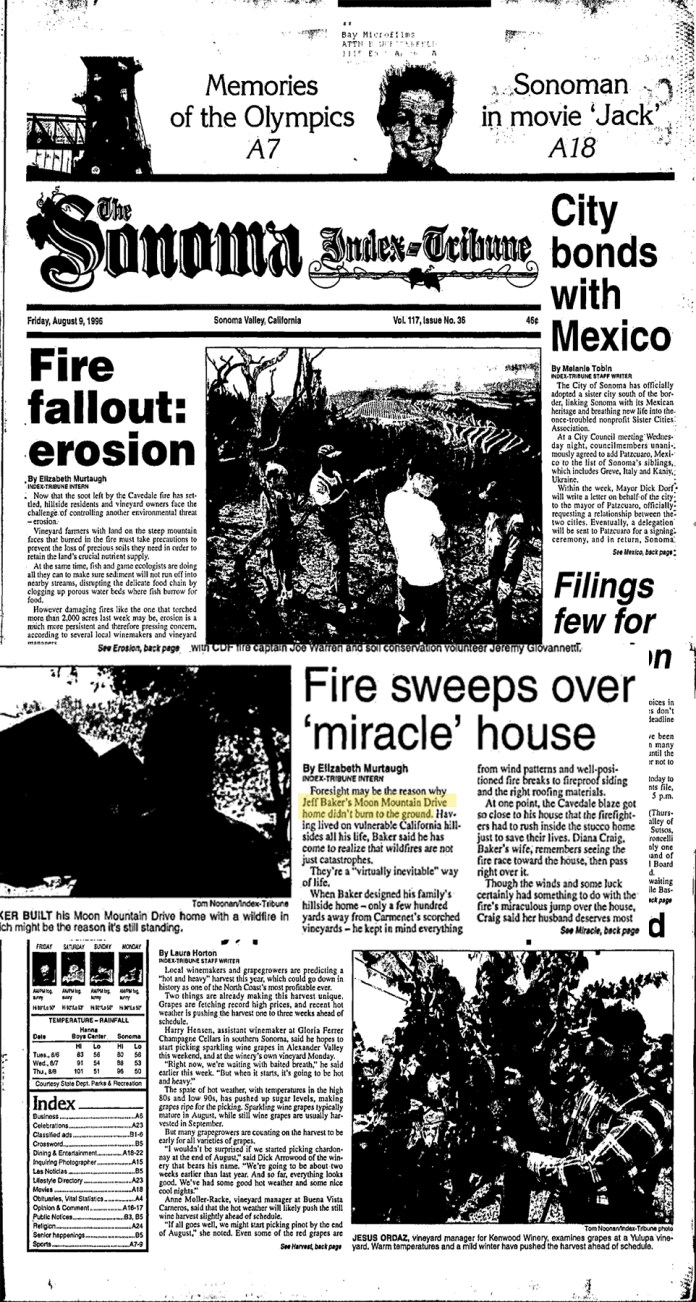
The 1996 fire was kept far smaller than ’23 or ’64 by the large number of firefighters and equipment quickly brought to bear.
In the Index Tribune of August 13, 1996, Harry Martin, a CDF officer, listed the following fire prone areas: Cavedale Rd., Nuns Canyon, Grove St., Seventh St. E., and Lovall Valley Rd. All but Grove St. are within the 2017 fire boundaries.
On Sunday, August 4, 1996, as the Cavedale Fire was being mopped up, a dangerous brushfire broke out in Boyes Hot Springs, adjacent to Central Avenue. Crews already fighting the big fire were able to subdue the Boyes blaze.
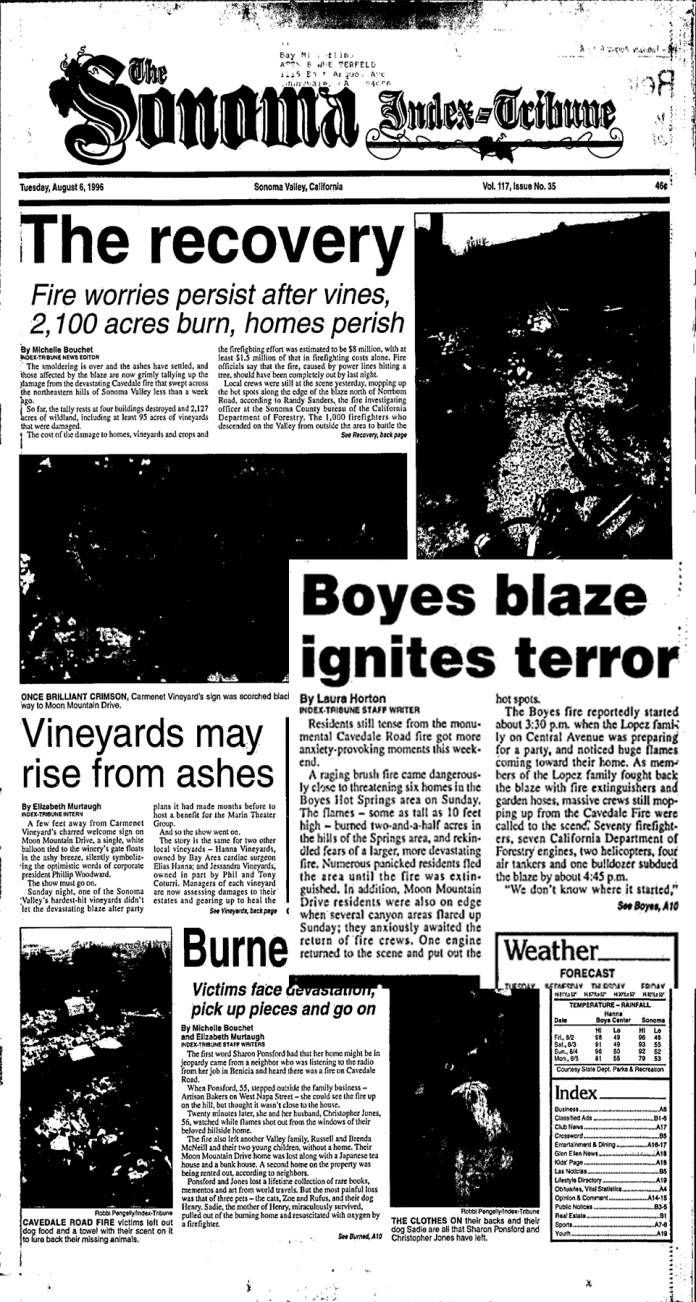
Jeff Baker’s Moon Mountain Road house survived the 1996 fire and the 2017 fire, as it was designed to do.
Fires in Sonoma Valley |
||||||
Date started |
Acreage |
Duration |
Origin/path/cause |
Buildings destroyed |
Number of firefighters |
|
| 1923 | 9/16 | 10,000 | 2 days | Napa County, Nuns Canyon/bee keepers | at least 119 | unknown |
| 1964 | 9/19 | 10,000 | 4 days | Nellligan Road/possibly power lines | 27 | 600 |
| 1996 | 8/2 | 2100 | 3 days | Cavedale Road/PGE accepted responsibility | 4 | 1500 |
| 2017 Nuns Fire only | 10/8 | 30,000 Sonoma Valley | 98% contained on 10/29 | Glen Ellen/under investigation | over 600 | At least 6,000 for all Sonoma County fires |
The Sonoma Valley Historical Society invites residents of the Sonoma Valley, the Springs, Glen Ellen and north to Kenwood to submit stories and photographs about how they and their families were affected by the October fires. These will be archived at the Historical Society in a special collection called “The Sonoma Fire Project” and will be used for research, local journalism, and possibly future publications.
If you’d like to submit your story and photos, send them to sonomafireproject@gmail.com. You can write in the body of the email, or attach a Word document. Photos can be attached in any format. It will also be helpful to have the following information:
Where you live (you don’t have to give an exact address, the general location is fine)
How long you have lived in the Sonoma Valley
Why you came here
What kind of work you do
Mailing address and phone number
The museum will send you a form to sign indicating that you give permission for your story and your photos to be used by researchers and journalists. Your name will always be associated with what you write and what you photographed.
We are doing this project to document the individual, personal side of this great regional tragedy, and are grateful to everyone who wants to participate.
If you have any questions, just send them along to project manager Lynn Downey at sonomafireproject@gmail.com.
707-694-0440

#32 G

#20.5

#14 D Revision

#14 E

#14 F

#14 G
From earliest European settlement (and possibly before), the Valley of the Moon was a place of rest and healing, but by the late 1890’s excitement was added to the activities: show business. First and always there was music. Theater and the spectacle of the circus were also popular. Movies arrived by 1917.
The following is a sampler of the variety of music available at the resorts.

Art Hickman had been coming to Sonoma Valley since 1910. He was a newspaper man who became the leader of a popular band in San Francisco. He is sometimes credited with inventing the word “jazz,” in Boyes Hot Springs. This dubious claim is fully discussed in Bruce Vermazen’s interesting article: http://www.gracyk.com/hickman.shtml
Hickman’s arrival in Boyes Springs was front-page news in 1923. (No elucidation as to the nature of his accidental burns is given.)
In that year, Prohibition was in force, which did not prevent the resorts from offering refreshing beverages to their guests, to enhance their musical appreciation. As we see from the headline, the El Verano resorts were “Again Raided.”

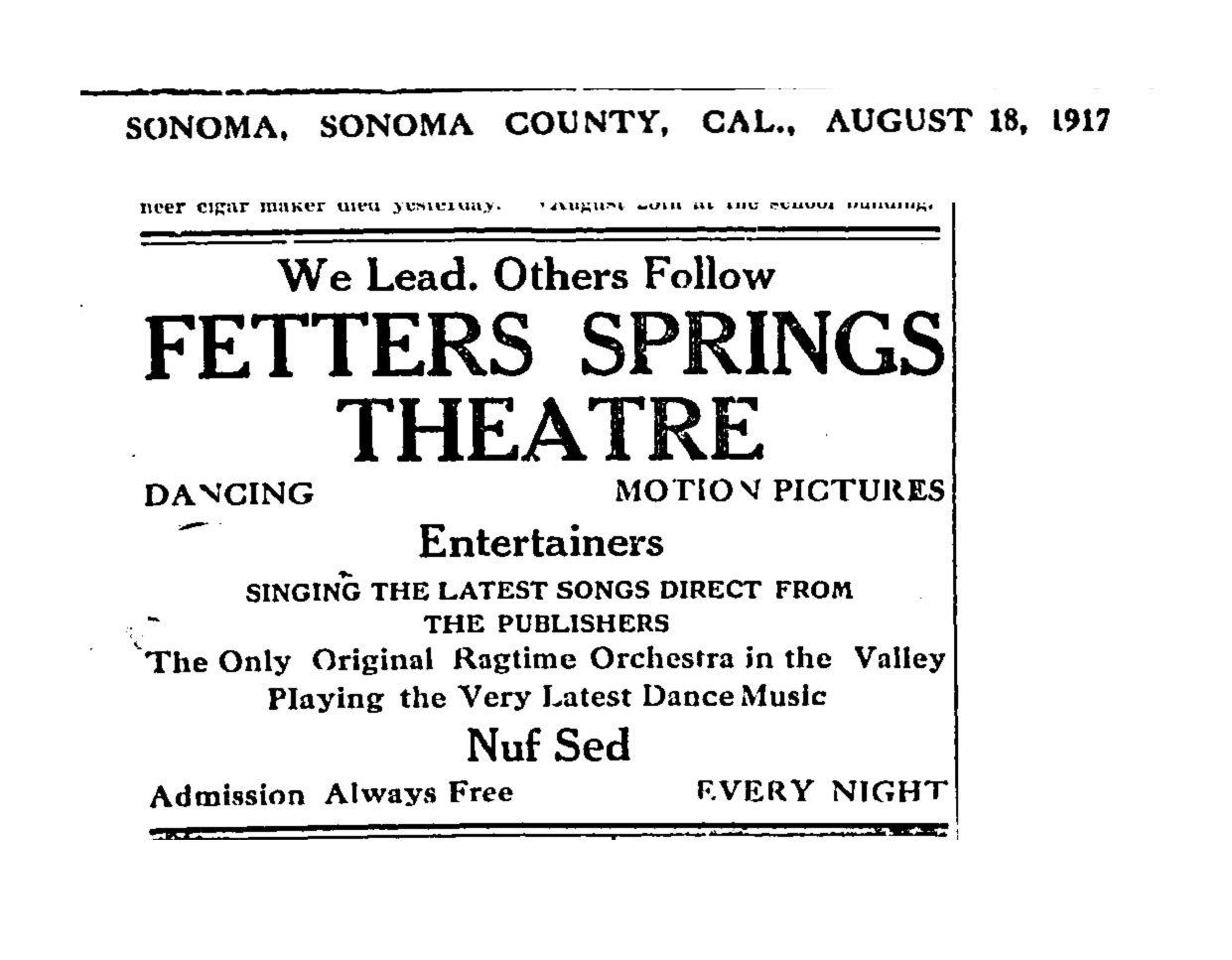
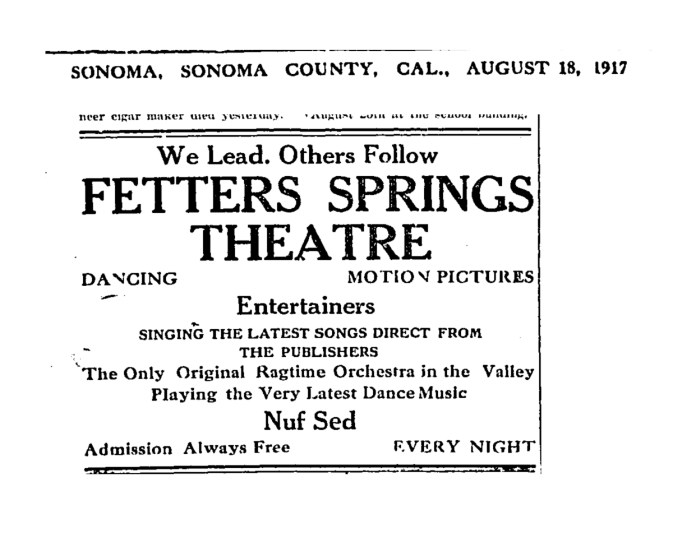
Was Nuf Sed the name of the “Original Ragtime Orchestra…” or just an emphatic statement?

It looks like a circus troop in this photo, marching with a band. The stamp on the reverse dates the card to 1909.
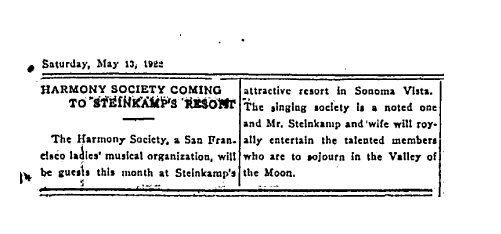
Some of the musical offerings were more high-toned. A Ladies Singing Society would be very refined.

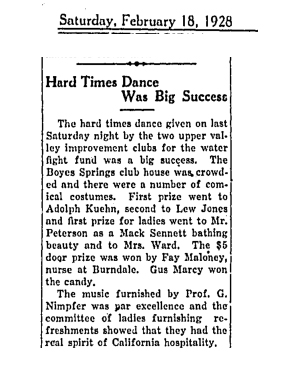
Between 1920 and 1950 there were over a dozen ads in the IT for “Hard Times” dances. Attendees were expected to come dressed in stereotypical farmers’ clothing, and decorations leaned towards hay bales, wagon wheels, and animal harnesses. The music for this 1928 affair, held at the Boyes Springs Club House, was provided by Prof. G. Nimpfer, who was originally a tailor and had run a resort in Agua Caliente under his name. What discipline his PhD was granted in is not known.

Paul Marcucci’s “Hill billy Band” from 1933. Marcucci was a talented musician and song writer who presided over Paul’s Resort for three decades in the mid-20th century.

Unfortunately described as a “negro orchestra,” the Funmakers featured Johnny Alston and Jeanne DeMetz. Alston and DeMetz recorded extensively. To get an idea of what they might have sounded like at the Fetters Resort, listen to this recording of “Sam the Boogie Man,” 1946, from the Prelinger Archive: https://ia600604.us.archive.org/13/items/78_sam-the-boogie-woogie-man_johnny-alston-and-his-orchestra-robert-scherman_gbia0007741b/Sam%20The%20Boogie%20Woogie%20Man%20-%20Johnny%20Alston%20and%20his%20Orchestra.mp3


Hugh Wedge and his Melody Men were active in the Valley in 1950 and 1951. Obvioulsy versatile, they played for dancing of all eras (modern and old-fashioned).

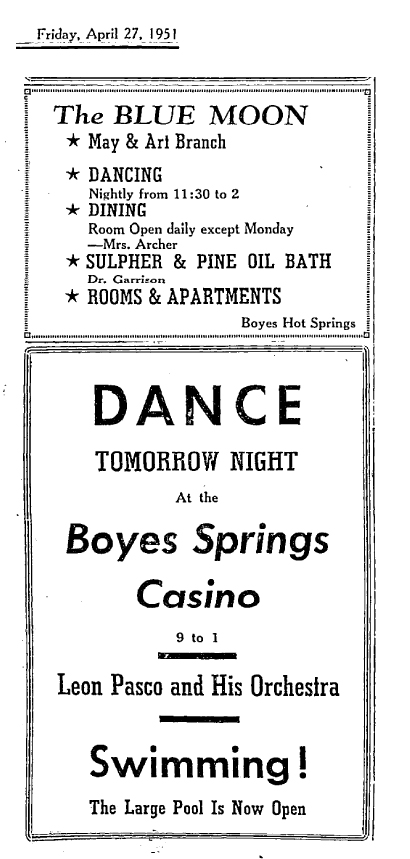
Leon Pasco’s orchestra, “from Napa,” gigged a lot in the resorts from 1948 through 1953. Hugh Wedge was also billed as from Napa. Did they really hail from there, or was that puffery to make them sound more exotic? The Funmakers were billed as “direct from many smash engagements at New York’s most elaborate NIGHT SPOTS,” which probably had some truth to it. But “from Napa?” Not very enticing.

Anson Weeks was famous as the leader of the orchestra at the Mark Hopkins Hotel in the 1920s and 1930s. For more on Weeks, see https://soundcloud.com/peter-mintun/sets/anson-weeks-his-orchestrahttp://www.sfmuseum.org/hist1/weeks.html
In 1969 Pete Mancuso took over the old Resort Club in the heart of Boyes Hot Springs and renamed it Little Peter’s Melody Club. The establishment was in operation until the mid 1980s.

The Melody Club sign was in place until 2014, when it was removed for safety.
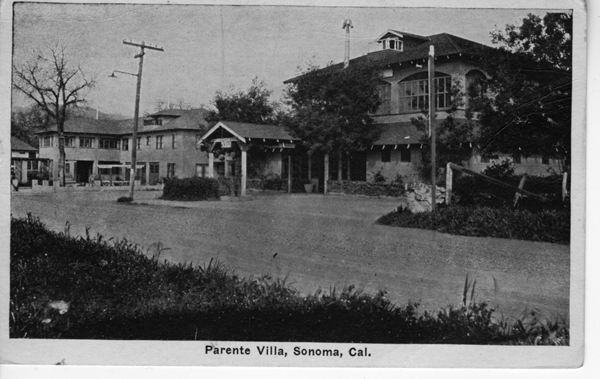
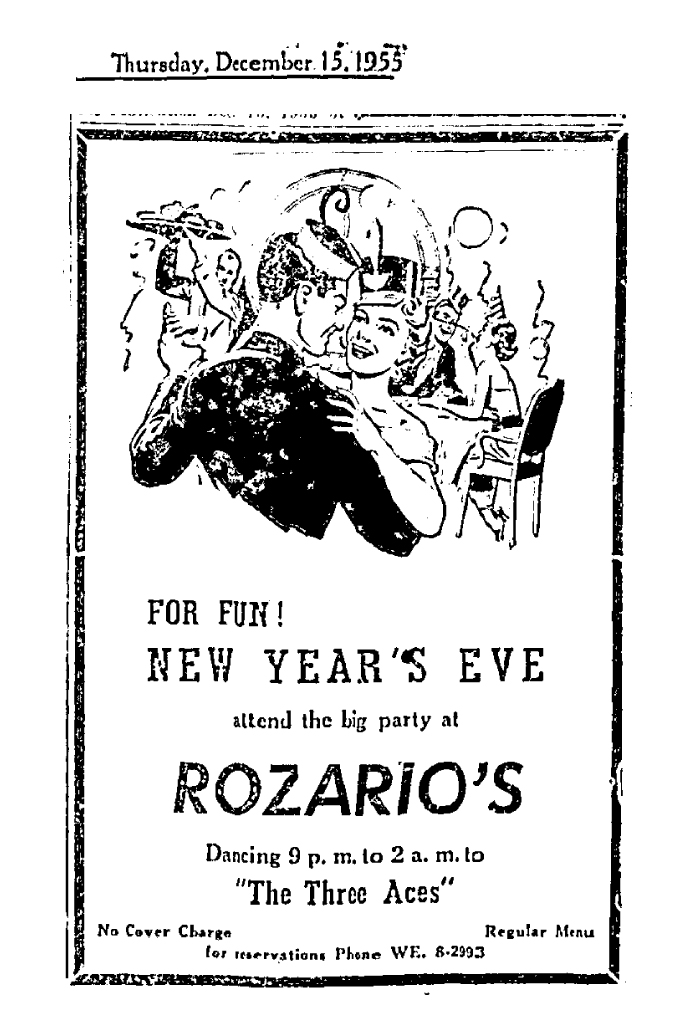
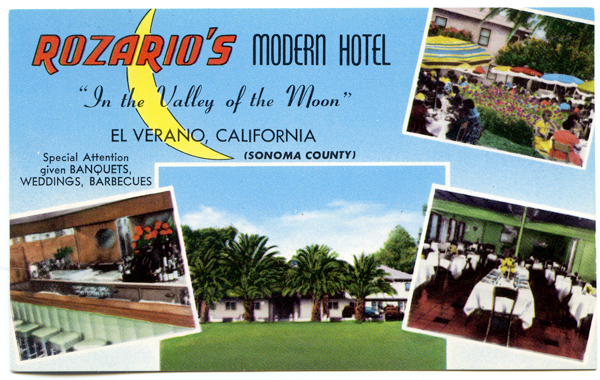
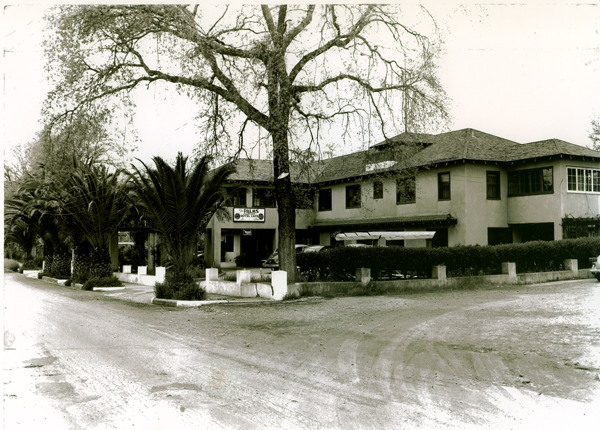
Rozarios’ resort, the successor to Parente’s Villa, was located on Verano Avenue between the Highway and the bridge.
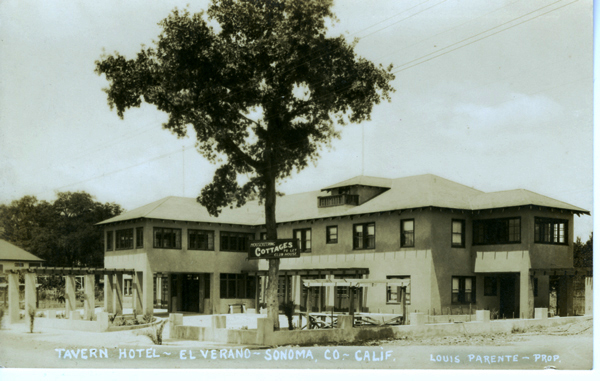
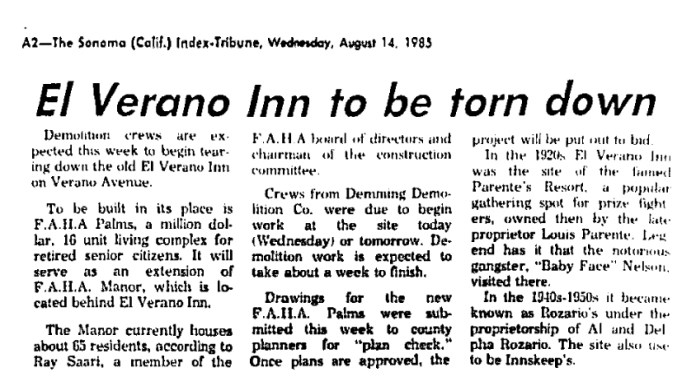
Louis Parente, a notorious bar owner, fight promoter and would-be politician, came to El Verano in 1906 from San Francisco. (Please see Jeff Elliot’s great santarosahistory.com for much more on Parente: http://santarosahistory.com/wordpress/2016/07/the-village-of-vice-in-the-valley-of-the-moon/
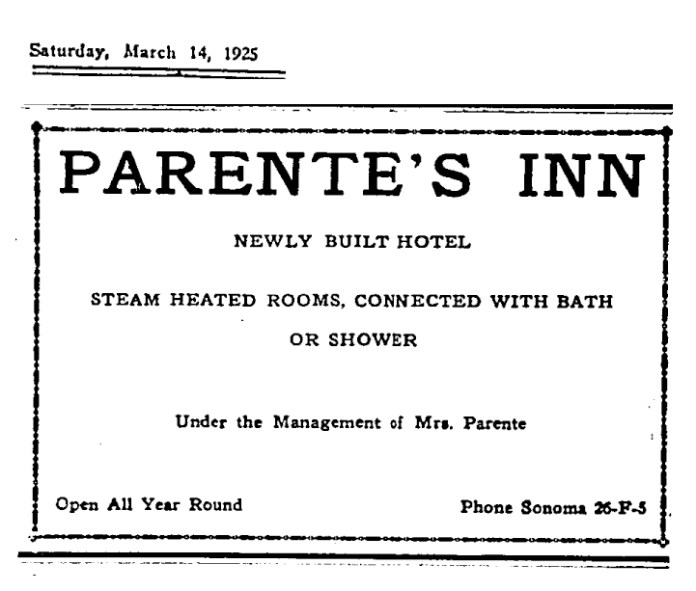
By 1925 he had built a “new” hotel.


According to the Index Tribune, “The 43 room hotel, hut, cottages and grounds were purchased by the Rozarios in 1943, and it was on January 1, 1944 that they opened it for business. The former San Francisco and Marin county residents had purchased the property from Joe Parente [actually Louis Parente], colorful Bay Area sports figure who brought many prize fighters here to train.”
Rozario’s was popular through the 1950s for wedding receptions, fashion shows, and formal dinners.


The Rozarios sold the resort to Carl Innskeep and Joe La Rango in 1955.
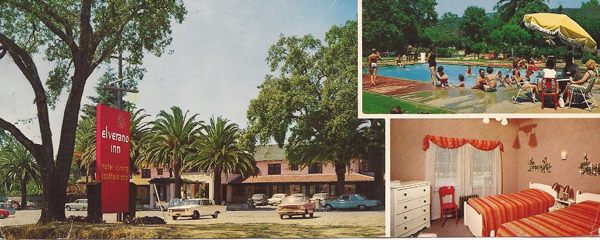
It later became known as the El Verano Inn.
The buildings were torn down in 1985 to make way for an extension of the Finnish American Home Association’s housing complex for retired people, which was located behind the old resort building. In that year, the editor of the FAHA Manor News explained in a letter to the editor of the Index Tribune that FAHA wanted to preserve the building, but “could not afford the very expensive improvements necessary…” Thus we lost another piece of our history.
The site at the corner of Vallejo and Highway 12, now in use as the employee parking lot for the Sonoma Mission Inn, has a long history.
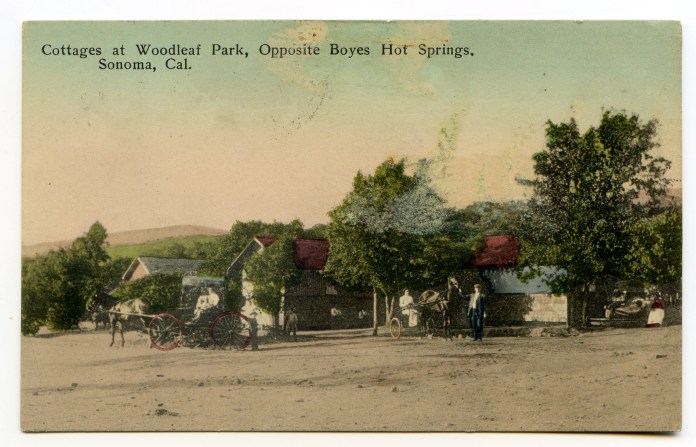
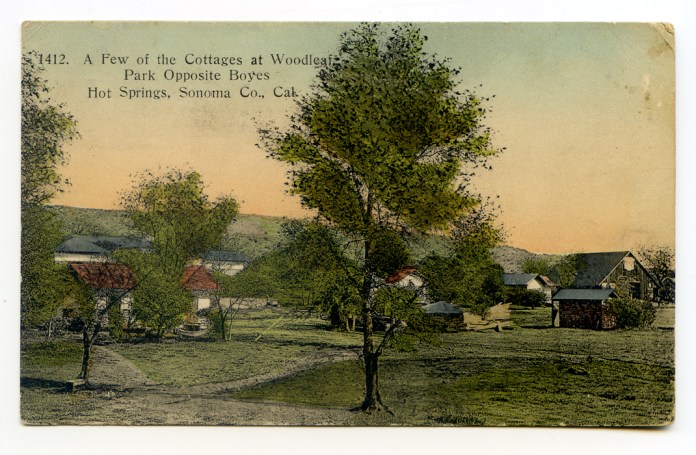
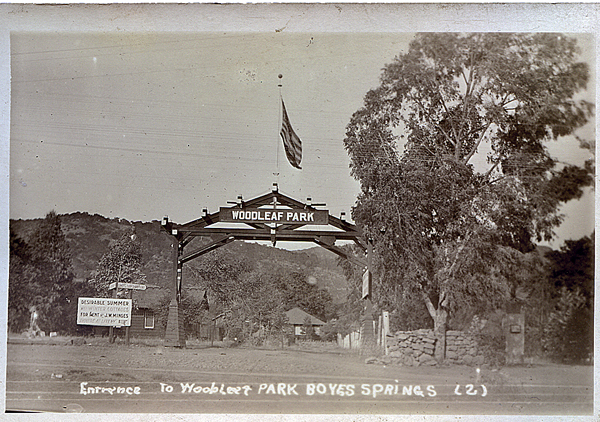
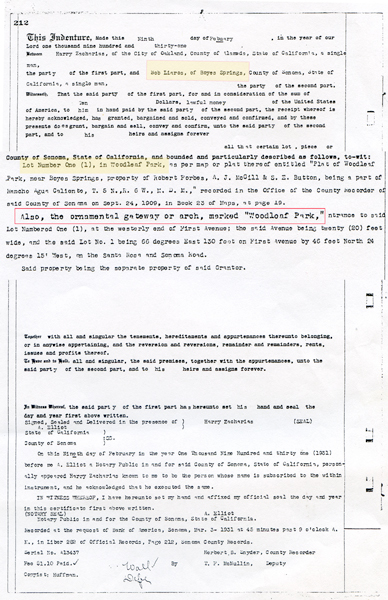
This postcard, post marked 1913, shows the entry arch, to Woodleaf Park (in the middle of the lot), which was one of the early subdivisions in Boyes Hot Springs. The sign at left reads “Desirable Summer and Winter Cottages for rent. J. W. Minges.” Minges was a prominent land owner and businessman in early twentieth century Boyes Hot Springs and was often referred to as the “mayor” of Boyes Springs.


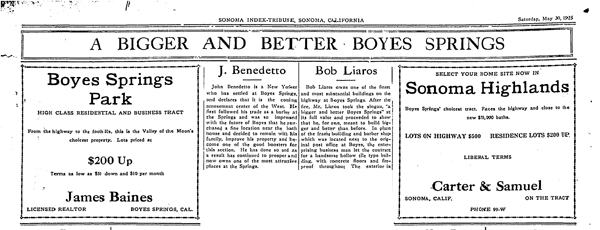
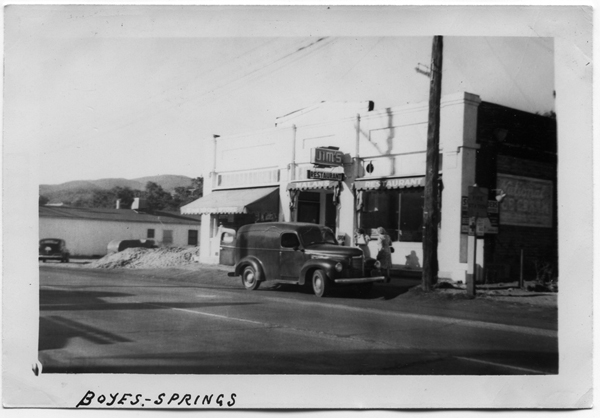
This is part of a full page ad (above) from 1925 promoting Boyes Hot Springs. It reads, in part, “In place of the frame building and barber shop that was located next to the original post Office at Boyes, the enterprising business man (Bob Liaros) let the contract for a handsome hollow-tile building with concrete floors and fireproof throughout.”
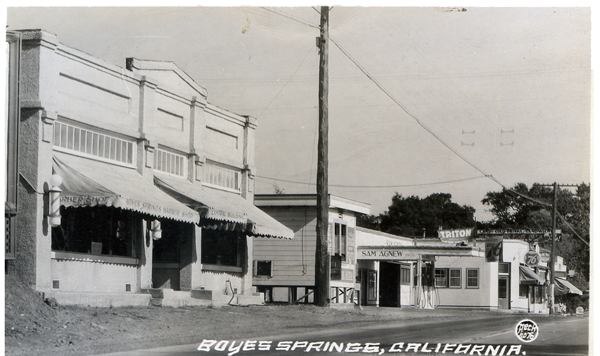
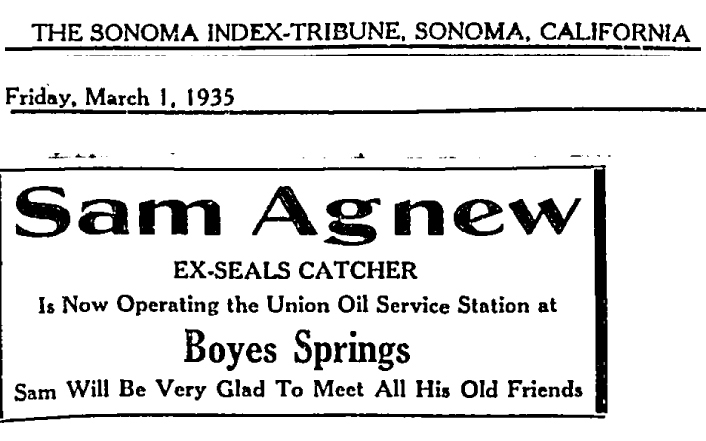
The view from the 1930s (below) shows the building mentioned above. Lairos was another Boyes booster and long-time business owner. Beyond the Liaros building are the ice plant and Sam Agnew’s service station at Vallejo St.

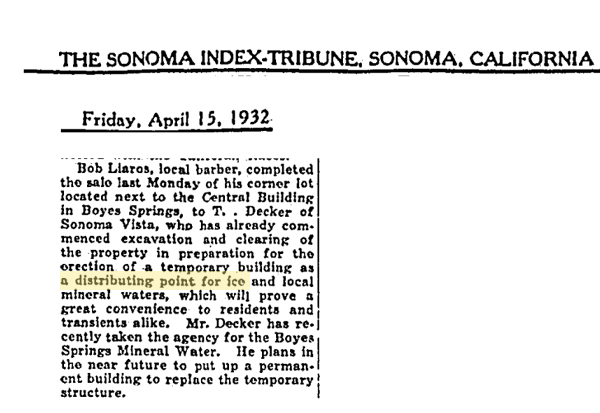
Liaros sold part of his land to the proprietor of the ice plant.


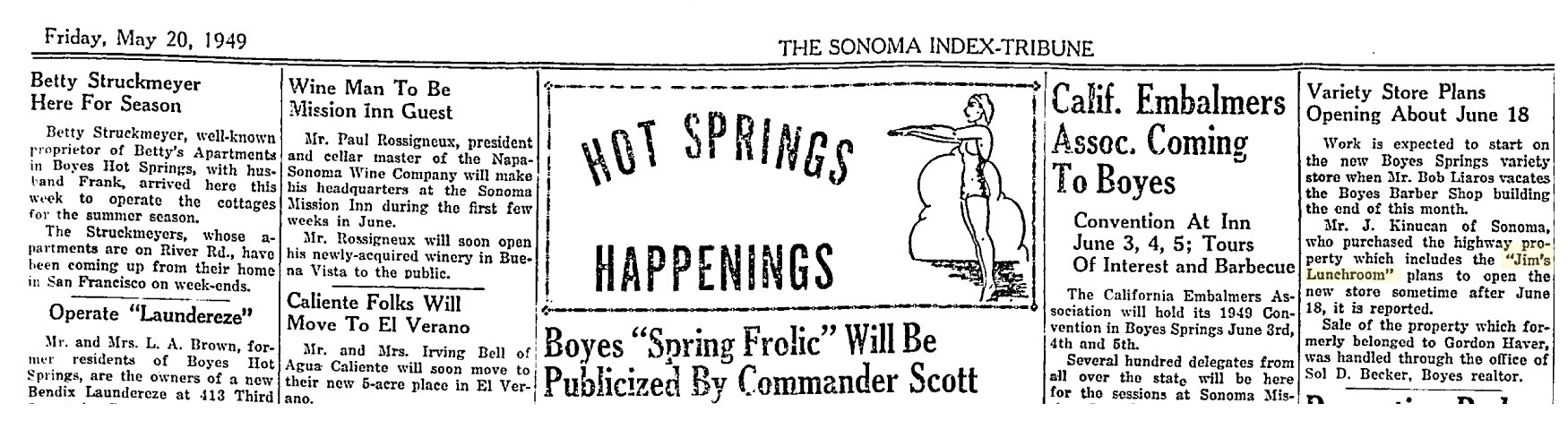
The building changed hands in 1949.
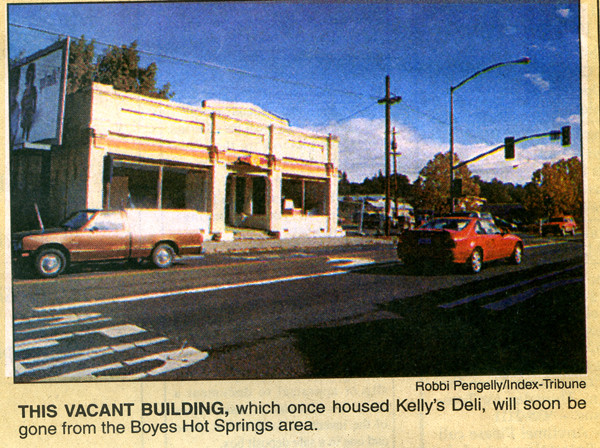
This article mentions that Jim’s Lunchroom is located in the building. If only we could get the Embalmers to come back! Perhaps they could “frolic?”

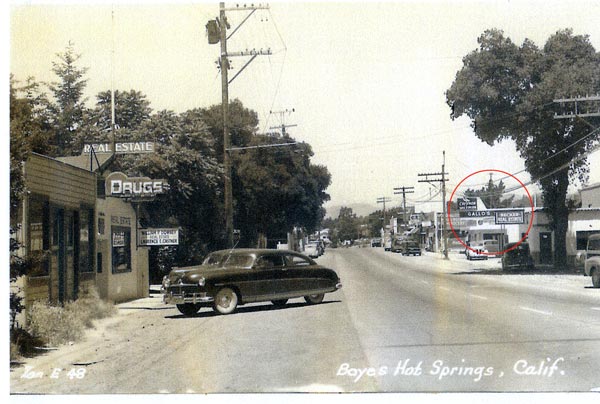
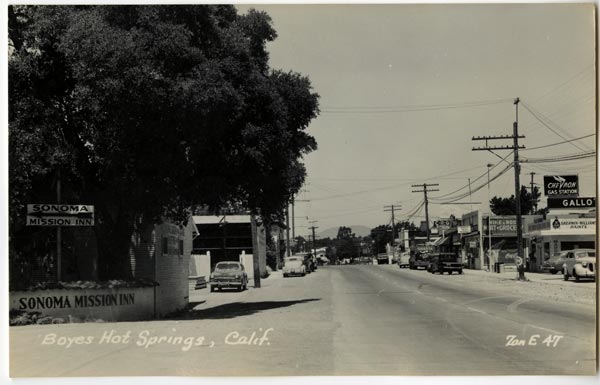
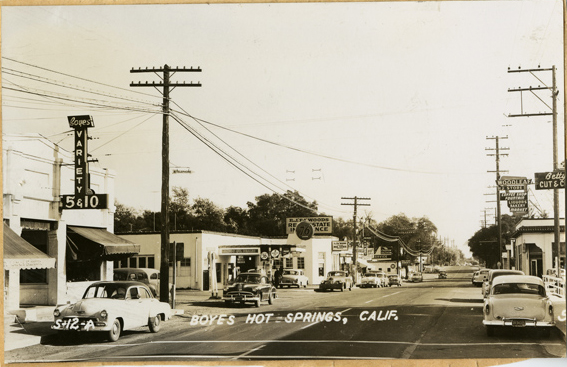
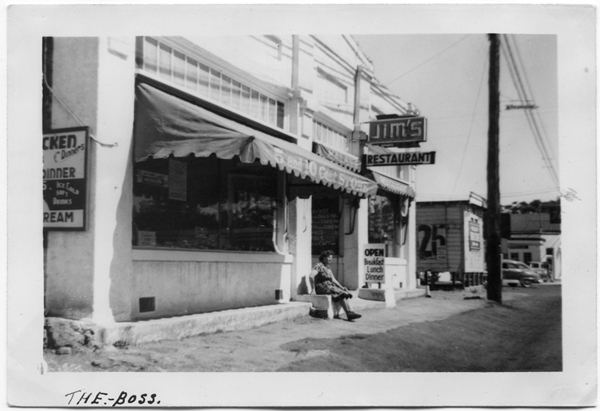
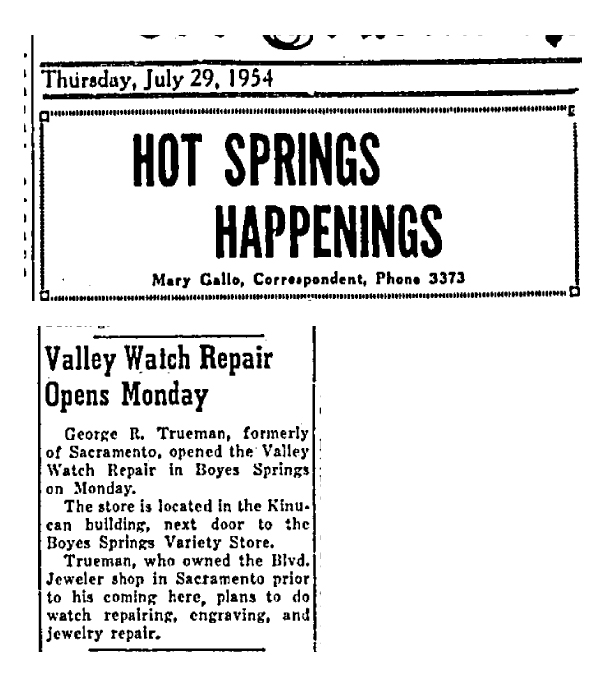
The above mentioned variety store, operated at one time by the Polidori family.
1930s ?
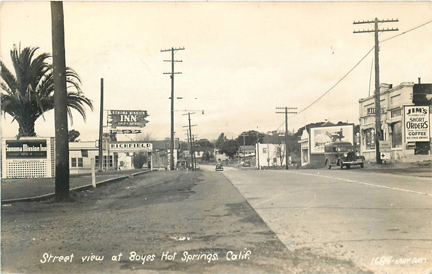
1950s
1992
The building was demolished as an eyesore in 1992. Progress!?

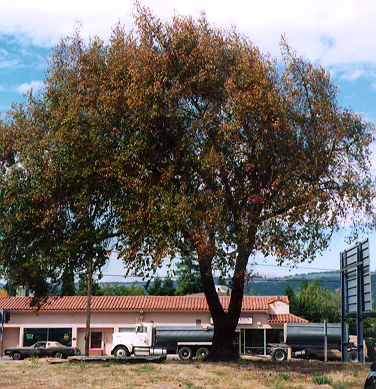
In 1997, a lone California Bay tree stood on the lot, but it was dying.

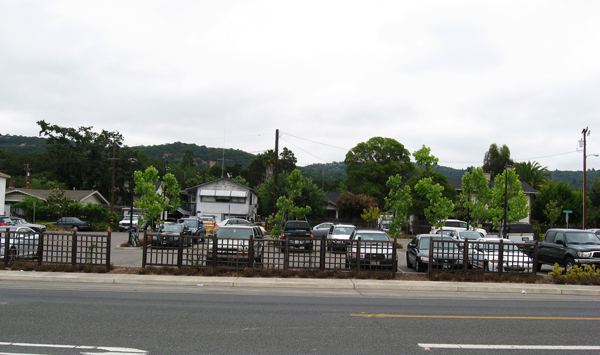
The merely functional parking lot in 2008.
Thanks to the Sonoma Valley Historical Society, Stanford University Library Special Collections, and Mr. Lloyd Cripps.
Addendum:

Document describing the land in Woodleaf Park that Bob Liaros bought in 1931, including the ornamental arch.
Thanks to the Sonoma Valley Historical Society for photos and the Index Tribune. If you enjoy the Springs Museum, please consider donating; use the button on theHome page! Thank you!


Thomson Avenue, not Thompson Avenue, was named for Dr. Allen Thomson, who had been physician to General Vallejo, and who married one of his granddaughters. Thomson was president of the company that developed the subdivision known as Boyes Springs Park . Thomson Street is its southern border.
The building at the southeast corner was a Red Crown gas station circa 1930. It later became the Ferrando’s Plumbing building and now houses La Michoacana Ice Cream and Plain Janes. It was famously made over by Rico Martin in 2015.

The caption says “Questerman/Churchill Garage.” Note the misspelling of the street name and the designation “east.”
Directly across Highway 12 from the end of Thomson (not East Thomson!) was Baker’s Drive In, established in 1957 (and open 24 hours per day!)
In 1958 Norman Baker had big plans to build a truck stop on this property, but the county would not approve the project.

Looking South, Farrell’s sign at left, Baker’s Drive In at right.

Looking at Bakers’ Drive In on Hwy 12, from Thomson. Red Crown building seen at left.

Looking North
These photos from 1958, courtesy of the Sonoma County Library, were used in a court case, the nature of which is unknown, but could have been a suit over a traffic accident. In the photo of the highway looking south, a sign can be seen (below the Richfield sign) which proclaims Farrell’s Resort, which would have been on the property now partially occupied by Arroyo Vet Hospital.
In 1972, John Metallinos and family opened the Fruit Basket on Arnold Drive.

They opened their Boyes Springs branch sometime later, probably in the early 1980s, at the old Baker’s Drive In. On June 15, 1983, a fire destroyed that building.
Nearly a year later, the Boyes Springs Fruit Basket reopened, “in a flourish of live Greek music and dancing,” in its new building, which was designed by architect William Dimick.


The Fruit Basket in 2017. It really is a graceful building.
My thanks to Mark Maberly for information about Dr. Thomson, and his general enthusiasm for our history. As always, contributions of knowledge are welcomed. Please leave a comment.